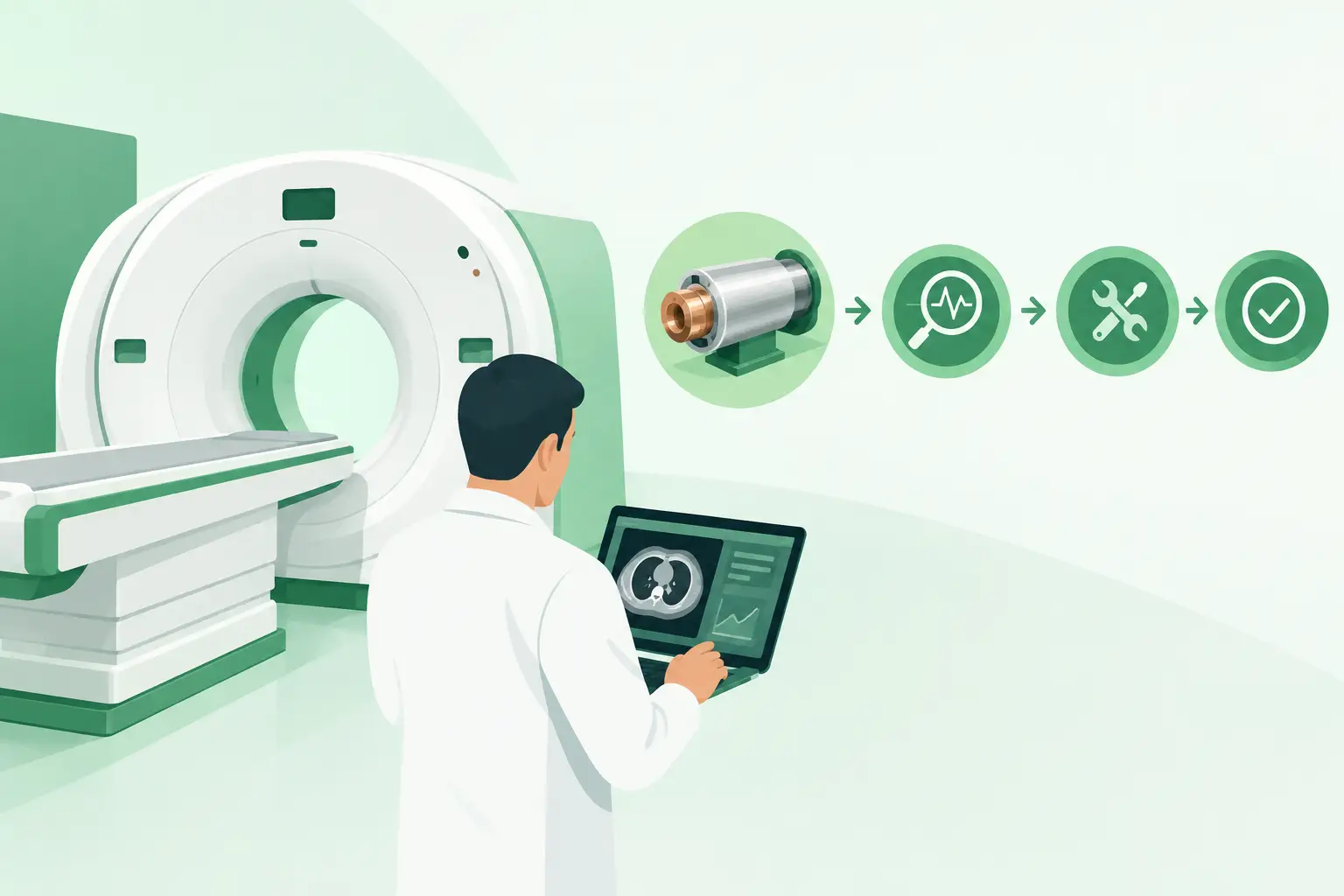
A CT room sitting idle over one failed board is not a parts problem. It is a revenue problem, a scheduling problem, and often a patient care problem. That is why discontinued medical equipment parts demand a different sourcing approach than routine replenishment. Once an OEM stops supporting a component, the normal purchasing path gets slower, narrower, and far less predictable.
For imaging departments, independent service organizations, and biomedical teams, the issue is rarely just availability. It is about finding the exact part number, confirming compatibility, judging condition, and getting a quote fast enough to avoid prolonged downtime. Legacy systems can remain clinically and financially useful for years after factory support changes. The challenge is keeping them operational when replacement parts no longer move through standard channels.
Why discontinued medical equipment parts create procurement risk
When a component is discontinued, the market changes immediately. Supply tightens, documentation may be harder to confirm, and pricing becomes less linear. What used to be a straightforward reorder turns into a specialized search across secondary inventory, refurbishment channels, and independent supplier networks.
In medical imaging, that risk is amplified by system complexity. A failed power supply, detector component, coil assembly, monitor, transducer, or control board may affect far more than one subsystem. Some failures produce complete downtime. Others create intermittent issues that still disrupt throughput and service schedules. Either way, the buyer has to solve two problems at once - restoring function and controlling procurement risk.
The usual distributor model is not built for this. Standard catalogs work well for active SKUs with stable manufacturer support. They are less effective when buyers need obsolete, end-of-life, or hard-to-find parts tied to specific modality generations and configuration histories.
What makes sourcing discontinued medical equipment parts difficult
The first challenge is identification. Older systems often have multiple revisions, OEM substitutions, and field-level service changes over time. A description like "MRI power board" is not actionable. Buyers need the exact part number, approved alternates if they exist, and confidence that the replacement matches the installed configuration.
The second challenge is market fragmentation. Discontinued inventory is scattered across service depots, excess stock, dismantled systems, third-party warehouses, and refurbishing operations. Some suppliers may have stock but limited traceability. Others may quote quickly but lack the technical detail needed for approval.
The third challenge is urgency. Hospitals and service teams do not usually have the luxury of waiting several days while multiple vendors investigate. A sourcing partner has to move quickly, but speed without verification creates its own cost. Receiving the wrong part, a failed unit, or an undocumented substitute can extend downtime instead of reducing it.
Where buyers usually lose time
Most delays happen before the order is placed. Teams spend hours validating nomenclature, chasing alternate part numbers, and checking whether a listed component is actually in stock. Internal review adds another layer. Purchasing may need pricing and lead time. Biomed or field service may need photos, condition details, or compatibility confirmation. Finance may need justification if the quote is high because the part is scarce.
Another common issue is assuming that obsolete means unavailable. In practice, many parts remain obtainable through aftermarket channels long after OEM support ends. The real difference is that the sourcing process becomes more investigative. Success depends on access to inventory data, supplier relationships, and the ability to cross-reference part histories quickly.
A practical sourcing approach for legacy imaging systems
For buyers managing discontinued equipment, the best process is disciplined rather than complicated. Start with the exact part number from the failed component if possible, not just the equipment model. Include serial number, modality, and any known revision information. If the installed part has labels, software versions, or board markings, capture those details up front. That shortens the back-and-forth and reduces mismatch risk.
Next, separate acceptable options by use case. If the need is urgent, a tested refurbished part with documented condition may be the right answer. If the system is nearing retirement, cost control may outweigh preference for new inventory. If the asset supports a high-volume imaging schedule, warranty terms and functional testing may matter more than purchase price alone.
Then evaluate the supplier on operational factors, not just quote value. Can they verify stock? Do they understand modality-specific parts? Can they identify alternates or supersessions? Can they provide fast turnaround on hard-to-find items without treating every request as a custom research project? In this segment, responsiveness is part of product quality.
New, refurbished, and harvested parts - when each makes sense
There is no single right condition category for discontinued parts. It depends on the system, the urgency, and the buyer's risk tolerance.
New old stock can be ideal when it exists, but it is often limited and priced accordingly. Refurbished inventory is frequently the most practical option for legacy imaging systems because it balances availability with cost. The key is whether the refurbishment process includes appropriate inspection and functional validation, not simply cosmetic cleaning or repackaging.
Harvested parts from deinstalled systems may also have a place, especially for rare assemblies that are no longer manufactured. But this is where supplier quality matters most. Without clear evaluation standards, buyers may trade one downtime event for another. For critical imaging assets, the conversation should always include testing status, warranty support, and condition disclosure.
Why exact-match verification matters more than speed alone
When a room is down, every buyer wants immediate shipment. That urgency is justified. But with discontinued medical equipment parts, fast shipping only helps if the part is correct. Legacy imaging platforms often include model-year variations, OEM engineering changes, and regional configurations that are easy to overlook.
A supplier that asks for additional identifiers is not slowing the process down unnecessarily. In many cases, that verification step prevents a failed install, return cycle, or repeat outage. For procurement teams, this is where experienced sourcing support adds value. The goal is not just to find something close. It is to secure the exact-match part or a validated equivalent that can be installed with confidence.
How supplier networks change the outcome
For obsolete parts, inventory access is rarely limited to what one warehouse shelves directly. The stronger model is a broad, specialized sourcing network backed by usable part data. That matters because discontinued items move through many channels - service stock, independent resellers, refurbishment pipelines, and surplus equipment markets.
A supplier with reach across those channels can often locate options that a general distributor cannot see. That becomes especially useful for modalities with expensive assemblies and long service lives, such as CT, MRI, ultrasound, nuclear, mammography, C-arm, and X-ray systems. In those environments, one hard-to-source component can keep an otherwise functional system offline.
This is where a specialist such as Meditegic fits the market. Buyers in the imaging aftermarket need more than a website search result. They need a procurement partner that can work from exact part numbers, navigate legacy equipment environments, and return reliable options quickly.
What buyers should ask before placing the order
A good quote for a discontinued part should answer the questions that matter operationally. Is the item in stock now or subject to supplier confirmation? Is it new, refurbished, or harvested? Has it been tested, and if so, how? Is there a warranty? Are there known alternates? Is there any reason the installed system configuration could affect fit or function?
These are not paperwork questions. They determine whether the sourcing decision shortens or extends downtime. A low quote with weak verification can become the most expensive option once labor, repeat shipping, and lost equipment availability are considered.
The bigger decision behind every obsolete part request
Every request for a discontinued part raises a broader asset question: maintain, cannibalize, or replace. There is no universal threshold. A legacy ultrasound system with modest repair costs may justify continued support. An aging CT with repeated failures and limited parts access may push the economics in another direction.
Still, many systems remain worth maintaining if the right aftermarket parts strategy is in place. Buyers that document part histories, build relationships with specialized suppliers, and act early on known failure points are usually in a better position than teams sourcing only after a full shutdown. The most effective procurement approach is not reactive. It anticipates obsolescence before it becomes an emergency.
Discontinued parts are part of the reality of long-life imaging equipment. The organizations that handle them best are not the ones that never face obsolescence. They are the ones that know how to source with precision, move quickly without guessing, and keep an aging system productive long after standard supply channels move on.