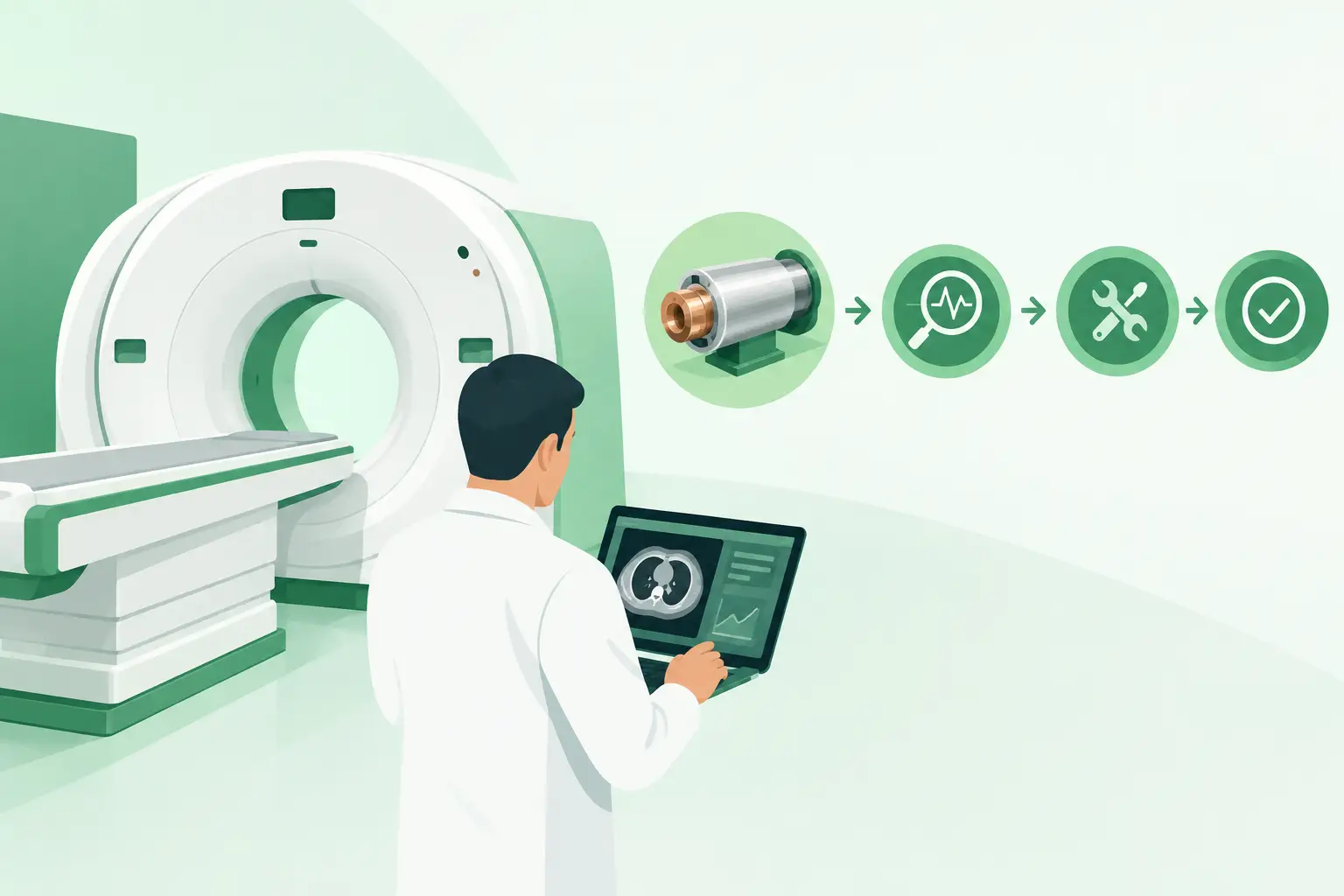
A CT room sitting idle for two days does not create an abstract budget problem. It delays scans, disrupts schedules, and forces purchasing, biomed, and service teams to make a parts decision under pressure. That is why the question of new vs refurbished imaging parts matters less as a general procurement debate and more as an uptime decision tied to a specific system, failure point, and service timeline.
For experienced imaging buyers, the right answer is rarely ideological. New is not automatically better in every case, and refurbished is not automatically the budget option you choose only when funds are tight. The better approach is to evaluate the part by function, risk profile, availability, and time to install. In many service environments, the most effective sourcing strategy uses both.
How to evaluate new vs refurbished imaging parts
The first variable is criticality. A replacement part that directly affects image quality, patient safety, or system stability deserves a different level of scrutiny than a cosmetic assembly or a non-core accessory. That does not mean refurbished parts are unsuitable for critical applications. It means your acceptance criteria need to be clear. You need confirmation of compatibility, testing, condition, and warranty terms before the part reaches your dock.
The second variable is lead time. If an MRI or C-arm is down and the clinical schedule is backing up, the best part on paper is not always the best part operationally. A new OEM part with a long backorder can be less valuable than a properly refurbished component that ships the same day and restores service quickly. For hospitals and independent service organizations, downtime cost often outweighs the price difference between sourcing options.
Budget is the third variable, but it should not be isolated from lifecycle value. If a refurbished detector board, power supply, or coil component provides verified performance and meaningful savings, it may improve maintenance economics without creating additional risk. On the other hand, if a new part extends service life, reduces repeat failures, or simplifies warranty support, the higher upfront cost may be justified.
When new imaging parts make the most sense
New parts are often the preferred option when traceability, full manufacturer specifications, or longer expected service life are central to the purchase decision. This is common in environments with strict internal procurement standards, standardized maintenance protocols, or low tolerance for any ambiguity around prior use.
A new part can also be the strongest choice when the failure involves a high-stress component with no dependable refurbished channel, or when the system is relatively current and OEM supply is still stable. In those cases, buying new may reduce administrative review, simplify validation, and support a more straightforward repair path.
There is also a practical resale and asset-management consideration. For providers managing premium imaging fleets, the use of new replacement parts may align better with long-term equipment valuation and service documentation. If the organization plans to redeploy, resell, or maintain full service records for capital planning, that may influence the sourcing decision.
Still, new parts have limitations. They may carry longer lead times, especially for specialized imaging assemblies. They may be priced at a level that is hard to justify on older systems. And in some cases, the part is technically available as new but not available fast enough to solve the actual problem.
When refurbished imaging parts are the smarter buy
Refurbished parts are often the more practical option when speed, cost control, and access to discontinued inventory are driving the decision. This is especially true in the imaging aftermarket, where older CT, MRI, ultrasound, nuclear, and X-ray systems remain clinically useful long after OEM parts support becomes inconsistent.
A quality refurbished part can keep a legacy asset productive without forcing a premature capital replacement decision. For many healthcare organizations, that is not a secondary benefit. It is the reason the aftermarket exists. When a part is no longer stocked through standard distribution, refurbished inventory may be the only realistic path to restoring system function.
Refurbished also makes sense when the part category has a well-established testing and repair process. Many imaging components can be evaluated, restored, and verified effectively by specialized providers with the right technical capability. In those cases, the performance gap between new and refurbished may be minimal, while the difference in cost and availability is significant.
That said, not all refurbished inventory is equal. The term covers a wide range of conditions and processes. One supplier may simply clean and resell a pulled component. Another may inspect, repair, calibrate, and function-test the part against application-specific standards. Buyers should not treat all refurbished parts as interchangeable.
What buyers should verify before purchasing
In a new vs refurbished imaging parts decision, the real issue is not label alone. It is documentation and confidence.
Start with exact part-number matching. Imaging systems are full of revisions, software dependencies, and model-specific compatibility issues. A near match is often not good enough. Confirm the part number, applicable modality, system version, and any board or firmware considerations before approving the order.
Next, ask how the part was sourced and tested. For refurbished inventory, you want to know whether the unit was pulled from a working system, repaired after failure, or rebuilt through a structured process. You also want to know what testing was completed. Bench testing, functional verification, calibration, and image-performance checks all matter, depending on the component.
Warranty terms deserve close attention. A strong warranty does not eliminate risk, but it does indicate that the supplier stands behind the part. More importantly, it gives your team a defined path if the component fails early or arrives with an issue. For urgent repairs, that support can be as important as the price.
Finally, evaluate the supplier, not just the part. In imaging service, responsiveness matters. If there is a problem with identification, shipping, return handling, or replacement availability, a low quoted price loses value quickly. Buyers need vendors that understand modality-specific parts, can quote fast, and can locate alternatives when the first option is not available.
Cost, risk, and uptime are connected
Procurement teams sometimes evaluate new and refurbished options as a simple savings comparison. In practice, the better framework is total operational impact.
If a refurbished ultrasound board saves 40 percent and ships today, that may be the clear winner when the alternative is several days of downtime. If a new MRI component costs more but reduces the chance of repeat service calls on a high-volume scanner, that premium may be justified. If either option comes from a supplier that cannot verify compatibility, neither is a good buy.
This is why experienced buyers build sourcing decisions around use case. A trauma center with limited tolerance for equipment interruption may set one standard for a primary CT scanner and another for a backup room. An independent service provider may choose refurbished parts to support customer budgets while reserving new parts for high-failure-risk applications. A dealer preparing a system for resale may balance cosmetic condition, service records, and margin requirements differently than a hospital biomed team focused on restoring function this week.
Building a practical sourcing policy
The most effective organizations do not force every purchase into one category. They create internal guidelines for when new is preferred, when refurbished is acceptable, and what documentation is required for each. That reduces debate during urgent failures and speeds approvals when time matters.
A practical policy usually accounts for part criticality, system age, modality, available warranty, testing documentation, and expected lead time. It also identifies approved suppliers that can support both current-production and legacy imaging platforms. That flexibility matters because the market does not always offer a clean choice between new and refurbished. Sometimes the real decision is between a verified refurbished part now and an uncertain supply chain later.
For buyers managing multiple modalities and aging fleets, the strongest procurement position is not loyalty to one sourcing category. It is access to reliable options, accurate part identification, and fast answers when a scanner goes down. That is where specialized aftermarket support adds value. Meditegic works in that space because imaging uptime depends on more than inventory alone.
The most useful question is not whether new or refurbished is better in the abstract. It is which option gets the right system back into service with the right level of confidence, at the right cost, without creating the next problem.