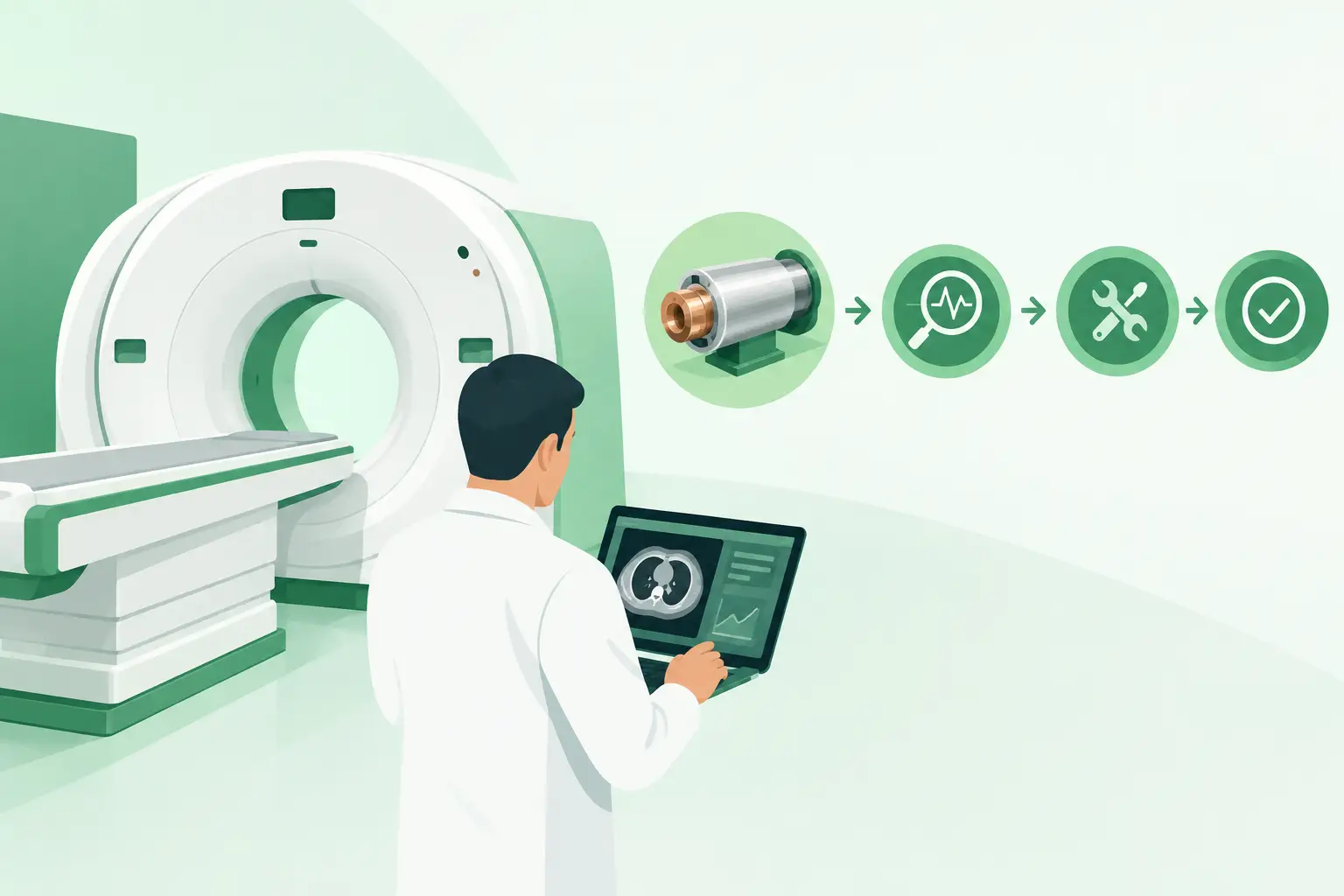
A CT room sitting idle for half a day is not a purchasing issue. It is lost scan capacity, delayed patient care, schedule disruption, and pressure on every team tied to that asset. That is why replacement parts procurement in healthcare imaging has to be treated as an uptime function, not a routine buying task.
For hospital supply chain teams, biomeds, and independent service organizations, the challenge is rarely ordering a common item. The real test comes when a system fault points to a specific board, detector component, power supply, transducer, or other assembly that is expensive, time-sensitive, discontinued, or difficult to verify. In those cases, the procurement process has to move fast without creating new risk.
Why replacement parts procurement is different in imaging
Medical imaging equipment does not behave like general facility equipment, and the parts market does not behave like standard MRO distribution. A replacement part for an MRI, CT, C-arm, or ultrasound platform often sits inside a chain of dependencies involving software compatibility, OEM revisions, serial number ranges, modality-specific fit, and service urgency. A part that is technically similar may still be wrong for the system in front of you.
That complexity changes the buying criteria. Price matters, but so do traceability, condition, lead time, and confidence that the quoted item matches the exact equipment configuration. A low quote that arrives late or turns out to be the wrong revision usually costs more than a higher quote that gets the room back online quickly.
There is also the issue of market fragmentation. Many imaging replacement parts are spread across OEM channels, independent stock, teardown inventory, refurbishers, international sources, and secondary supplier networks. That creates opportunity, especially for legacy and hard-to-find components, but it also increases the burden on the buyer to validate what is actually available.
What strong replacement parts procurement looks like
The best procurement teams build processes around three outcomes: speed, match accuracy, and continuity of supply. Those outcomes sound straightforward, but in practice they require disciplined sourcing and clean technical communication.
Speed starts with how the request is defined. A vague description such as "X-ray board" slows everything down. A request that includes the exact part number, equipment model, serial number, OEM reference if known, and condition preference gives suppliers a real basis to quote. When the fault is urgent, every round of clarification adds downtime.
Match accuracy depends on more than a part number alone. In imaging, supersessions, alternate revisions, firmware implications, and region-specific configurations can all affect fit. Procurement works best when sourcing teams can cross-reference against a broad parts database and supplier network rather than relying on a narrow catalog search.
Continuity of supply matters because many buyers are not dealing with one-time events. A service organization supporting multiple accounts, or a health system operating mixed OEM fleets, may need recurring access to the same classes of parts. In those environments, procurement is not just about filling one order. It is about building a dependable path to parts across modalities and equipment generations.
The real trade-offs buyers face
There is no single right approach for every order. Replacement parts procurement always involves trade-offs, and experienced buyers know the best decision depends on the clinical and operational context.
New versus refurbished is one of the most common examples. New parts may offer stronger preference in some organizations, especially for critical assemblies or internal policy reasons. Refurbished parts can be the more practical option when OEM lead times are long, budgets are constrained, or the equipment itself is in a later stage of lifecycle support. The right choice depends on risk tolerance, urgency, and the remaining service life of the system.
Stocked inventory versus sourced-to-order is another. Stocked parts reduce response time, which is valuable for emergency failures. Sourced-to-order options can expand access to rare or discontinued components, but they may introduce more variability in lead time and availability. Buyers who understand this difference can set more realistic expectations with internal stakeholders.
OEM channel versus independent supply is not always a simple decision either. OEM sources may be preferred for certain parts or service agreements. Independent suppliers often become essential when dealing with older systems, budget constraints, or parts the standard channel no longer supports effectively. What matters is not the label on the source. It is whether the supplier can provide the correct part, clear condition disclosure, and reliable fulfillment.
How to reduce delays before the quote stage
A significant share of procurement delays happen before anyone issues a quote. Internal handoffs, incomplete identifiers, and unclear approval paths often create more downtime than external sourcing does.
The most effective teams standardize the intake process. They make sure every request includes the part number if available, system details, site location, fault context, urgency level, and preferred condition. If a part number is uncertain, they route the request through someone who can validate it before sending it to market. That one step can save hours.
It also helps to separate true downtime events from planned sourcing. An emergency request for a failed CT power assembly should not move through the same workflow as a noncritical stocking purchase. When everything is treated as urgent, nothing moves cleanly. Triage improves both speed and decision quality.
Procurement and technical teams also need a shared language for substitutions and alternates. If a supplier offers a compatible revision or a tested refurbished option, the buyer should know in advance who can approve it and under what conditions. Without that clarity, a workable solution can sit waiting while the room stays offline.
What to expect from a serious sourcing partner
In specialized imaging environments, supplier capability matters as much as supplier price. A serious sourcing partner should be able to respond quickly, but speed alone is not enough. The real value comes from market reach and technical confidence.
That means access to a large supplier network, the ability to source across multiple imaging modalities, and familiarity with part-number variations found in legacy and current systems. It also means knowing when not to force a quote. If an item cannot be validated properly, the supplier should say so instead of pushing uncertainty back onto the buyer.
Fast quotation turnaround is especially important when internal teams are under pressure to restore service. But a good quote should do more than confirm price and lead time. It should clarify part condition, availability status, and any relevant sourcing considerations. Buyers need enough information to make a practical decision without chasing basic details.
This is where a specialized partner such as Meditegic fits best - not as a generic distributor, but as a procurement resource for hard-to-find, exact-match, and urgent imaging parts across mixed equipment environments.
Building a smarter replacement parts procurement strategy
The strongest organizations do not wait for a major failure before improving their process. They treat replacement parts procurement as part of asset support planning.
For high-value imaging systems, that often means reviewing recurring failure points, identifying equipment that is aging out of standard support, and understanding which parts are becoming harder to source. Once those patterns are visible, procurement can work with clinical engineering and service teams to decide where proactive stocking makes sense and where responsive sourcing is sufficient.
Not every part should be stocked. Carrying expensive assemblies that may never be used can tie up capital unnecessarily. On the other hand, a small number of known failure items can justify planned inventory if the cost of downtime is high enough. It depends on modality, utilization, service coverage, and replacement lead time.
A smarter strategy also includes supplier rationalization. Managing too many low-specialization vendors often creates noise rather than resilience. A focused set of suppliers with real imaging aftermarket depth usually produces better quotes, faster validation, and fewer surprises.
Why this matters beyond the purchase order
When replacement parts procurement works well, it supports more than a maintenance transaction. It protects scanner availability, stabilizes service performance, and helps control the hidden costs that come with extended outages. Those costs show up in rescheduled patients, overtime labor, loaner arrangements, and strained internal resources.
For buyers responsible for uptime, the goal is not simply to buy parts. It is to secure the right part, at the right time, from a source that can support the reality of medical imaging service. That standard is higher than general purchasing, and it should be.
A good procurement process will never eliminate every delay or every hard-to-find part scenario. But it can reduce avoidable friction, improve decision speed, and give your team better options when the pressure is on. In imaging, that is often the difference between a manageable service event and a much larger operational problem.