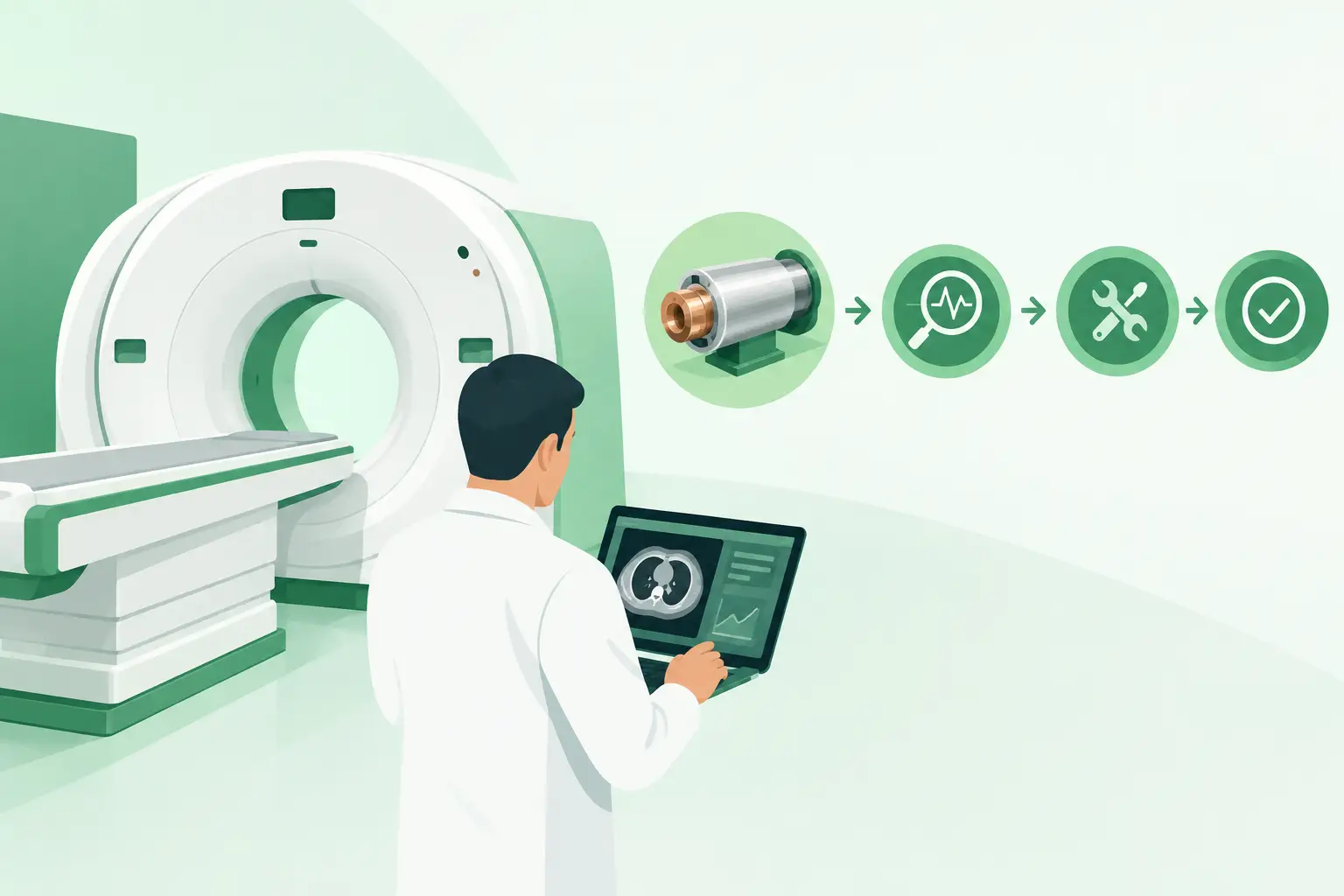
When a CT gantry is down or an MRI console board fails, procurement delays are not an administrative problem. They become an operational problem fast. A sound parts procurement strategy is what separates a short service event from a prolonged outage that affects schedules, revenue, service commitments, and patient access.
For imaging environments, parts buying is rarely routine. The challenge is not simply finding a vendor with stock. It is identifying the correct component, confirming compatibility, weighing new versus refurbished options, and securing delivery on a timeline that matches the urgency of the repair. That is why procurement strategy matters most in the categories where error, delay, and poor sourcing discipline are expensive.
What a parts procurement strategy should actually do
A practical parts procurement strategy should reduce downtime risk while keeping purchasing control intact. In healthcare imaging, that means the strategy has to support exact-match sourcing across multiple OEMs, legacy systems, and varying asset conditions. It also needs to work under pressure, because many purchases are triggered by failures, not planned maintenance windows.
In simple terms, the strategy should answer five questions before the emergency happens. Which parts are operationally critical? Which suppliers can reliably source them? What technical data is needed to avoid ordering mistakes? When is refurbished acceptable? And who has authority to approve urgent purchases without creating delays?
If those answers are unclear, teams end up improvising. Improvisation usually costs more than planning.
Why imaging parts procurement is different
General MRO purchasing logic does not always apply to diagnostic imaging equipment. A low-volume, high-value replacement part for a PET/CT or mammography system carries a different risk profile than a common facility spare. Availability may be limited, OEM lead times may be long, and some components may already be discontinued.
There is also a documentation problem. A purchase request might arrive with an informal description rather than a verified part number. Service teams may know the failed assembly but not the precise revision needed. On older systems, substitutions are not always straightforward. One wrong digit in a part number can mean a return, another service visit, and more downtime.
That is why procurement in this category depends on more than price comparison. It depends on supplier specialization, parts intelligence, and the ability to move quickly without sacrificing accuracy.
The core elements of a stronger parts procurement strategy
The best procurement strategies start with asset criticality, not catalogs. If a system directly supports high patient volume, time-sensitive diagnostics, or contract service obligations, its replacement parts should not be sourced the same way as lower-priority equipment. Critical assets need prequalified suppliers, faster approval paths, and a clearer view of likely failure points.
The next element is part identification discipline. Teams need a consistent process for capturing model information, serial numbers, OEM part numbers, revision details, and failure symptoms. Even experienced buyers lose time when requests arrive incomplete. A standardized intake process reduces rework and shortens quote cycles.
Supplier structure matters just as much. Relying on a single source may seem simpler, but it creates exposure when inventory is thin or a component has become hard to find. A better model is a primary supplier group with proven access to new, refurbished, and obsolete inventory channels. This gives buyers options without forcing them to restart the search every time a standard source comes up short.
Finally, the strategy has to define acceptable buying paths for different scenarios. A planned replacement during preventive maintenance can follow a more cost-sensitive process. A down system often requires a speed-first process. Treating both situations the same usually means overpaying for routine buys or moving too slowly during urgent events.
Building a parts procurement strategy around uptime
Uptime-driven procurement starts by classifying parts based on operational consequence. For example, coil components, detector-related assemblies, power modules, control boards, and transducers often have very different lead-time and substitution realities. Some are worth stocking locally in limited quantities. Others make more sense to source through a responsive specialist with broad network access.
That distinction is important because inventory is expensive. Overbuying ties up capital in parts that may never move, especially across mixed fleets and aging modalities. Underplanning creates downtime risk. The right balance usually comes from identifying a narrow list of high-impact items to stock and pairing that with a supplier network capable of sourcing less predictable needs quickly.
This is also where historical service data becomes useful. Review repeat failures, past lead times, emergency purchases, and assets with recurring parts shortages. Procurement strategy should be shaped by actual failure patterns, not assumptions. If certain systems repeatedly require the same hard-to-find boards or assemblies, that pattern should drive supplier planning and budget expectations.
How to evaluate suppliers for parts procurement strategy
A supplier should be judged on more than unit price. In imaging aftermarket sourcing, the real questions are whether the supplier can verify the part, access alternatives, quote quickly, and deliver consistently under urgent conditions. A low quote is not useful if the part is incorrect, undocumented, or unavailable when needed.
Responsiveness is one of the clearest performance indicators. Technical buyers need a supplier that can work from part numbers, model details, and system context without excessive back-and-forth. Fast quotation turnaround matters because procurement delays often begin before the purchase order, during the effort to confirm availability and condition.
Breadth of access matters too. Many procurement failures happen because buyers are searching through fragmented channels, each with limited visibility. A specialized sourcing partner with a broad supplier network can often reach inventory that standard distributors cannot. That is especially valuable for legacy imaging systems, discontinued components, and exact-match replacements where time is limited.
Quality control should not be assumed. Buyers should understand how parts are described, tested, graded, and documented, especially for refurbished inventory. Refurbished can be the right decision in many cases, but only when the supplier can clearly communicate condition and traceability.
New, refurbished, and obsolete parts: choosing the right path
A mature parts procurement strategy does not default to one condition category. It uses the right sourcing path for the equipment, budget, and urgency involved.
New parts may be the best fit for certain high-risk applications, newer systems, or situations where warranty requirements are strict. The trade-off is often lead time and cost. Refurbished parts can offer a strong balance of availability and value, particularly for mature imaging platforms where OEM supply is limited or no longer economical. The trade-off is that supplier vetting becomes more important.
Obsolete or discontinued parts require a different mindset altogether. In these cases, the procurement challenge is less about purchasing and more about market access. Teams need a source that can search beyond standard channels, validate compatibility, and move quickly when inventory appears. Waiting to start that search until the unit is already down is rarely ideal.
Common gaps that weaken procurement performance
One of the biggest gaps is treating every request as a new event. Without documented sourcing history, approved alternates, or supplier benchmarks, buyers lose time repeating the same verification work. Another common problem is poor coordination between clinical engineering, service, and purchasing. The technical team may know exactly what failed, while procurement may still lack the data needed to place the order correctly.
Approval bottlenecks are another issue. If urgent purchases require the same path as routine spending, repair timelines stretch for reasons unrelated to supply availability. Clear escalation rules can prevent that.
Many organizations also underestimate the value of specialization. Imaging systems are complex, and broadline suppliers are not always equipped to support exact-match sourcing across modalities and generations of equipment. In practice, a specialized partner often reduces both search time and ordering risk. That is one reason organizations working across CT, MRI, ultrasound, X-ray, mammography, and nuclear imaging often turn to focused sourcing providers such as Meditegic when standard channels fall short.
Making the strategy work day to day
A strong strategy becomes useful when it is built into daily purchasing behavior. That means standard request forms, updated asset records, preferred supplier tiers, and a clear process for urgent versus planned buys. It also means reviewing supplier performance based on fulfillment speed, quote accuracy, part quality, and problem resolution, not just invoice totals.
Teams should revisit the strategy periodically because fleet age, OEM support status, and service demand all change. A sourcing plan that worked two years ago may not fit current realities if more systems are aging into limited-support status.
The most effective parts procurement strategy is not the one with the most policy behind it. It is the one that helps technical and purchasing teams get the right component, at the right time, with the fewest disruptions. In imaging service, that kind of procurement discipline does more than control spend. It protects uptime when it matters most.