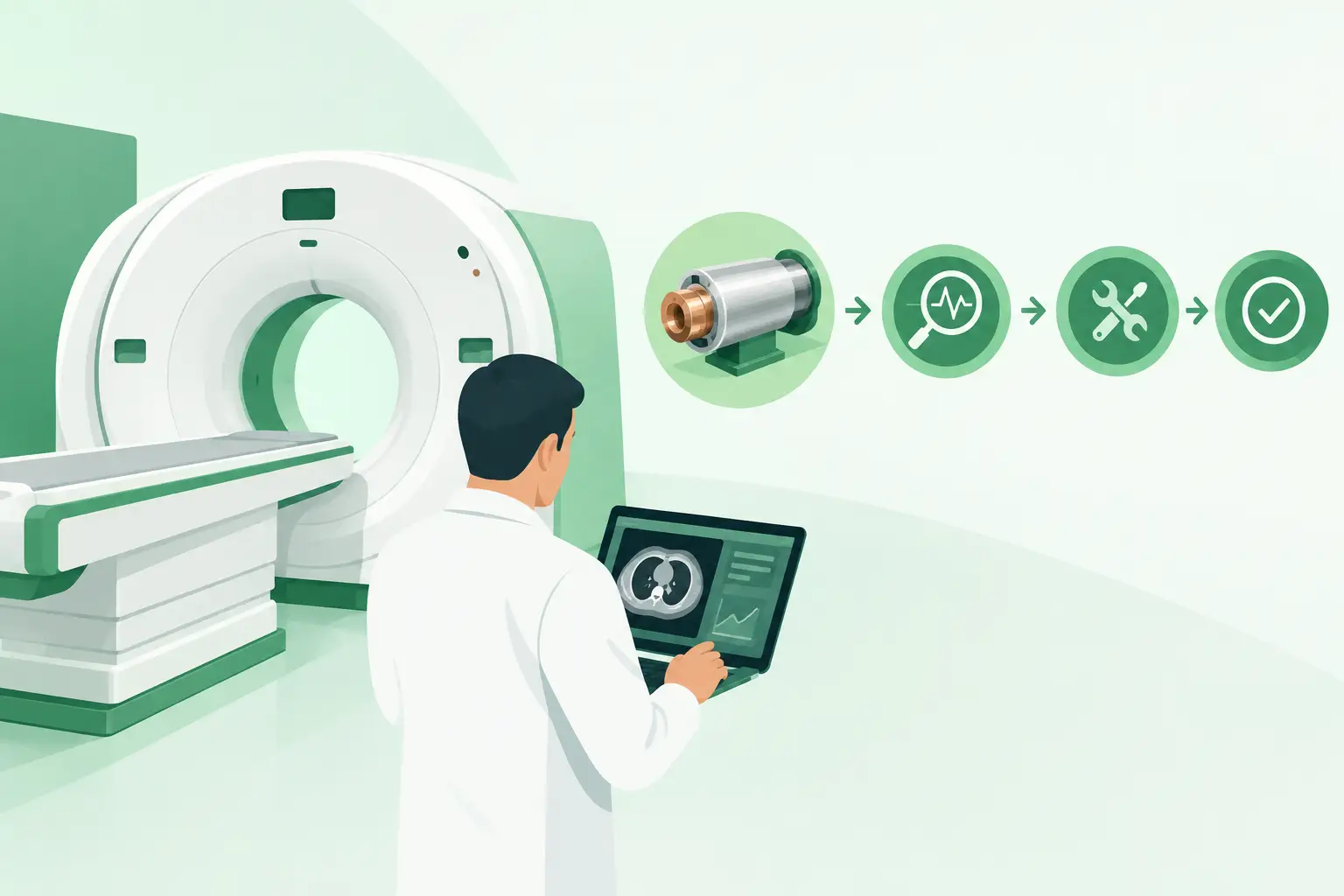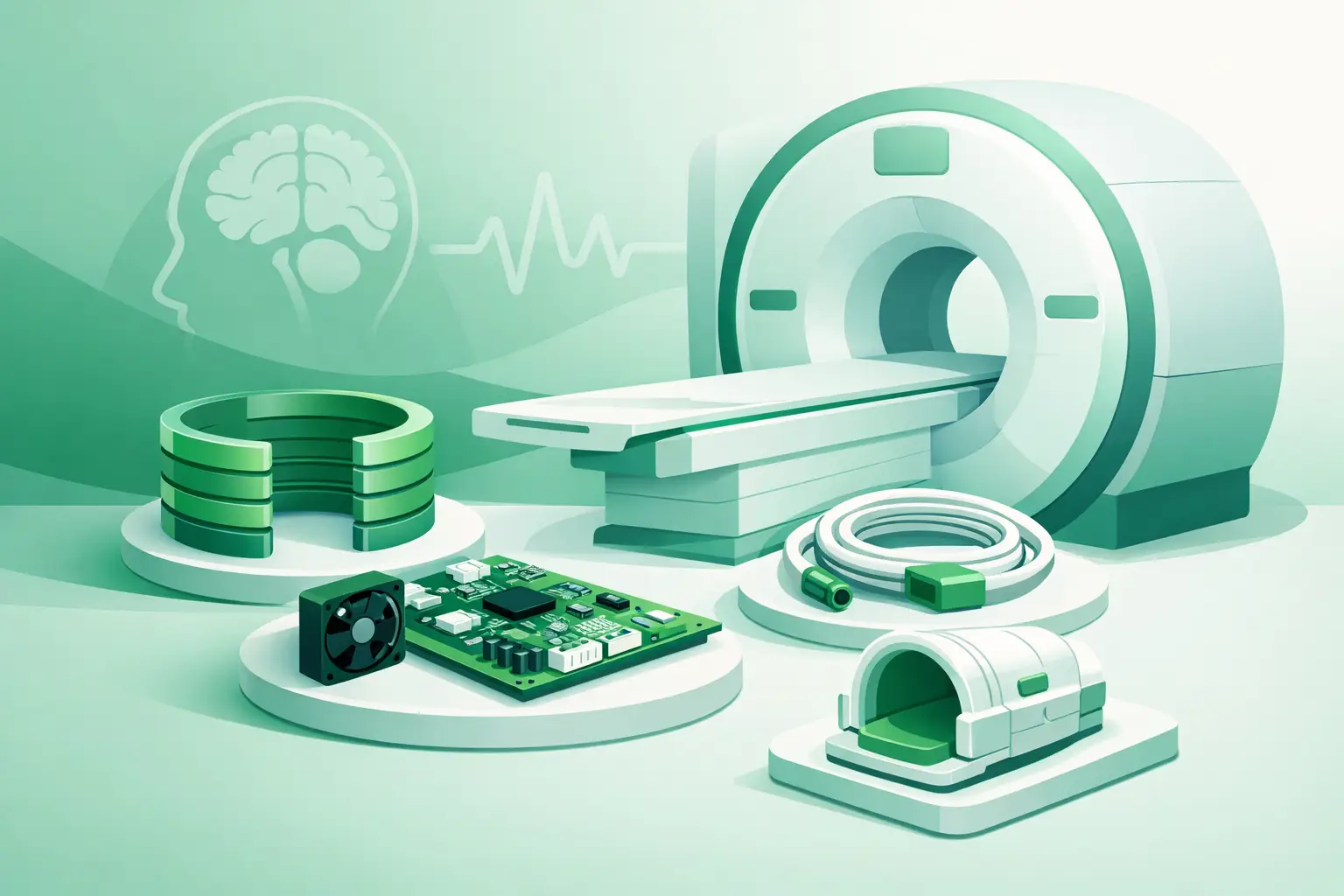
An MRI room can go from fully booked to idle over a single failed board, chiller issue, or table movement fault. For imaging directors, biomeds, and independent service teams, knowing the top replacement components for MRI systems is less about theory and more about protecting uptime, patient throughput, and service response times.
MRI platforms are complex assemblies of high-value subsystems, and failures rarely happen in convenient categories. Some parts degrade gradually and show intermittent faults. Others fail without warning and stop scans immediately. The most critical replacement components tend to share three traits: they fail often enough to matter, they are expensive enough to affect budget decisions, and they are specific enough that sourcing delays can stretch downtime far beyond the actual repair time.
What makes MRI replacement parts high priority
Not every MRI spare carries the same operational weight. Consumables and cosmetic items matter, but they usually do not decide whether a magnet can return to service this week or next month. High-priority MRI components are the parts that directly affect image generation, cooling, power delivery, patient handling, and system control.
For procurement and service teams, the real issue is not just whether a part is available. It is whether the exact match is available, whether a refurbished option is acceptable for the application, and whether lead time aligns with the service window. A lower-cost part with uncertain provenance can create repeat failures, calibration issues, or compatibility problems with legacy software and hardware revisions.
Top replacement components for MRI systems
RF amplifiers and related RF components
RF amplifiers sit near the top of the list because they are central to signal transmission and image quality. When an RF amplifier begins to fail, symptoms may include reduced performance, image artifacts, aborted scans, or complete inability to run protocols. Depending on the system architecture, the issue may involve the amplifier itself, RF power modules, interface boards, or associated cabling.
These components can be difficult to source quickly, especially for older platforms. Buyers often have to choose between new, refurbished, or exchange inventory. That decision depends on system age, budget, and the criticality of the application. For a newer scanner in a high-volume facility, a new OEM-equivalent option may be preferred. For an aging system nearing capital replacement, a tested refurbished unit may be the more practical path.
Gradient amplifiers and gradient subsystem parts
Gradient amplifiers are another frequent priority because they directly affect spatial encoding and scan execution. Failures in this category can present as system trips, unusual noise, incomplete sequences, or image distortion. Gradient-related service events may also involve power sections, control boards, or cooling interfaces rather than the amplifier assembly alone.
The trade-off here is cost versus confidence. Gradient components are expensive, and not every failure justifies replacing the full assembly. In some cases, a board-level repair or targeted replacement is enough. In others, partial fixes only extend downtime if the broader subsystem is already unstable.
MRI coils
Coils are among the most commonly replaced MRI components because they see heavy daily use and are vulnerable to wear, cable damage, connector failure, and fluid ingress. A failed coil may not disable the whole scanner, but it can take specific exams out of service and create immediate scheduling problems.
Head coils, spine coils, knee coils, body arrays, and flexible coils each have different failure patterns. High-use departments often treat certain coils as mission-critical spares because the scanner may be operational while key revenue-producing exams are not. For buyers, this is where exact compatibility matters. A coil that is physically similar but not approved for the system configuration is not a solution.
Patient table and positioning components
Table movement issues create a different kind of downtime. The magnet, gradients, and RF chain may all be functional, but if the patient table will not index properly or fails safety checks, the room still cannot run as expected. Common replacements include table drive motors, control boards, sensors, hand controllers, locks, and power supply components.
These parts are sometimes underestimated during spare planning because they do not sound as specialized as magnet or RF hardware. In practice, they can be just as disruptive. They also tend to require careful part-number verification because table assemblies often vary by system generation and configuration.
Power supplies and power distribution boards
MRI systems depend on stable power across multiple subsystems. Power supply failures can trigger broad, confusing symptoms that look like software faults, communication errors, or intermittent subsystem loss. Replacing the correct power supply, power distribution module, or related board often restores function quickly, but diagnosis has to be precise.
These are strong candidates for strategic stocking in service organizations that support multiple installed systems. They are common enough to matter and important enough that waiting on a quote or shipment can extend downtime unnecessarily.
Chiller components and cooling system parts
Cooling is not secondary in MRI. It is operationally central. Chiller failures, pump problems, heat exchanger issues, sensors, valves, and controller boards can all force the system offline or create unstable performance that leads to repeated shutdowns.
The challenge with cooling-related replacements is that the failed part may sit outside the scanner cabinet while still affecting the entire imaging chain. Service teams often need a supplier that understands both imaging equipment and the supporting cooling infrastructure. A generic industrial replacement is not always appropriate when system integration, alarm behavior, and environmental tolerances are involved.
System control boards and interface boards
Many MRI service calls come down to electronics that coordinate communication between major subsystems. Control boards, interface boards, CPU assemblies, and I/O modules can fail outright or create intermittent faults that are difficult to isolate. These parts are especially important in legacy MRI systems, where discontinued boards may be far harder to find than more visible mechanical components.
This is where sourcing capability matters most. A standard catalog distributor may not have access to low-volume, revision-specific boards pulled from deinstalled systems or professionally refurbished inventory. For older scanners still producing clinical value, these components often determine whether the unit stays viable.
Operator console and display components
Console workstations, monitors, keyboards, control panels, and related electronics are not always the highest-value parts, but they are common operational bottlenecks. If the console cannot boot, display images correctly, or communicate with the scanner, the room stops.
For these parts, compatibility and configuration details matter as much as physical availability. Software version, graphics requirements, connector type, and OEM-specific setup can all affect whether a replacement works without introducing additional service steps.
How buyers should prioritize MRI spare sourcing
The best way to evaluate the top replacement components for MRI is by combining failure impact with sourcing difficulty. A part that fails often but ships easily is one kind of problem. A part that fails rarely but takes three weeks to locate is another. The highest-risk category is the component that does both.
Hospitals and service firms usually benefit from separating MRI parts into three groups: fast-moving operational spares, expensive critical-path assemblies, and legacy or discontinued items that require broader sourcing support. That framework helps control spending without treating every part request as an emergency purchase.
It also helps to decide in advance where refurbished inventory is acceptable. Many organizations are comfortable using tested refurbished boards, power supplies, and assemblies when documentation, condition standards, and warranty terms are clear. Others reserve new parts for the most sensitive applications. There is no universal rule. The right choice depends on risk tolerance, scanner age, service contract obligations, and the clinical role of the system.
What to verify before placing an order
MRI parts procurement is rarely forgiving of guesswork. Before ordering, buyers should confirm the full part number, applicable system model, revision level, and whether the component is outright purchase, exchange, or repairable core. It is also worth checking if the failed part is one element of a larger subsystem issue. Replacing a board without addressing the upstream power or cooling problem can waste both money and service time.
For urgent cases, quote speed matters, but accuracy matters more. A fast response only helps if the sourced part is correct, tested appropriately, and ready to ship on the timeline the service event requires. That is why many imaging buyers work with specialized suppliers rather than broad-line distributors. Meditegic supports that need by helping procurement and service teams locate exact-match and hard-to-find imaging components across OEM and legacy environments.
MRI uptime depends on more than having a parts list. It depends on knowing which components stop operations most often, which ones are hardest to replace, and which sourcing decisions reduce repeat downtime instead of shifting it a few weeks down the road.