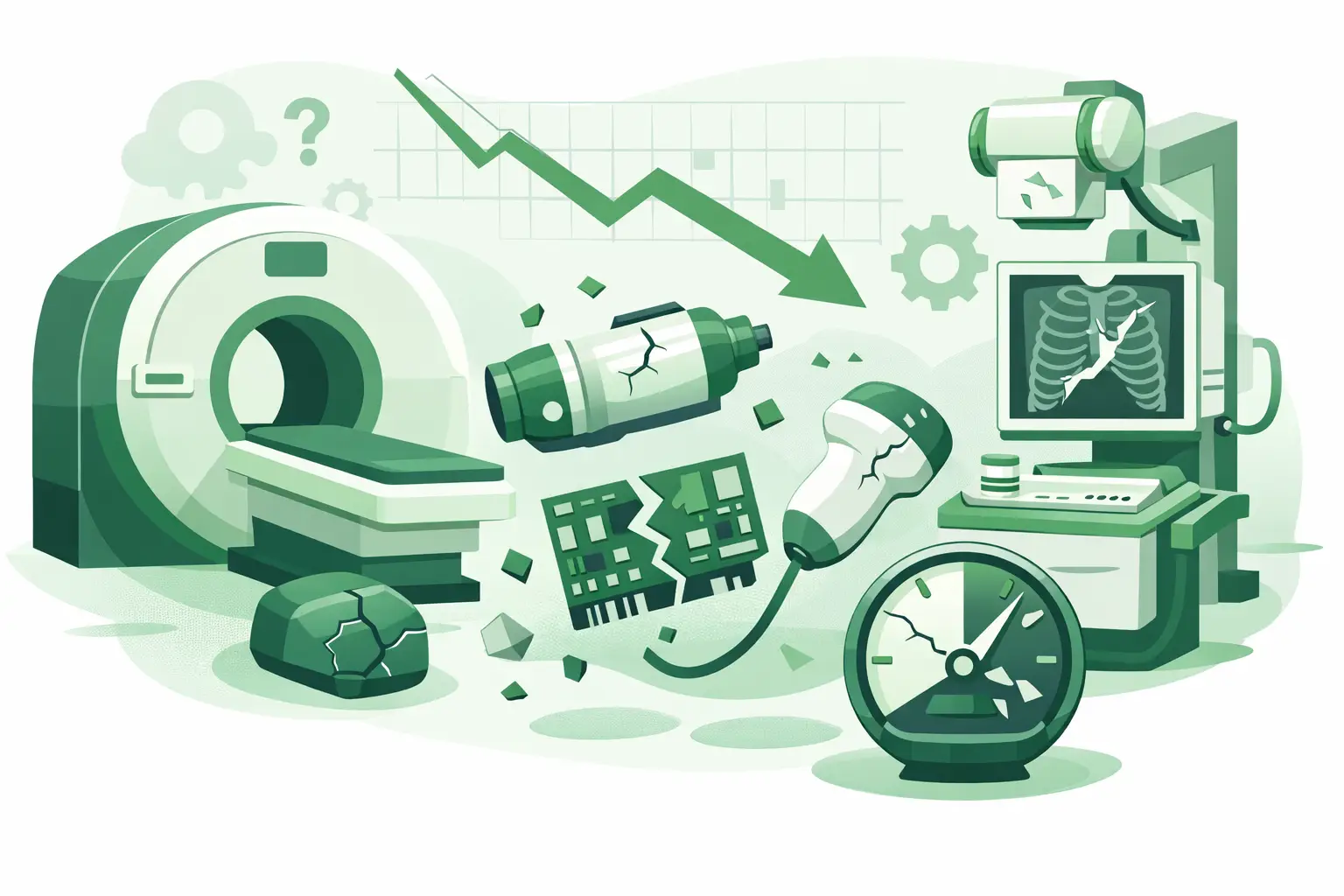
A CT room goes offline because the tube reached end of life faster than expected. An ultrasound unit starts dropping image quality because a transducer cable has intermittent damage. A C-arm is unavailable for cases because a power module failed without much warning. When teams ask which imaging parts fail most, they are usually not asking out of curiosity. They are trying to protect uptime, control emergency spend, and avoid delays that affect patient scheduling.
The short answer is that the highest-failure parts are usually the ones exposed to heat, motion, high voltage, repetitive handling, or heavy daily use. But failure patterns vary by modality, service environment, and equipment age. A high-throughput hospital imaging department and a lower-volume outpatient site may own the same model and see very different replacement cycles.
Which imaging parts fail most by modality
Across diagnostic imaging, the most failure-prone categories tend to be tubes, detectors, power assemblies, coils, transducers, cooling-related components, and user-interface hardware. These are not always the most expensive parts on the system, but they are often the parts most likely to interrupt operation.
In CT, X-ray tubes remain one of the most common failure points because they operate under significant thermal stress. Tube life depends on scan volume, protocol mix, warm-up discipline, and system age. Tube arcing, declining output, image artifacts, and exposure errors are familiar signs. High-voltage cables, cooling components, and detector-related assemblies also create service events, but the tube is still the part most buyers plan around.
In MRI, coils are a frequent source of trouble. They are handled constantly, moved between exams, flexed, dropped, and exposed to cable strain. Coil failure can show up as poor signal, channel dropouts, or intermittent exam issues that are difficult to isolate at first. Beyond coils, power supplies, gradient-related components, chiller assemblies, and patient table parts can drive downtime, especially on older systems where wear and environmental conditions catch up.
In general radiography and mobile X-ray, tube assemblies and detectors are the parts that most often move from performance concern to urgent replacement. Portable systems also place more stress on connectors, brakes, wheels, control panels, and battery-related hardware. The imaging chain may get the most attention, but simple electromechanical components can take a unit out of service just as effectively.
In ultrasound, transducers are the leading failure item by a wide margin. They are highly specialized, expensive, and vulnerable to impact, cable damage, fluid intrusion, and wear from repeated disinfection cycles. Keyboards, trackballs, touch panels, power supplies, and internal boards also fail, but probes usually represent the highest-volume replacement category because they are the most exposed component in daily use.
In C-arm systems, generators, monitors, brakes, control boards, cables, and tube-detector assemblies are all common failure areas. These systems are moved frequently and used in procedure-driven environments where accidental impacts and cable stress are hard to avoid. In mammography, detector assemblies, compression hardware, power boards, and tube-related components are all recurring service concerns. In nuclear and SPECT environments, photomultiplier-related issues, detector electronics, and motion-control components can become increasingly difficult to source as systems age.
Why these parts fail first
There is a reason the same categories come up across modalities. Parts fail fastest when they combine technical complexity with real-world stress.
Heat is one of the biggest drivers. Tubes, power supplies, generators, and some detector-related assemblies operate in conditions where thermal cycling is constant. Even when the system is used correctly, repeated heat buildup and cooldown gradually shorten useful life. If ventilation is poor or cooling performance declines, that timeline compresses.
Motion is another factor. Table drives, gantry components, brakes, bearings, fans, cable carriers, and positioning hardware all wear because they move repeatedly. The same is true for handheld or frequently repositioned accessories such as ultrasound probes and MRI coils. Every bend, pull, twist, and impact adds cumulative risk.
Voltage and signal sensitivity matter as well. Imaging systems rely on stable electrical performance. When power quality is inconsistent, or when boards and modules age, intermittent faults become more common. These failures are especially costly because they can mimic software issues, calibration problems, or accessory faults before the root cause is confirmed.
Then there is the simple reality of use intensity. A part on a low-volume backup room may last years longer than the same part on a primary scanner running full days with limited downtime. Failure rates are not just about design. They are also about throughput, handling discipline, and service history.
The parts that create the most expensive downtime
The part that fails most often is not always the part that hurts operations the most. That distinction matters for procurement planning.
A keyboard, fan, monitor, or brake assembly may fail more frequently than a major imaging component, but those items are often easier to replace. By contrast, a CT tube, DR detector, MRI coil, or specialized power assembly may fail less often in relative terms yet create significantly more downtime because lead times, compatibility requirements, and approval steps are more complicated.
This is where buyers often separate high-frequency failures from high-impact failures. High-frequency items tend to be accessories, cables, smaller electromechanical parts, and user-interface hardware. High-impact items are the major assemblies that require exact part matching, technical verification, and immediate sourcing support. Both categories matter, but they should be managed differently.
For many organizations, the real cost is not the replacement part alone. It is canceled scans, rescheduled patients, overtime for service teams, and pressure on alternate equipment. A part with a moderate purchase price can still become an expensive event if it is difficult to identify or unavailable through standard channels.
Which imaging parts fail most on older systems
Older platforms shift the failure profile. Once equipment passes its prime support years, replacement demand often expands beyond the obvious wear items.
On legacy systems, control boards, discontinued power modules, interface boards, display components, and specialty cables become more common pain points. The challenge is not only that they fail. It is that they may no longer be readily stocked by the OEM or mainstream distributors. At that stage, even a relatively small component can strand an otherwise serviceable system.
Aging systems also tend to produce clustered failures. A site may replace one board, only to discover that a fan assembly, power supply, or detector subcomponent is also near end of life. That does not always mean the equipment should be retired. It does mean procurement teams need access to broader sourcing options, including refurbished and hard-to-find parts, to extend asset value responsibly.
What buyers should watch before failure becomes downtime
Most imaging parts do not fail without any warning, but the warning signs are easy to miss when operations are busy. Declining image quality, intermittent faults, longer boot times, overheating alerts, unusual sounds, calibration drift, and repeated service calls around the same subsystem usually point to a component that is degrading rather than a one-time anomaly.
For purchasing teams and biomeds, the practical question is not only which parts fail most. It is which parts on your installed base are most exposed right now. The answer depends on modality mix, exam volume, equipment age, and whether the site has experienced recurring issues with a known subsystem.
That is why part history matters. If the same coil family, tube type, transducer model, or power board has already created downtime across multiple sites or units, it is worth reviewing stocking strategy, alternate sourcing paths, and refurbishment options before the next failure occurs.
A smarter way to plan for high-failure imaging parts
The best procurement response is not to overstock everything. That ties up budget and can create shelf-life or obsolescence problems. A better approach is to identify the parts that are both failure-prone and operationally critical, then build a sourcing plan around them.
For some organizations, that means keeping select high-use accessories on hand while relying on fast external sourcing for larger assemblies. For others, especially service providers supporting multiple OEM environments, it means maintaining a qualified source for hard-to-find components that can be quoted quickly and verified accurately. Meditegic fits that need when standard channels do not.
The most effective teams treat failure patterns as procurement data, not just maintenance events. They track what fails, what takes longest to replace, and what repeatedly disrupts scheduling. That turns reactive buying into a more controlled service strategy.
If there is one useful rule, it is this: the imaging parts that fail most are usually the ones under the most stress, but the parts that matter most are the ones you cannot afford to wait for. Knowing the difference is what keeps uptime from turning into a scramble.