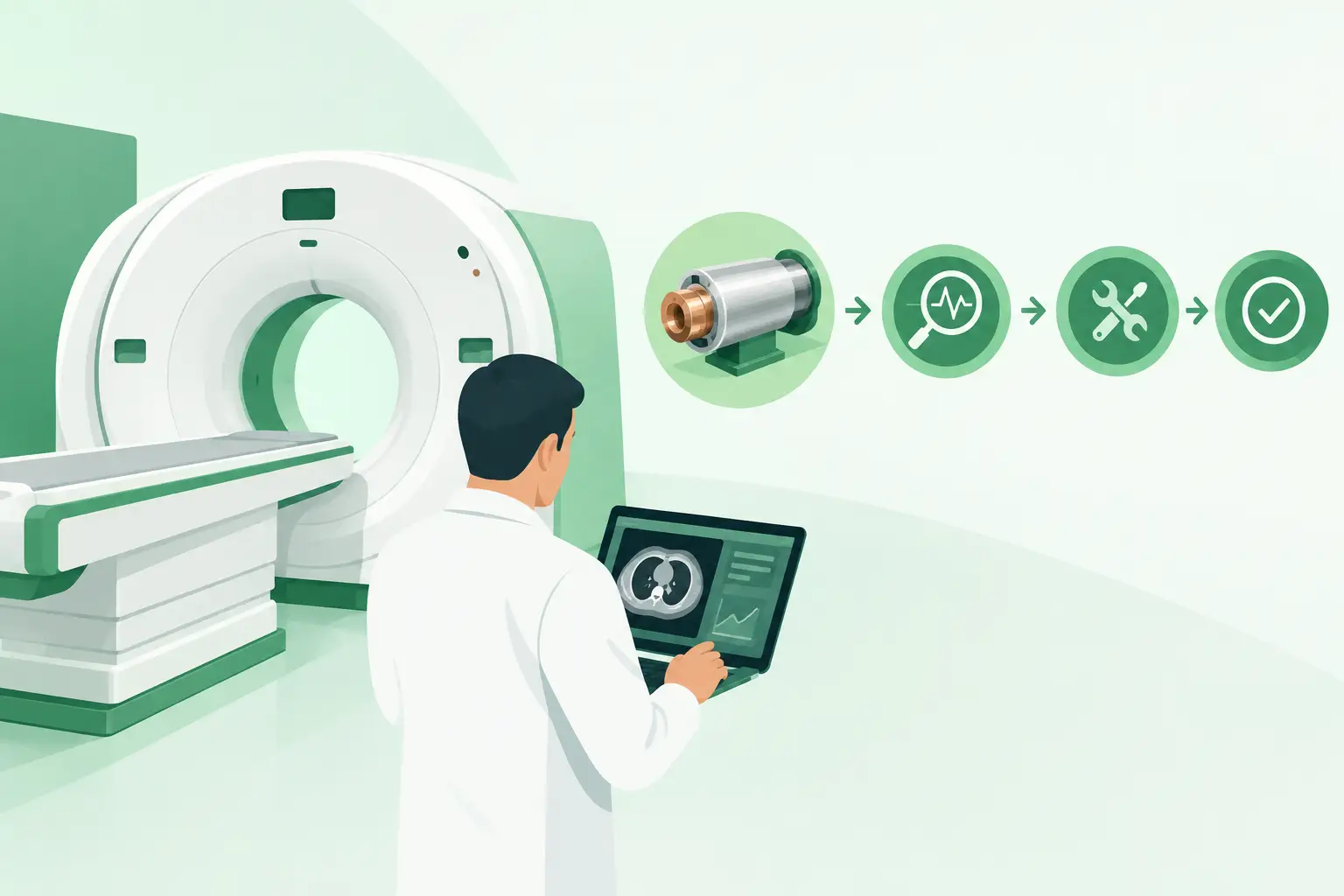
A stalled X-ray room does not create a minor scheduling issue. It disrupts patient flow, delays reads, strains service teams, and puts pressure on purchasing to find the right part fast. That is why X ray machine spare parts are not just a maintenance line item - they are a direct uptime decision.
For hospitals, imaging centers, independent service organizations, and biomedical teams, the challenge is rarely just buying a component. The real challenge is identifying the exact replacement, confirming compatibility, and securing it quickly enough to avoid extended downtime. On older systems, that problem gets harder. On multi-vendor fleets, it gets harder still.
Why X ray machine spare parts are harder to source than they look
On paper, an X-ray system may appear simpler than CT or MRI. In practice, parts sourcing can be just as complicated because the installed base is broad, many systems stay in service for years, and part revisions matter. A detector interface board, generator assembly, control panel, collimator component, power supply, or tube support part may have several similar variants with very different fit and function.
That creates risk for buyers who are under time pressure. A part description alone is often not enough. Model numbers can be incomplete, OEM naming conventions can vary, and legacy equipment may have undergone field modifications over time. If the wrong part is ordered, the result is not just a return. It is more lost time, another service visit, and another day of reduced imaging capacity.
The sourcing issue is also affected by product life cycle. Many imaging providers are supporting systems well beyond their original sales window because replacement capital is limited or scheduled years out. That means procurement teams often need access to discontinued, refurbished, or hard-to-find X ray machine spare parts that standard distribution channels do not reliably stock.
What buyers should verify before ordering
Speed matters, but speed without validation creates expensive mistakes. The most effective buyers treat every order as a technical match exercise, not a generic replenishment task.
The starting point is the exact part number, including any suffixes or revisions. If that number is missing, the next best inputs are system model, serial number, manufacturer, subsystem details, and a clear description of the failure. Photos of labels, boards, connectors, or installed assemblies can also help narrow down alternatives when documentation is incomplete.
Condition is the next decision point. New parts are often preferred for obvious reasons, but availability and budget do not always line up. Refurbished components can be the practical choice when lead times are tight or OEM stock is no longer available. The key is not whether a part is new or refurbished in the abstract. The key is whether it has been properly identified, tested where applicable, and supplied by a source that understands medical imaging equipment.
Lead time should also be examined closely. Buyers sometimes receive a fast quote that masks an uncertain fulfillment path. A dependable sourcing partner should be able to clarify whether the part is in stock, being sourced through a qualified network, or dependent on teardown, repair, or incoming inventory. That distinction matters when an imaging room is down.
The parts categories that most often affect uptime
Not every component failure has the same operational impact. Some can be planned around. Others stop scans immediately.
High-priority X ray machine spare parts often include generator components, high-voltage assemblies, control boards, tube-related components, collimator assemblies, exposure switches, power supplies, user interface modules, table parts, detector-related electronics, and mechanical assemblies tied to positioning or movement. Cooling components, cables, connectors, and interlocks can also create full system interruptions even though they may look secondary on a bill of materials.
This is one reason experienced procurement teams avoid oversimplifying failure events. The failed item may be small, but if it sits in a critical path, it becomes a system-level problem. A sourcing process built around part criticality, not just part cost, usually leads to better downtime control.
New vs refurbished parts: the real trade-off
There is no single rule that fits every imaging department. New parts may be the best route for current-generation systems, warranty-sensitive repairs, or components with heavy wear exposure. Refurbished parts often make more sense for mature platforms, discontinued systems, or urgent repairs where a premium lead time is not available through OEM channels.
The trade-off usually comes down to four factors: system age, failure type, budget tolerance, and required speed. A refurbished board for a legacy room can be a smart operational decision if it restores function quickly and matches the installed configuration. On the other hand, a heavily stressed assembly in a high-volume environment may justify a new replacement if one is available.
What buyers should avoid is treating refurbished inventory as interchangeable commodity stock. In imaging, refurbishment quality depends on technical handling, testing practices, and the supplier’s familiarity with the platform. A low price is not a savings if the part arrives with uncertain provenance or compatibility.
How to build a better sourcing process for X ray machine spare parts
The organizations that reduce downtime most effectively usually do not rely on last-minute searches alone. They build a repeatable process for identifying, approving, and ordering parts before the next urgent failure occurs.
A strong process starts with equipment documentation. Service histories, common failure points, part-number cross-references, and installed-base details should be easy for biomed, service, and purchasing teams to access. When a fault occurs, those records shorten the path from diagnosis to quote.
Supplier strategy matters just as much. Standard distributors can cover routine items, but complex imaging environments need access to partners with broader aftermarket reach. That includes suppliers that can source across multiple OEMs, locate discontinued inventory, and support both new and refurbished options. For many institutional buyers, the practical value is not just stock on hand. It is access to a larger network and the ability to quote accurately under pressure.
Communication also affects turnaround. The best requests for quote are precise and complete. Instead of sending only a generic system name, buyers should provide the exact part number if available, the equipment model and serial, the urgency level, and any known compatibility notes. That extra detail often removes one or two rounds of back-and-forth, which can save a full day.
When exact match matters more than price
In imaging service, price always matters. But it does not matter equally in every situation.
If an outpatient room is offline, lost throughput can exceed the savings from choosing the lowest-cost source. If a field engineer is already on site, a failed first shipment adds labor cost and scheduling friction on top of the part issue itself. If a system is older and the available supply is thin, delaying the purchase in search of marginal savings can mean losing the part entirely.
That does not mean buyers should ignore cost control. It means total operational cost should guide the decision. A higher-priced exact-match part with verified availability may be the cheaper option once downtime, technician time, rescheduling, and administrative effort are factored in.
What to expect from a specialized parts supplier
A capable aftermarket partner should do more than send a price. Buyers should expect support with part identification, condition options, sourcing visibility, and realistic lead-time communication. That is especially true when dealing with legacy systems, rare assemblies, or incomplete part data.
Specialization also shows up in how quickly a supplier can move from limited information to a usable quote. In medical imaging, that ability is not a convenience. It is part of the service. Meditegic operates in this space because technical buyers often need more than catalog access - they need a sourcing partner that can work across fragmented inventory channels and help secure the right part with less delay.
The best sourcing relationships are built on accuracy first. Fast response matters, but only if the response leads to the correct component and a credible delivery path.
Planning ahead for aging X-ray fleets
Many providers are balancing capital constraints with rising service demands, which means aging X-ray systems will remain in use longer than originally planned. That makes parts strategy more important each year. Waiting until a key assembly fails can leave teams exposed to shrinking availability and longer search times.
A more practical approach is to identify vulnerable systems now, review high-failure components, and map which X ray machine spare parts are already becoming difficult to find. In some cases, that supports a proactive stocking decision. In others, it simply means prequalifying a supplier with the right reach before the next urgent request hits.
For imaging operations, uptime is rarely protected by luck. It is protected by having the right information, the right sourcing path, and the discipline to treat parts procurement as a technical function rather than a routine purchase.