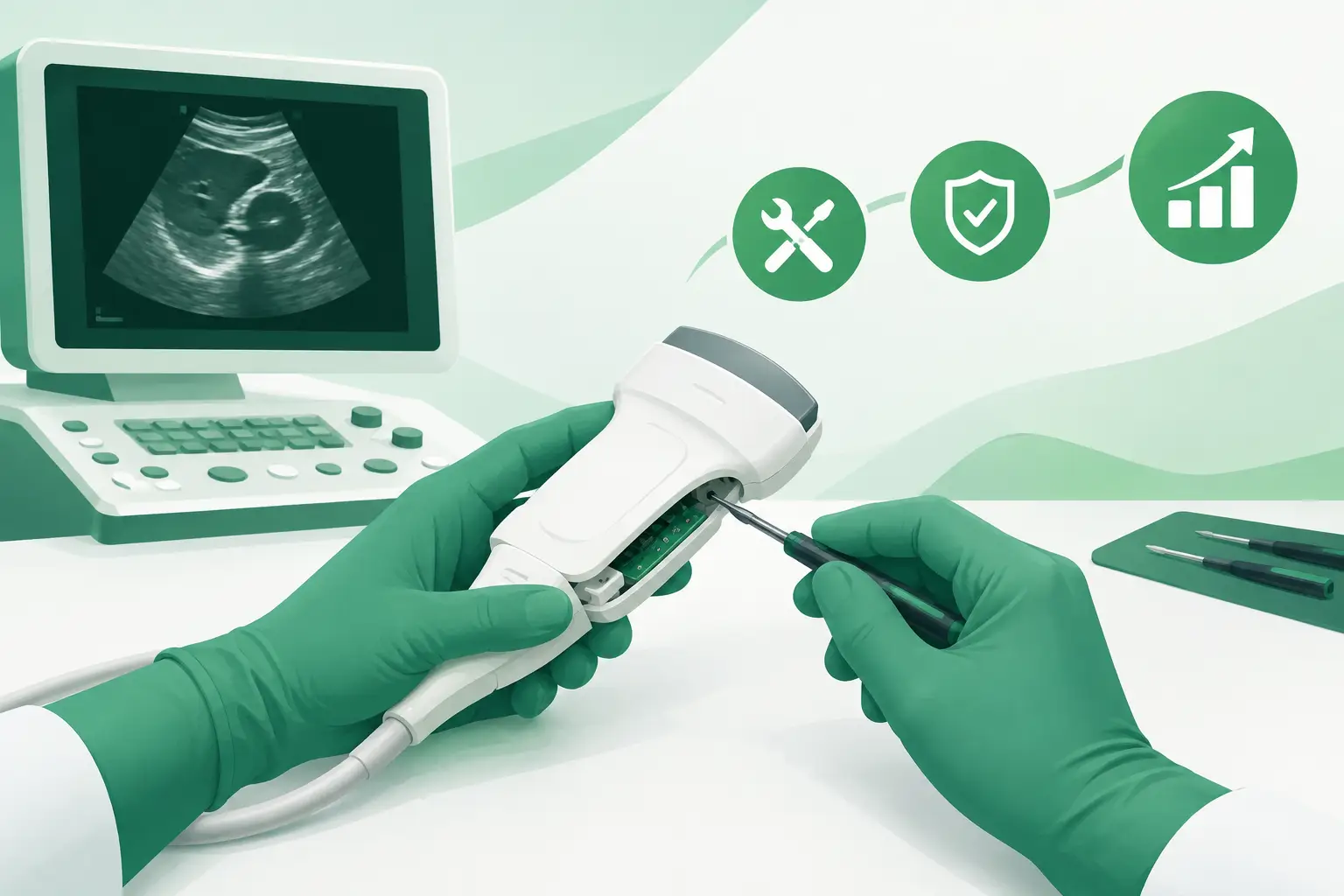
An aftermarket imaging vendor checklist review is most useful when a failure is specific, intermittent, and expensive to misdiagnose. Consider a Philips EPIQ ultrasound system with a probe that connects normally but develops intermittent image dropout, missing elements, noise bands, or a recurring probe-recognition issue during examinations. The immediate temptation is to source another probe. The operational risk is ordering a physically similar transducer that does not match the system, software environment, connector configuration, or intended clinical application.
For an ISO, biomedical department, or clinic owner, the correct question is not simply, “Can this vendor supply an EPIQ probe?” It is, “Can this vendor validate the exact replacement required for this system and provide evidence that the offered probe is appropriate before downtime extends?”
Start With the Failure, Not the Vendor Search
An intermittent ultrasound image failure does not automatically prove that the transducer has failed. A probe with a damaged cable, stressed strain relief, contaminated or worn connector contacts, or internal element failure can produce intermittent dropout. Yet similar symptoms can originate at the system-side probe port, connector interface, software configuration, or an application-specific setting.
First, isolate the symptom using qualified service procedures. Record whether the issue follows the probe when it is tested on another compatible system, or whether it remains at one EPIQ probe port. Note the affected transducer, exam preset, frequency range, and any system messages. If the image loss changes when the cable is moved near the probe handle or strain relief, cable damage becomes more likely. If the condition appears only on one port with known-good probes, the transducer may not be the source of the fault.
This evidence matters during sourcing. A capable aftermarket supplier should ask for it because the goal is to obtain the correct component, not sell a replacement for an unresolved system fault.
The Aftermarket Imaging Vendor Checklist Review
When reviewing a vendor for a Philips EPIQ ultrasound transducer, assess the offer against the technical record of the failed probe. A generic listing based only on “EPIQ compatible” is not sufficient for a high-value diagnostic asset.
1. Confirm OEM part-number-level identification
The OEM part number from the failed probe label is the starting point. Provide the full number exactly as shown, along with any revision, serial information, and connector details that are relevant to the unit. Do not rely only on the transducer family name, such as a linear, curved, or phased-array probe designation.
Within the same system family, changes in revision, connector design, supported application, and software configuration can affect whether a probe is suitable. The vendor should be prepared to cross-reference the requested OEM part number rather than making an assumption from a photo or a broad model description. If a label is damaged or incomplete, provide clear photographs and the EPIQ system model so the vendor can investigate further. Compatibility must be confirmed against the exact system and part number before ordering.
2. Ask what condition actually means
Used, refurbished, and select new replacement parts are not interchangeable descriptions. For a probe, condition affects both procurement risk and service planning. A used probe may be appropriate when the objective is rapid restoration of service and the vendor can identify the exact unit. A refurbished probe may be preferable when repair work and functional testing have been performed, but the scope of refurbishment should be clear.
Ask the vendor to define the offered condition in practical terms. Was the probe evaluated for image performance? Were the cable, strain relief, housing, connector, and lens inspected? Are there known cosmetic defects that do not affect operation? The correct depth of documentation depends on the clinical use, urgency, and the buyer's internal acceptance process, but vague condition language should trigger follow-up questions.
A vendor should not represent a probe as equivalent to the failed unit without validating the OEM part number and intended compatibility. The decision to repair the original probe or replace it also depends on the nature of the defect. External cable or strain-relief damage may be repairable through a qualified probe repair channel. Internal element dropout, repeated intermittent faults, or significant housing damage can make replacement the more practical path. That determination requires inspection, not assumption.
3. Review test evidence in the context of the symptom
A transducer that powers up is not necessarily a transducer that will resolve an intermittent imaging complaint. Ask what testing was performed and whether the vendor can explain its relevance to the issue you observed. For example, an intermittent dropout concern should lead to questions about image evaluation, connector condition, and cable handling during inspection.
The right documentation varies by probe type and vendor process. The key is traceability: the offered item should be tied to the quoted part number and condition, rather than described as a generic substitute. If your department has receiving checks, align them with the original failure record so the replacement can be evaluated quickly upon arrival.
4. Evaluate the vendor's ability to locate an exact match
The hardest part of a probe replacement is often not finding an ultrasound transducer. It is finding the exact-match unit when the required part is older, uncommon, discontinued, or needed urgently. A vendor's sourcing depth becomes relevant when local stock does not produce a verified match.
Ask whether the supplier can search beyond its immediate inventory and whether it works at the OEM part-number level. This is especially important for multi-site service organizations supporting mixed fleets of Philips, GE, Siemens, Canon/Toshiba, Hologic, Fujifilm, Hitachi, and other imaging platforms. A broad catalog is useful only when the sourcing process prevents part-number substitutions from becoming field-installation problems.
Meditegic supports this type of search through a network of more than 600 suppliers and access to more than 500,000 part numbers, including difficult-to-source diagnostic imaging components. For an EPIQ probe request, the practical value is not a broad claim of availability. It is the ability to investigate the exact OEM part number, compare available units, and return a quotation based on a specific sourcing requirement.
5. Check communication before the order is placed
A vendor review should also test whether the supplier understands the service event. The response should distinguish between a confirmed failed probe and a suspected probe fault. It should request the information needed to prevent a mismatch, including the Philips EPIQ model, OEM probe part number, revision when available, the observed symptom, and the required delivery location.
Clear communication is especially valuable when a unit is supporting active clinical scheduling. The vendor should be able to state what is known about the offered component and what still requires confirmation. Promises made without part-number validation create avoidable risk, particularly with legacy equipment and components that may have several similar-looking versions.
What to Send With a Quote Request
A concise, complete request reduces back-and-forth and gives the sourcing team a better chance of locating the correct probe. Include these details:
- Philips EPIQ system model and the affected probe port, if relevant
- Complete OEM part number from the failed transducer label
- Probe family or designation exactly as labeled
- Revision, serial number, and clear label and connector photographs when available
- Failure behavior, including whether the issue follows the probe or remains with the system
- Your preference for used or refurbished condition, if your technical process permits either
- Delivery country and the operational deadline driving the request
Do not omit the symptom simply because the immediate request is for a replacement. It gives the vendor context to identify missing information and helps your team avoid replacing a probe when a system-side issue is more likely.
A Better Standard for Probe Sourcing
For a Philips EPIQ probe with intermittent image dropout, the right vendor is not the one that replies first with a broad compatibility claim. It is the one that helps establish the failure, verifies the exact OEM part number, describes the offered unit's condition clearly, and treats system compatibility as a technical requirement rather than a sales detail.
Before approving a replacement, confirm the system model, probe OEM part number, revision, and compatibility with Meditegic. Request a quote with the failure details and label information so the sourcing process can focus on the exact probe needed to return the system to service.