A Philips EPIQ ultrasound system can appear fully operational until a volumetric exam exposes the actual failure: intermittent dropout, a dark sector, unstable color flow, or image loss when the probe cable is moved. In those cases, ultrasound transducer repair trends matter because the decision is no longer simply whether a probe can be repaired. Service teams must determine whether the fault is isolated to a repairable cable, connector, lens, or strain-relief issue, or whether an internal array or electronics failure makes exact-match replacement the more dependable path.
For biomedical teams, ISOs, and refurbishers supporting Philips EPIQ platforms, the practical trend is toward more disciplined fault isolation before a transducer is sent for repair or replaced. That protects uptime and prevents ordering a costly probe when the observed image artifact originates elsewhere in the scan chain.
Ultrasound Transducer Repair Trends on Philips EPIQ Systems
The most significant shift is the increasing complexity of the transducers themselves. High-performance probes used with EPIQ systems may incorporate dense element arrays, sophisticated beamforming-related electronics, identification circuitry, and complex cable assemblies. These designs support demanding applications, but they narrow the margin for a repair that restores only the visible external damage while leaving an intermittent internal fault unresolved.
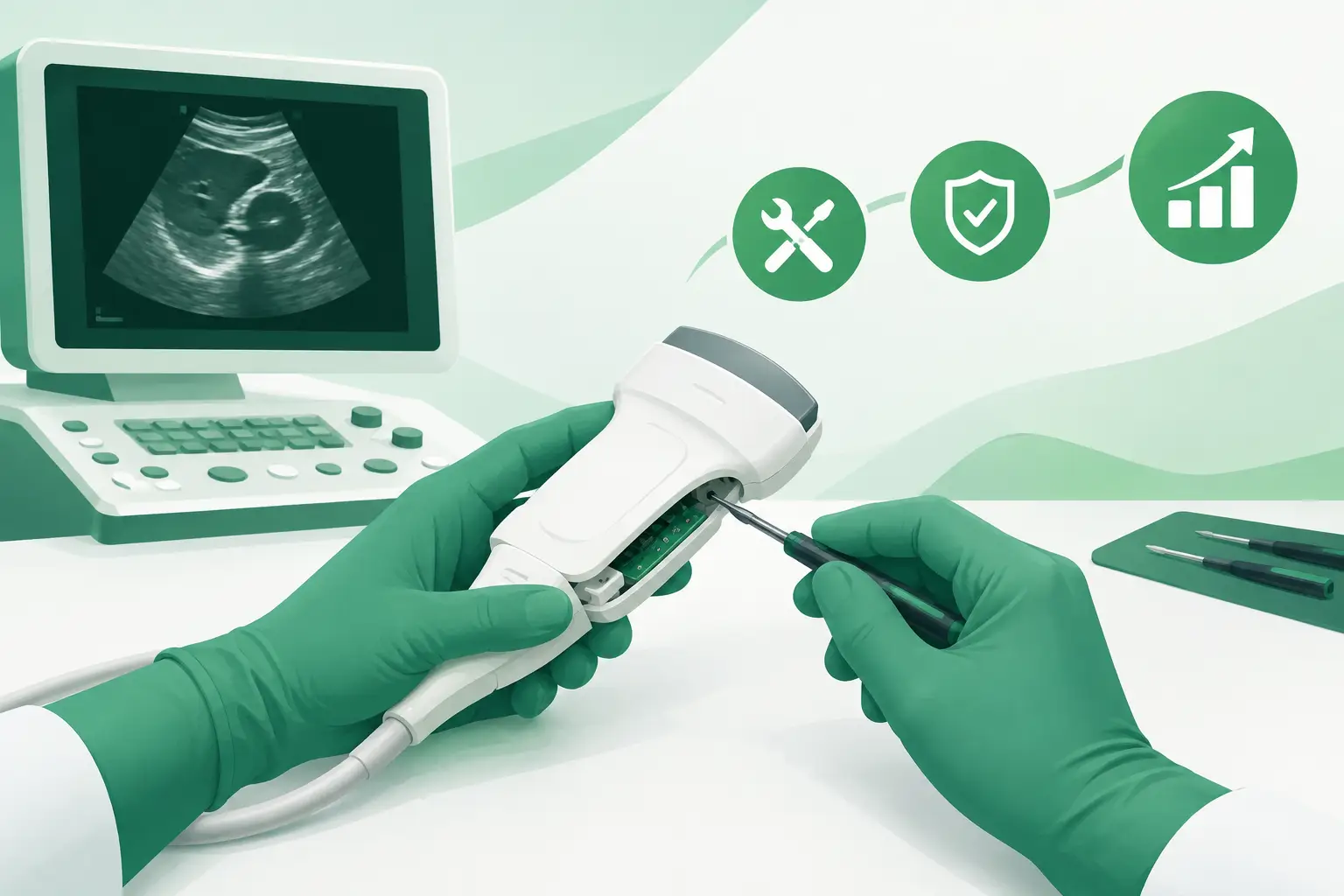
This does not mean repair is no longer viable. Cable damage, damaged strain relief, worn connectors, minor lens issues, and some housing defects can be legitimate repair candidates when a qualified evaluation confirms that array performance and internal electronics remain stable. The trend is that competent repair decisions now rely more heavily on electrical testing, element assessment, image verification, and repeatability checks rather than visual inspection alone.
A second trend is the growing importance of history. A probe that fails only after repeated cable flexing, after a drop, or during a specific exam type tells a different story than one with a permanent dead region across every preset. Technicians are documenting when the artifact occurs, which port is in use, whether another probe behaves normally, and whether the symptom follows the transducer. That information shortens the path to the right repair or replacement decision.
A third trend is stronger demand for exact system and probe identification. A transducer may look similar to another Philips probe yet differ in connector arrangement, system recognition, software support, or intended application. Visual matching is not enough. Confirm the OEM part number from the probe label and verify the EPIQ system revision before sourcing a replacement.
What a Failing Transducer Usually Looks Like
The failure pattern often points to the part of the transducer most likely involved. A stable black band or recurring dropout in the same image region can indicate element-array damage, internal connection failure, or a related acoustic-path issue. If the defect remains in the same portion of the image regardless of scanning technique, it deserves close attention.
Intermittent image loss when the cable is moved is more consistent with cable conductors, shielding, strain relief, or connector-related wear. A probe may pass a quick startup check yet fail during a lengthy exam when cable position changes. This is why a brief visual check should never be the sole basis for clearing a transducer.
Erratic color Doppler behavior, noise, image flicker, or a probe that is intermittently recognized can also involve the connector interface or internal electronics. Those symptoms require careful isolation because a contaminated, worn, or damaged system port can mimic a probe failure. Avoid assuming the transducer is at fault before comparing it with a known-good compatible probe and, where appropriate, checking the suspected probe in a verified compatible system.
Physical findings still matter. Cracked housings, split strain relief, cable kinks, exposed shielding, fluid intrusion, lens damage, and evidence of impact should be documented. External damage does not automatically prove internal failure, but it changes the likelihood that a repair evaluation will uncover additional defects.
Isolate the Fault Before Authorizing Repair
Start with the symptom, not the purchase decision. Record the probe model designation and OEM part number, the EPIQ system model, the software or system revision if available, the affected port, and the clinical behavior observed. A precise description such as “intermittent dropout appears when the cable is flexed near the strain relief” is much more useful than “probe has poor image.”
Then compare behavior methodically. Test a known-good compatible transducer in the same port. If it produces normal images, the original probe becomes the primary suspect. If both probes show similar artifacts, investigate the system port, front-end hardware, configuration, or other parts of the imaging chain before sending the transducer out.
If the suspected probe can be evaluated on another verified compatible system, determine whether the symptom follows it. A fault that follows the probe supports a transducer-level diagnosis. A fault that remains with one scanner port does not. This distinction is especially valuable when an intermittent probe recognition problem could otherwise lead to an unnecessary replacement order.
Document whether the issue occurs on every preset or only in a particular mode. B-mode, color flow, spectral Doppler, and volumetric imaging can place different demands on the probe and scan chain. A mode-specific symptom is diagnostically useful, but it should not be interpreted in isolation. The exact cause depends on the transducer design and the specific EPIQ configuration.
Repair Versus Replacement Is a Reliability Decision
Repair makes sense when the defect is localized and testing indicates that the array and internal functions remain within acceptable performance. A cable or connector repair may return a valuable probe to service without replacing the entire assembly. For a facility with a planned backup probe and a manageable service window, that can be an appropriate operational choice.
Replacement becomes more compelling when the probe has confirmed array failure, recurrent internal faults, extensive fluid damage, or a repair history that suggests the issue is no longer isolated. It can also be the better option when a clinic cannot tolerate uncertainty after a repair because the probe supports a high-volume or time-sensitive exam schedule.
The trade-off is not simply repair cost versus replacement cost. Consider diagnostic confidence, the likelihood of repeat failure, availability of a backup, application coverage, and the consequences of another interruption. A repaired transducer may be the right answer for one failure mode, while an exact-match replacement is the more reliable answer for another.
What to Verify Before Ordering a Replacement Probe
The sourcing trend that matters most is part-number-level confirmation. Before requesting a quote, provide the OEM part number from the transducer label, not only the probe family name. Also provide the Philips EPIQ system model, relevant system revision or software information when available, photos of the label and connector, and a concise description of the failure.
Do not rely on a product photo, connector appearance, or an assumption that every probe in the same family is interchangeable. Compatibility can depend on the exact transducer variant and system configuration. If the original probe has been repaired before or its label is damaged, compare all available identifiers and confirm the part number before proceeding.
For hard-to-find ultrasound probes and other imaging components, Meditegic supports technical buyers through a network covering more than 500,000 part numbers and 600+ suppliers. The practical value is not generic availability. It is the ability to pursue a specific, exact-match component for a system that cannot remain idle while a team searches fragmented channels.
The Direction of Transducer Support
The repair market is becoming more selective, not less useful. Better testing and better failure documentation help distinguish a repairable external or cable-related defect from a deeper array or electronics problem. That distinction helps service teams avoid both premature replacement and false confidence in a repair that does not address the root cause.
When a Philips EPIQ probe shows recurring dropout, intermittent recognition, or image degradation, preserve the evidence, isolate the fault against a known-good probe and port, and confirm the OEM part number before making the next move. Request a quote with the transducer label details, system information, and observed symptom so the replacement search can begin with the correct match.