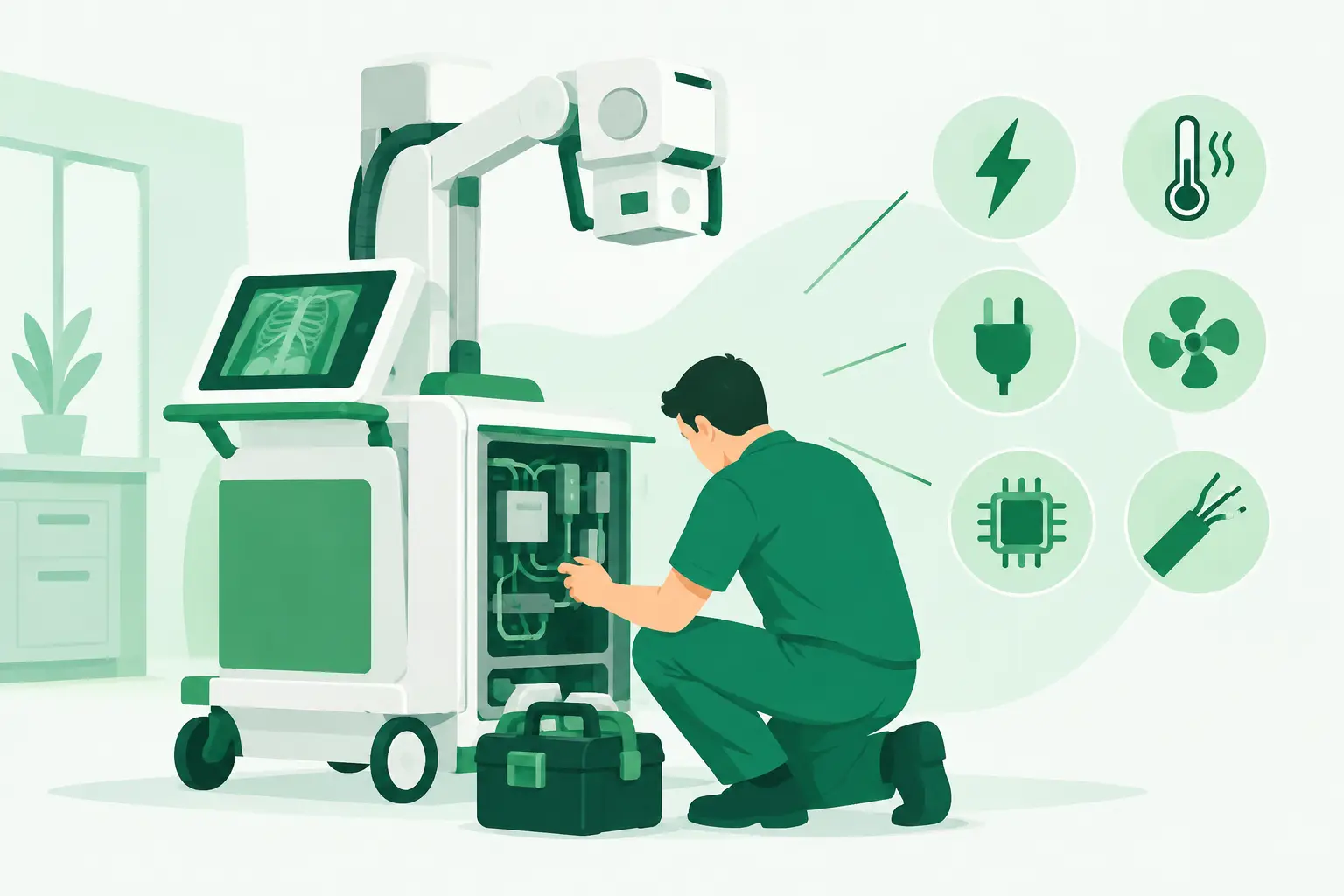
An X-ray generator fault that appears halfway through a mobile radiography round is rarely just a “generator problem.” On a Siemens Mobilett mobile X-ray system, the fault may originate in the high-voltage tank assembly, inverter power stage, generator control PCB, low-voltage power supply, cooling circuit, exposure switch path, or a communication connection between those components. Understanding what causes X-ray generator faults means separating the displayed error from the failed part before an avoidable replacement order extends downtime.
This guide focuses on the generator section of a Siemens Mobilett mobile radiography system, particularly systems where an intermittent exposure failure, generator-ready failure, or repeated shutdown points toward the high-voltage and power-control path. Exact component layout and interchangeability vary by Mobilett generation and configuration. A qualified service engineer should follow the applicable OEM documentation and radiation-safety procedures for all diagnosis and repair work.
What Causes X-Ray Generator Faults in Mobile Systems?
The most common causes fall into four connected areas: unstable incoming or stored power, failed generator electronics, high-voltage insulation or cable problems, and thermal protection events. A fifth category, communication loss, can make a healthy generator appear defective when the console or controller cannot confirm status from the generator assembly.
The key distinction is whether the system fails before exposure preparation, during rotor or prep, at exposure initiation, or only after a sequence of exposures. Timing matters. A unit that will not reach ready state has a different fault path than one that exposes briefly and then shuts down, or one that works cold but faults after repeated portable exams.
Power quality and battery-related faults
Mobile X-ray systems depend on stored energy and controlled charging behavior. Weak batteries, degraded battery connections, charging-circuit faults, and low-voltage supply instability can prevent the generator from completing its startup checks or supporting a requested exposure load. The generator may report a generic fault even though the root cause is upstream of the high-voltage section.
Look for a pattern. If failures occur primarily when the system is operating away from its charger, after a long transport route, or at higher technique selections, investigate the battery and low-voltage power path before condemning a generator module. Voltage drop under load, loose high-current connections, and overheated connectors can produce intermittent symptoms that disappear during a brief bench check.
Inverter, control-board, and power-supply failure
Modern mobile generators use power electronics and control circuitry to regulate exposure output. A failed inverter module, gate-drive circuit, control PCB, or internal power supply can prevent the generator from initializing, inhibit exposure, or trigger protective shutdowns. These failures may be caused by age, component fatigue, prior overheating, contamination, or electrical stress.
A board-level issue often presents as an inconsistent or non-specific fault. The system may boot normally, recognize the tube assembly, and still fail when a generator command is issued. In other cases, it may display communication-related errors because the generator controller no longer responds consistently.
Before replacing a control board or generator module, isolate whether the issue follows the board, the harness, or the system environment. Inspect connectors for pushed-back pins, discoloration, moisture ingress, and damaged locking features. A connector that opens only when the arm is moved or the unit is driven can closely imitate an electronics failure.
High-voltage tank, cable, and insulation breakdown
The high-voltage tank assembly is a critical part of the generator path. It conditions and delivers the voltage required by the X-ray tube circuit, and faults in this area can cause exposure aborts, arc-related events, repeated high-voltage errors, or protective lockouts. Damage may involve insulation degradation, internal component failure, cable deterioration, or connection problems at the tank or tube housing interface.
These faults can be intermittent at first. A system may complete lower-demand exposures but fail under higher output requirements, after warming up, or in high-humidity conditions. That does not automatically prove a high-voltage tank failure. Tube-side problems and generator-side problems can produce similar error behavior, so the service record, fault history, and approved diagnostic tests are essential.
High-voltage circuits require controlled procedures and appropriately qualified personnel. Do not treat a generator error as permission to probe energized high-voltage components. The practical purchasing decision comes after the engineer has established whether the fault is in the tank assembly, the associated cable set, the tube housing interface, or the generator control section.
Thermal faults and cooling-related shutdowns
If the mobile system runs normally at the beginning of the day but fails after a series of exposures, heat is a strong clue. Generator power electronics and high-voltage components rely on cooling paths, thermal sensors, fans, heat sinks, and airflow. A failed cooling fan, blocked ventilation path, loose thermal sensor connection, or degraded heat-transfer interface can trigger protective shutdown before permanent damage occurs.
Technicians should distinguish an actual overtemperature event from a sensor or control fault. If a temperature-related error appears immediately after a cold start, the sensor circuit or control board deserves attention. If the same error follows sustained use and clears only after cooldown, inspect cooling performance and the condition of related components.
Isolating the Fault Without Replacing the Wrong Part
The fastest route to an exact replacement is a disciplined symptom record. Start with the error text or code, but also capture the operating condition: whether the unit was charging or running on battery, the selected technique, the exposure count before failure, ambient conditions, and whether the fault recovers after restart or cooldown.
Next, determine the failure stage. A no-boot condition points first toward system power, low-voltage supplies, and control electronics. Failure to reach ready state may involve interlocks, generator initialization, power availability, or communication. A fault only at exposure initiation directs attention toward the generator command path, inverter section, high-voltage circuit, and tube-related interfaces. Repeated faults after normal operation elevate the probability of a thermal or load-related condition.
Review service history before deciding on repair versus replacement. If the same module has been repaired repeatedly, if there is visible heat damage, or if the component is sealed or not economically repairable in the field, replacement is often the lower-risk option. Conversely, a confirmed damaged harness, connector, cooling fan, or external power component should be addressed before sourcing a high-value generator assembly.
A substitution test using a known-good, approved component can be useful when performed within OEM procedures. It is most valuable when the system fault is repeatable and the suspected module can be safely isolated. Avoid ordering based solely on a similar symptom from a different Mobilett revision. Generator assemblies, power boards, and high-voltage components may look alike while using different firmware, connectors, mounting arrangements, or system interfaces.
What to Verify Before Ordering a Generator Component
For a Mobilett generator-related replacement, the OEM part number is the first requirement. A system model name alone is not enough. Confirm the part number from the component label, service documentation, or approved system records, then verify the system’s exact model and revision.
Also provide the observed fault behavior and any available error information. This helps distinguish a request for a high-voltage tank, inverter module, generator control PCB, power supply, cooling component, or cable assembly. If the part has a revision label, serial reference, or firmware-dependent designation, include it in the quote request. Physical photographs of labels and connectors can prevent an incorrect cross-reference when a legacy system has had prior field modifications.
For discontinued or difficult-to-source imaging components, Meditegic can assist with part-number-level sourcing through a network of 600+ suppliers and 500,000+ part numbers. The objective is not simply to locate a similar component. It is to identify the correct replacement for the installed generator configuration so the system can return to service without creating a new compatibility problem.
A generator fault is costly because it can remove a mobile unit from bedside service with little warning. The best next step is to preserve the fault details, confirm the failed section through qualified diagnostics, and request a quote with the OEM part number, system revision, and photos of the component label.