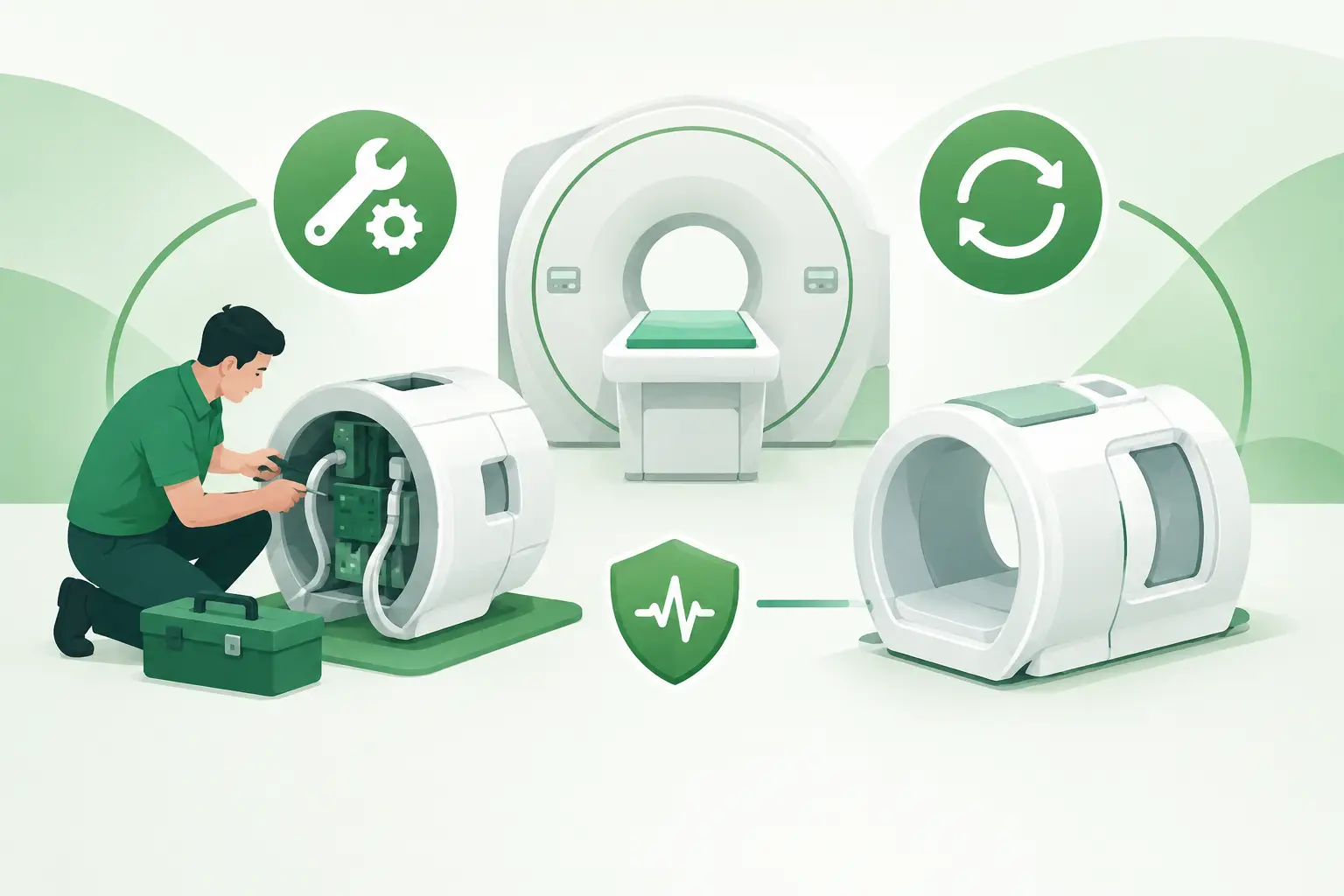
An MRI room can be ready for patients, staffed, and scheduled for a full day, yet remain unproductive because one RF coil is generating artifacts or failing coil identification. Coil repair versus replacement is therefore not a simple purchasing decision. It is an uptime decision that requires a clear diagnosis, verification of compatibility, and an honest assessment of clinical risk.
For biomedical teams, ISOs, and imaging service providers, the right path depends on the failure mode, coil type, system generation, repairability, and the availability of an exact-match replacement. A low-cost repair that returns a coil with intermittent performance can create repeat service calls and lost scan time. Conversely, replacing a repairable coil without checking its condition may add unnecessary cost and delay.
Start With the Failure, Not the Purchase Order
MRI RF coils fail in several ways, and the visible symptom does not always identify the failed component. A system may report a coil connection error, fail to recognize a coil, display low signal-to-noise ratio, show localized shading, or produce recurring artifacts. The source can be a damaged cable, connector pins, strain-relief failure, a failed preamplifier, broken conductor, tuning issue, or fluid intrusion into the coil housing.
Before choosing repair or replacement, document the exact error message, system model, coil model, OEM part number, serial number, and observed image-quality issue. Confirm whether the behavior follows the coil when it is connected to another compatible port or system, where permitted by service procedures. Inspect cable routing, connector condition, locking mechanisms, housing damage, and signs of prior repair.
This step matters because a coil may be blamed when the actual issue is a table-side connector, interface board, or system cable. Ordering a replacement coil without isolating the fault can leave the scanner down with the same original problem.
When Coil Repair Is the Better Option
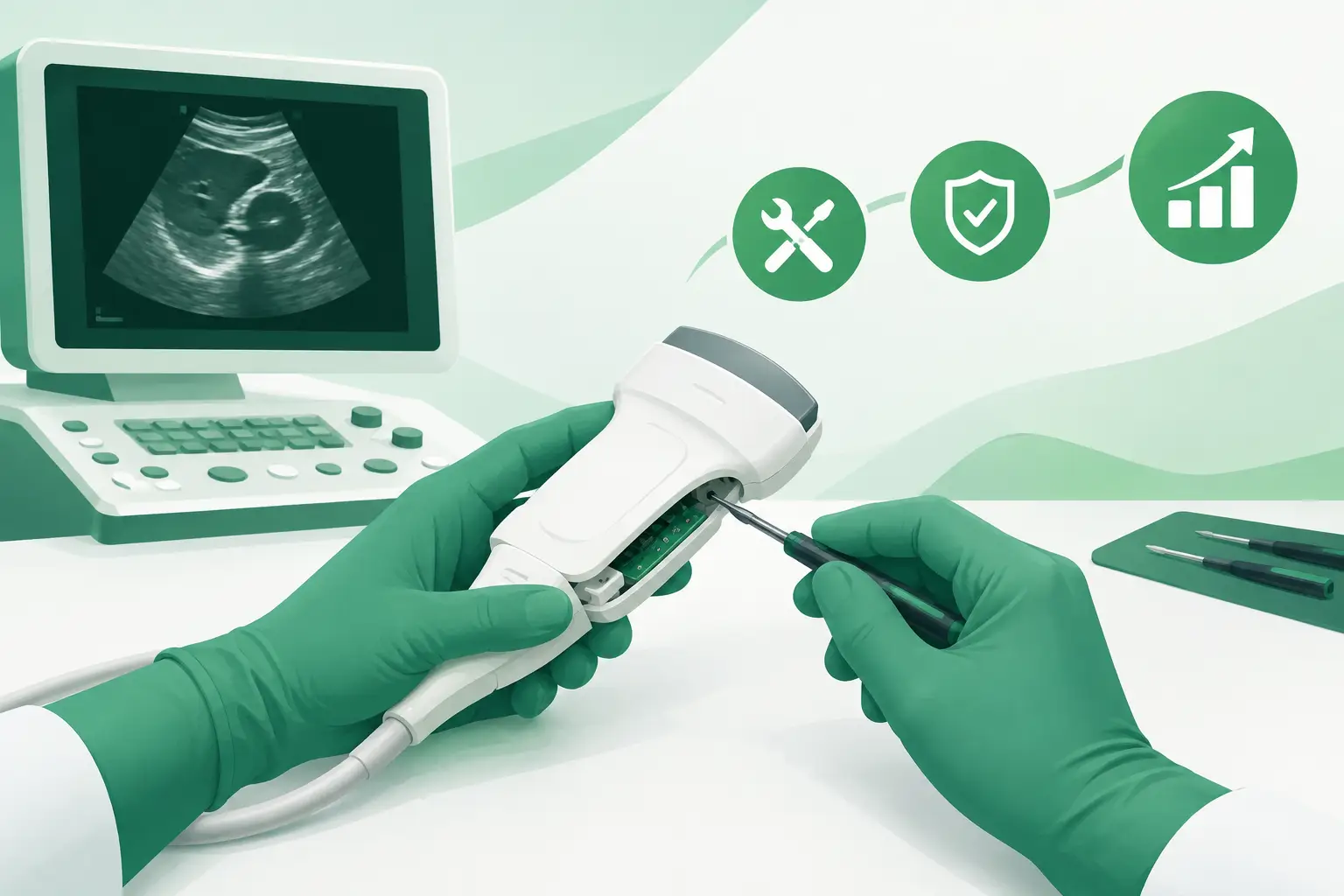
Repair is often a practical option when the fault is localized and the coil remains structurally sound. Common examples include external cable damage, worn strain relief, damaged connector components, and certain enclosure or pad issues. A repair can preserve a hard-to-find coil, particularly for legacy MRI platforms where replacement inventory is limited.
Repair is most defensible when the service provider can identify the defect, verify that the coil can be restored to its required electrical and mechanical condition, and complete functional testing afterward. For a coil used frequently in routine studies, the testing standard should be high. It should include coil recognition, channel operation where applicable, image uniformity, signal performance, and checks for noise or intermittent behavior during normal positioning.
A repair can also make sense when replacement lead time is uncertain. For an older GE, Siemens, Philips, Canon/Toshiba, or Hitachi MRI system, a specific extremity, spine, body, or dedicated application coil may no longer be readily available through standard channels. Restoring the installed coil can protect continuity while a replacement is sourced as a contingency.
Still, repair is not automatically the lower-risk decision. The main trade-off is remaining-life uncertainty. A cable repair on an otherwise well-maintained coil is different from repairing a coil with repeated errors, cracked housing, degraded positioning hardware, or a history of signal problems. Each additional repair can increase the chance that another component becomes the next point of failure.
When MRI Coil Replacement Is the Better Option
Replacement is generally the stronger choice when damage affects the coil's core electrical performance, patient-facing integrity, or long-term reliability. Internal conductor failures, repeated preamplifier issues, extensive fluid damage, severe housing cracks, and multiple prior repairs are warning signs that replacement may be more operationally sound.
Replacement is also preferable when the affected coil is clinically essential and has little backup capacity. A failed head coil, spine array, or high-use body coil can disrupt a large share of scheduled MRI work. In that situation, the relevant cost is not only the acquisition price. It includes canceled exams, rescheduling burden, staff time, patient inconvenience, and the possibility of sending studies elsewhere.
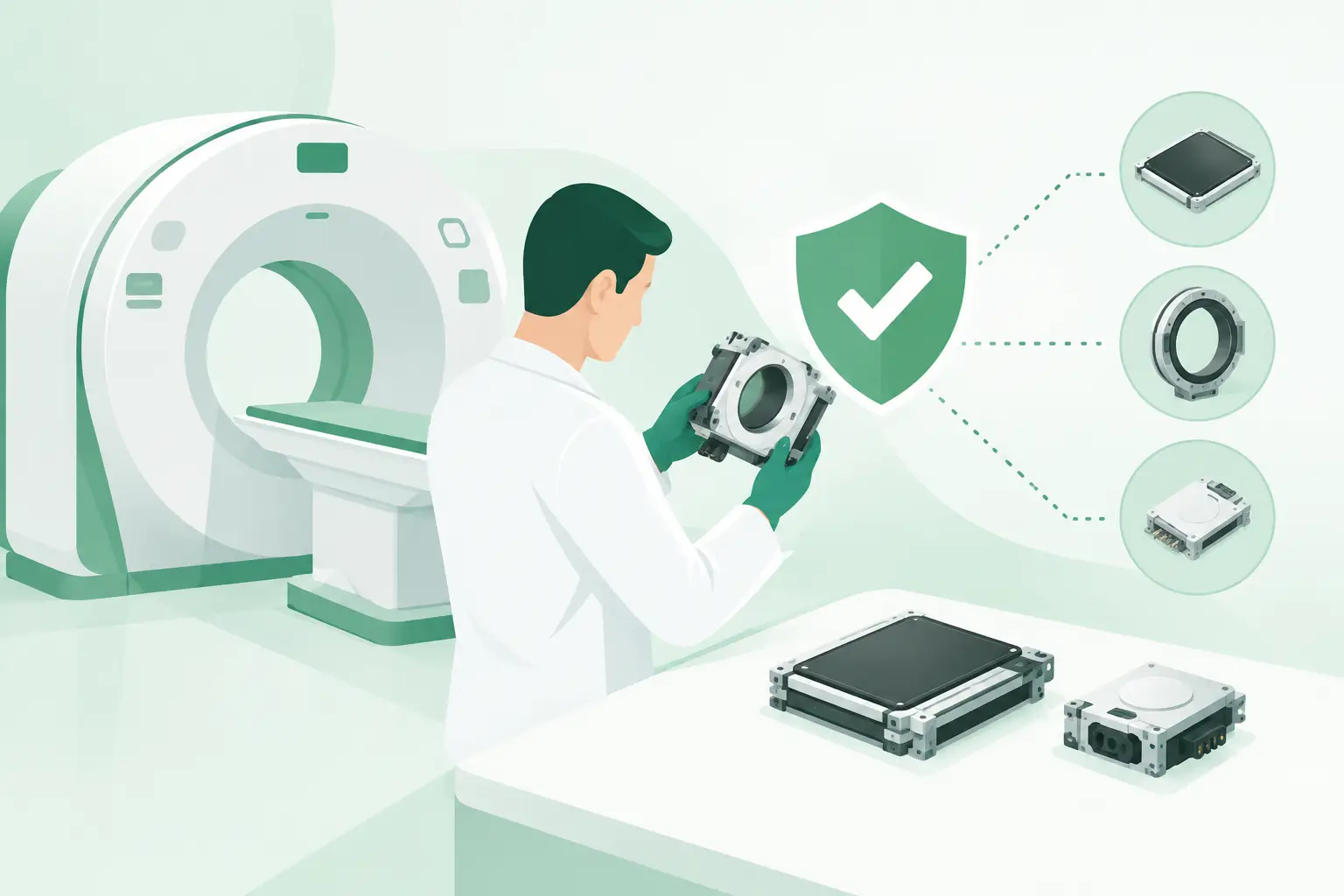
The replacement must be verified at the part-number level. MRI coils are not interchangeable simply because they look similar or share a modality brand. Coil compatibility can depend on scanner family, software generation, connector configuration, channel count, table interface, and application-specific design. A close-looking coil from the same OEM may not be recognized by the system or may not support the intended exam protocol.
For used or refurbished replacement coils, ask for confirmation of the OEM part number, compatible system model, condition, functional test status, and included components. A coil assembly may require specific pads, cables, adapters, or positioning accessories to return to clinical use. Missing components can turn an urgent replacement into another delay.
A Practical Coil Repair Versus Replacement Decision Framework
The decision becomes easier when technical and operational factors are evaluated together rather than in isolation. Start with the severity and location of the fault. External and isolated damage favors repair. Internal, recurring, or multi-component failures favor replacement.
Next, consider clinical dependency. If the coil supports a high-volume exam category and no equivalent backup is available, prioritize the option with the greatest confidence in near-term uptime. That may be a tested replacement even when repair appears less expensive on paper.
Then assess remaining service life. A coil with one clear fault and no history of instability may justify repair. A coil that has failed repeatedly, has visible wear across several areas, or has degraded image performance should be evaluated as an end-of-life risk. A replacement can reduce repeat intervention and provide a more predictable operating position.
Finally, compare actual lead times. A repair shop may quote a short turnaround but require shipping, assessment, approval, repair, testing, and return transport. A compatible replacement may be available immediately but require sourcing from another region. The fastest realistic route depends on the exact coil and the supplier's ability to validate part-number compatibility before shipment.
Cost Should Include Downtime Exposure
Purchase price alone is a weak basis for deciding between repair and replacement. A lower repair quote may be appropriate for a noncritical coil with an isolated fault and an available backup. It is less persuasive when the coil supports daily clinical workload and the repair outcome is uncertain.
Calculate the likely total exposure: service labor, shipping, diagnostic time, the cost of a temporary workaround, potential repeat failure, and revenue or care disruption from unavailable scan capacity. For many imaging providers, avoiding a second outage has greater value than saving a modest amount on the first transaction.
There is also a procurement advantage to having a defined backup strategy. Facilities operating legacy MRI systems should identify their highest-risk coils and record complete part-number information before a failure occurs. This gives the service team a faster path to request exact-match options, rather than trying to identify a coil from photographs during an active outage.
Sourcing an Exact-Match Replacement Coil
When replacement is selected, provide as much technical information as possible at the outset. The minimum should include the OEM part number, coil description, MRI system model, scanner serial number if available, error details, and photographs of the connector and identification labels. For specialized coils, include the intended application and any known configuration details.
A specialized imaging-parts supplier can use that information to cross-reference compatible inventory and global supplier sources. Meditegic supports this type of part-number-level sourcing across current and legacy diagnostic imaging platforms, including difficult-to-find MRI RF coils and related components.
Avoid substituting based on appearance, incomplete descriptions, or a generic coil category alone. The right replacement is the one that matches the system's technical requirements and can be verified before it reaches the site. That discipline reduces return shipments, repeat troubleshooting, and avoidable scanner downtime.
The best decision is the one that returns the MRI system to dependable clinical operation with the least risk of another interruption. Repair a coil when the failure is contained, testable, and likely to deliver reliable remaining life. Replace it when the defect, condition, or clinical dependency makes uncertainty more expensive than the part itself.