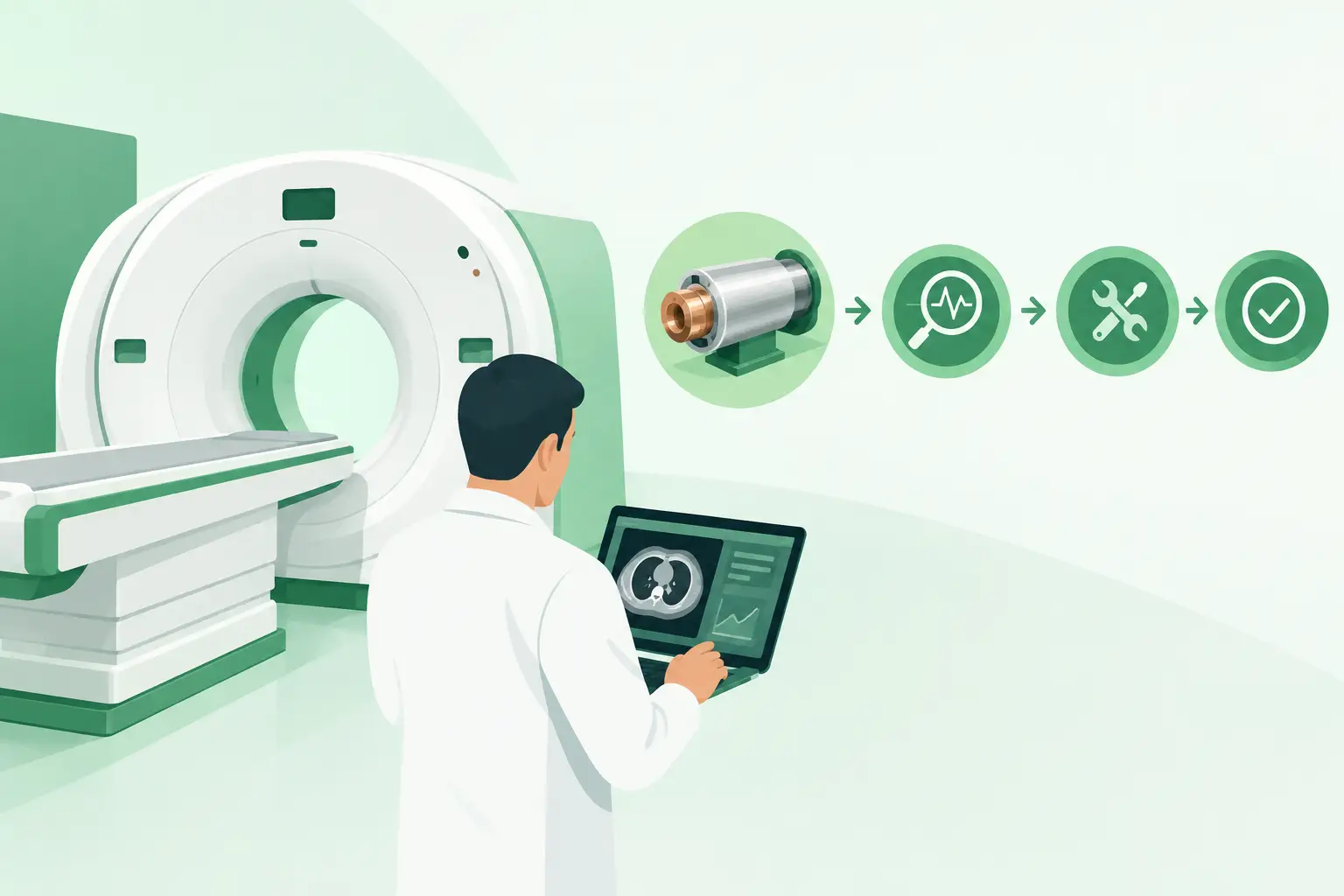
A CT detector failure can take a productive scanner out of service with little warning. The real challenge is rarely finding a listing that appears close. A useful CT detector supplier review determines whether the supplier can identify the exact detector component, document its condition, protect it in transit, and provide a clear path from request to installation.
For an ISO, clinical engineering team, or imaging equipment refurbisher, the right decision protects more than a repair budget. It protects scheduled patient exams, service response commitments, and the remaining useful life of a high-value CT platform. That requires evaluating suppliers on technical evidence rather than a short description and an attractive price.
What a CT Detector Supplier Review Should Measure
CT detectors are not generic replacement items. Detector modules, detector arrays, data acquisition-related components, flex assemblies, and associated electronics can differ by system generation, configuration, scan architecture, and OEM revision. A component that looks identical can still be electrically incompatible or unsuitable for the installed scanner.
Start a supplier review with identification accuracy. The supplier should work from the OEM part number whenever possible, then confirm the scanner manufacturer, model, system configuration, and the exact component being replaced. For a GE Healthcare, Siemens Healthineers, Philips, or Canon/Toshiba CT system, a valid cross-reference needs to account for the specific platform and revision, not simply the OEM name.
A supplier that asks for photographs of labels, board markings, or the removed part is not necessarily creating delay. In many cases, those details prevent a costly mismatch. This matters especially on older CT systems, where documentation may be incomplete and prior service activity may have introduced a later revision into the unit.
The next measure is condition transparency. Used and refurbished detector-related parts can be practical options, but the terms must mean something. Ask whether the item is pulled from a working system, inspected, repaired, or functionally tested. If a component was repaired, determine what work was performed and whether related connectors, boards, or mechanical interfaces were evaluated.
Condition should not be reduced to a single label. A reliable quotation identifies the part number, stated condition, availability status, and what testing or inspection information is available. Where functional bench testing is limited by the need for a complete system interface, the supplier should say so directly rather than imply a level of verification that did not occur.
Part-Number Accuracy Comes Before Price
A low purchase price loses its value quickly if the part cannot be installed. Detector sourcing is particularly sensitive because return shipping, repeat labor, scanner downtime, and rescheduled examinations can exceed the difference between two supplier quotes.
Before approving an order, provide the supplier with the strongest identifiers available: the OEM part number, system model, serial number where relevant, photographs of labels, and a description of the fault. An error code, artifact pattern, or service finding can help distinguish a detector issue from a problem in the DAS, power supply, cooling circuit, gantry cabling, or control electronics.
The supplier should also distinguish between an exact-match part and a possible alternative. An alternative may be appropriate when an obsolete component has a verified supersession or when an experienced service provider has confirmed interchangeability. It should not be presented as an exact replacement without evidence.
This is where a specialized imaging-parts source has an advantage over a general electronics reseller. CT equipment uses OEM-specific assemblies whose interchangeability depends on engineering details that do not show up in generic marketplace descriptions. Part-number-level sourcing reduces ambiguity before the part leaves the supplier.
Questions That Expose Sourcing Quality
A concise technical conversation often reveals more than a catalog page. Ask whether the quoted unit carries the exact requested part number or a documented cross-reference. Ask where the part is physically located, whether it is in stock or being sourced, and whether photos of the actual item can be provided.
Also ask what happens if the component is found to be incorrect on arrival. The answer should define the process for reporting an issue, the information needed for review, and the time window for notifying the supplier. Clear terms do not eliminate technical risk, but they make the response predictable when time is limited.
Evaluate Testing in the Context of the Part
Testing expectations should match the component. A detector module or assembly may require a compatible host system and calibration process for full operational verification. Not every supplier has every CT platform available for live testing, particularly for discontinued systems. That limitation is reasonable if it is disclosed.
What matters is whether the supplier can describe the checks that were completed. These may include visual inspection for physical damage, connector and pin condition, label verification, source-system history, or bench-level assessment where applicable. For a refurbished component, request a clear statement of the repair scope and post-repair checks.
Be cautious with broad claims such as “tested working” when no test method is described. That phrase may still be acceptable when backed by a known source history and a responsive warranty process, but it should prompt further questions for a detector-related repair. The more critical the component and the more remote the installation site, the more value there is in detailed evidence before shipment.
Testing is only one part of suitability. A detector can arrive in working condition yet fail to resolve the issue if the root cause was elsewhere. A capable supplier recognizes this distinction and does not diagnose a complex CT fault solely from a parts request. Service documentation and fault isolation remain essential before ordering.
Shipping, Packaging, and Lead Time Are Technical Requirements
Detector assemblies and associated electronics require more than ordinary parcel handling. Packaging should protect sensitive connectors, boards, and mechanical surfaces from impact, vibration, moisture, and electrostatic exposure where applicable. Ask how the item will be packed and whether the shipment will include clear part identification for receiving inspection.
For international orders, shipping competence also includes documentation accuracy. A delayed shipment can extend downtime just as surely as an unavailable part. Buyers operating across multiple regions should confirm the pickup location, estimated dispatch timing, carrier options, and any information required to support customs clearance.
Lead time should be stated in practical terms. “Available” can mean physically on a shelf, held by a partner supplier, or expected after removal from a system. These are different risk levels. A transparent supplier separates stock status from estimated transit time and avoids treating a sourcing lead as confirmed inventory.
When the scanner is already down, share the urgency at the start. The supplier may be able to prioritize identification, verify alternate inventory, or propose an expedited shipping method. Fast communication is valuable, but it should not replace confirmation that the part is correct.
Consider the Supplier’s Range Beyond One Detector Listing
A CT repair can uncover related requirements. A detector problem may involve gantry cables, power supplies, cooling components, control boards, collimators, table parts, or workstation hardware. A supplier with access to a broad CT spare-parts network can help consolidate the search when the fault investigation evolves.
This does not mean every component should be purchased from one source. For a common item already stocked by a trusted local vendor, local availability may be the better operational choice. The value of a specialized supplier becomes clearer when the requested part is discontinued, difficult to identify, needed for a legacy scanner, or unavailable through standard channels.
Meditegic supports this type of requirement by sourcing exact-match diagnostic imaging spares across major CT OEM environments, including hard-to-find detector-related parts and associated assemblies. For buyers, the practical benefit is a technical sourcing conversation centered on the requested part number, rather than a generic product search.
Make the Purchase Decision on Total Downtime Risk
A disciplined CT detector supplier review weighs four connected factors: identification confidence, condition and test evidence, fulfillment reliability, and issue-resolution terms. No supplier can remove every risk from used or legacy imaging parts. The goal is to make the remaining risk visible before the purchase order is released.
Keep a record of the installed part number, supplier documentation, photos, packaging condition, and service findings after installation. Over time, that record becomes a useful reference for repeat repairs and helps your team identify suppliers that consistently provide accurate parts and dependable support.
When a CT system is waiting on a detector-related component, the best supplier is not simply the one that responds first. It is the one that can give your technical team enough verified information to act with confidence.