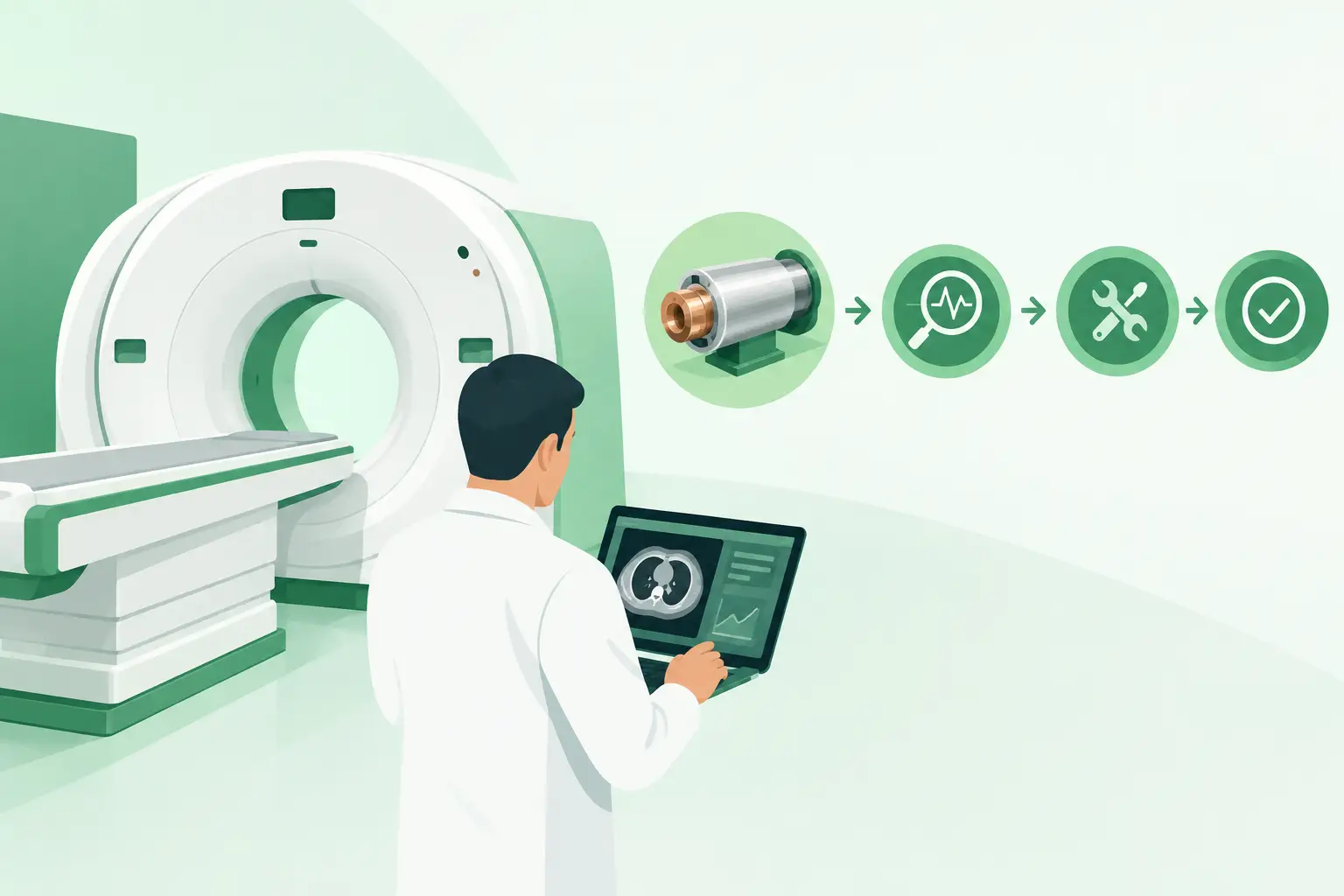
A CT scanner can be fully operational in the morning and unavailable by afternoon because of one failed gantry assembly. CT gantry components operate under constant rotational, thermal, electrical, and mechanical stress, so a fault in a board, drive element, cooling circuit, or interconnect can stop patient scanning immediately. For service teams, the priority is not simply finding a part with a familiar description. It is confirming the exact component configuration required by the installed system.
What CT Gantry Components Do
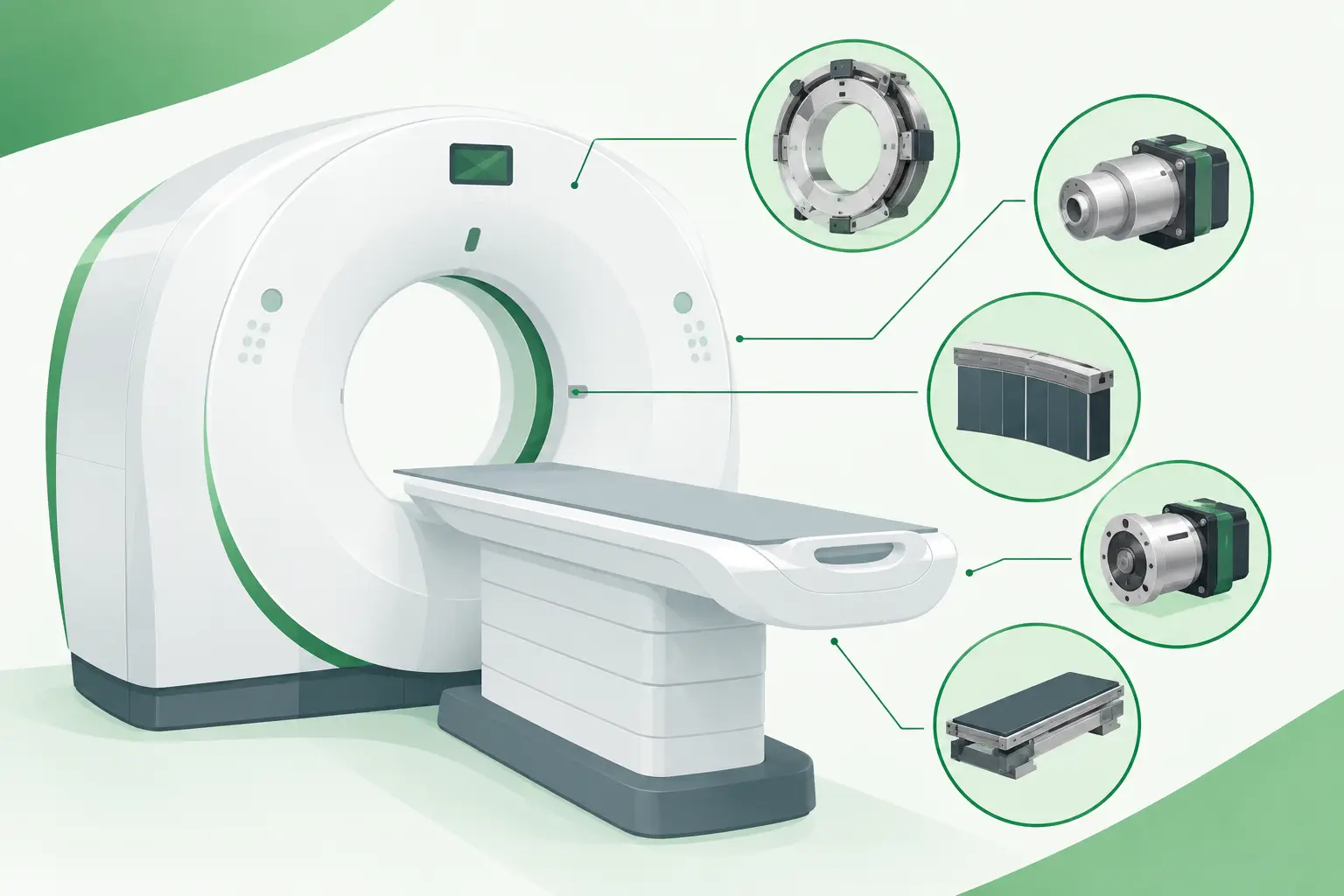
The gantry is the rotating imaging structure that houses and supports critical CT subsystems. Depending on scanner design, it contains the X-ray tube and tube housing, detector assembly, collimation hardware, high-voltage distribution elements, slip ring interfaces, cooling equipment, motion-control hardware, sensors, and electronic control boards. These assemblies must work in precise synchronization while the system performs high-speed rotation and image acquisition.
A gantry issue can present as a hard system fault, an intermittent error, abnormal noise during rotation, tube overheating, loss of communication, or an inability to complete calibration. The reported symptom matters, but it does not always identify the failed item. A rotation fault, for example, may originate in a motor-related component, encoder, drive board, cable path, power circuit, safety interlock, or gantry control assembly.
That is why technical buyers should treat the gantry as an integrated subsystem rather than a collection of interchangeable mechanical parts. A component that appears similar across two scanner families may have different firmware, connector layouts, cooling requirements, revisions, or calibration dependencies.
Core CT Gantry Component Categories
X-ray tube support, cooling, and high-voltage assemblies
The X-ray tube is one of the most closely monitored gantry items, but its supporting assemblies can be just as decisive for uptime. Tube housings, high-voltage tanks, cable assemblies, cooling pumps, heat exchangers, fans, filters, and fluid-management components all contribute to stable tube operation.
A cooling-related fault should not automatically be attributed to the tube. Low coolant flow, a failed pump, a leaking line, a defective temperature sensor, or reduced fan performance can trigger thermal protections and interrupt scanning. Before ordering, verify the system error history, operating condition, component part number, and whether the failed assembly is separate from or integrated with another module.
High-voltage components require the same discipline. Ratings, cable terminations, insulation design, and OEM-specific interfaces must match the installed platform. Substituting a visually similar high-voltage assembly without confirming compatibility can create further faults or introduce a safety risk.
Rotation and positioning hardware
CT gantry rotation depends on a coordinated set of mechanical and electronic components. Depending on the platform, this may include bearings, drive motors, belts, gears, rotary couplings, encoders, brakes, position sensors, and related mounting hardware. Wear in these parts can appear gradually through vibration, increased rotational noise, speed instability, or repeatable gantry positioning errors.
Mechanical symptoms still require a system-level diagnosis. A noisy gantry may indicate bearing wear, but it can also result from a drive-control problem or an imbalance associated with another installed assembly. When sourcing a replacement, document whether the item is supplied as a discrete part, an exchangeable assembly, or part of a larger gantry module. This distinction affects installation planning, labor requirements, and the availability of compatible spares.
Slip rings, power distribution, and electrical interconnects
The slip ring allows electrical power, signals, and in some configurations data pathways to pass between stationary and rotating sections. Associated parts may include contact assemblies, power distribution modules, harnesses, connectors, grounding components, and interface boards.
Intermittent gantry faults often lead technicians to inspect these areas because motion can expose weak connections or worn contact surfaces. However, troubleshooting should be evidence-based. Error codes, service documentation, measured voltages, connector inspections, and fault recurrence patterns help differentiate an interconnect failure from an upstream power or control issue.
For replacement sourcing, the OEM part number and revision are essential. Cable lengths, pinouts, shielding, connector keying, and board-level revisions are not details to infer from photographs alone. A correct match protects both the repair timeline and the integrity of the installed system.
Detector, collimation, and acquisition-related assemblies
The detector and collimation systems are central to image acquisition and dose control. Gantry-related spares in this area can include detector modules, detector electronics, preamplifier boards, collimator components, shutters, actuator assemblies, and related sensors or cabling.
These parts demand careful compatibility review because scanner generation, slice configuration, software level, and gantry architecture can affect interchangeability. Even where an assembly uses a similar external form factor, its internal configuration may be specific to a particular system variant.
A replacement detector-related component may also require calibration, alignment, or service-level testing after installation. Procurement and service teams should account for that work before selecting a part. The fastest sourced component is not necessarily the fastest return to service if required post-install procedures are overlooked.
Gantry control boards and safety circuits
Control boards coordinate rotation, thermal management, sensor feedback, interlocks, and communications between the gantry and the rest of the CT system. Commonly sourced items include gantry controller boards, motor drive boards, power supply boards, interface PCBs, sensor boards, and safety or emergency-stop assemblies.
Board sourcing requires more than matching a board description. Confirm the exact manufacturer part number, assembly number, revision, and any programmed or configuration-specific identifiers shown on the label. A later revision may be compatible, but that determination should come from documented cross-reference information or qualified technical review, not assumption.
Where a failure is intermittent, preserve the fault data before removing the existing board. This helps prevent an unnecessary replacement when the root cause is a harness issue, marginal power supply, environmental condition, or another connected assembly.
How to Identify the Right Replacement Part
The most effective request begins with information that allows a supplier to distinguish an exact match from a close but unsuitable alternative. Provide the CT manufacturer, system model, serial number when available, the component's complete OEM part number, all label photographs, and the board or assembly revision. Include the observed fault, relevant error codes, and whether the item is already diagnosed as failed.
The old part's physical condition matters as well. Burn marks, coolant residue, damaged connectors, worn mechanical surfaces, or missing subcomponents can change the evaluation. For assemblies with multiple attached cables, sensors, or brackets, clarify whether those items are needed with the replacement or will be retained from the original installation.
This information reduces back-and-forth and improves sourcing accuracy, particularly for legacy CT platforms where labels may be faded and OEM documentation may use several identifiers for related assemblies. A part-number-level search is more reliable than a generic request for a “gantry board” or “rotation part.”
Used, Refurbished, and Select New Spares: Practical Trade-Offs
The appropriate condition depends on the part type, failure urgency, installed system age, service capability, and available inventory. A used component with verified identity may be the practical answer when an older platform is down and OEM support is limited. A refurbished assembly can be appropriate when a component benefits from inspection, repair, or functional testing before reuse. Select new spare parts may be available for certain items, but availability varies by OEM, model, and part status.
Condition labels alone do not establish suitability. Buyers should confirm what is included, the exact part number, revision compatibility, testing or inspection status where applicable, lead time, and return or warranty terms. For high-value gantry assemblies, it is also sensible to confirm packaging and transport requirements. Sensitive boards, heavy mechanical parts, and coolant-related assemblies require different handling to arrive ready for installation.
Planning for Less Gantry Downtime
Gantry repairs become less disruptive when critical parts are identified before failure. Service organizations supporting multiple sites can review repeat-failure history, scanner age, and lead-time exposure to determine which assemblies warrant advance sourcing attention. This does not mean stocking every possible item. It means recognizing which exact-match parts would create the longest outage if they failed unexpectedly.
For single-site clinics and smaller imaging operations, detailed equipment records are equally valuable. Maintain the CT model, serial number, installed options, major gantry assembly part numbers, and prior service history in one accessible record. When a failure occurs, that information speeds technical verification and quotation.
Meditegic supports imaging service teams and clinical engineering departments by locating difficult CT gantry components across major OEM platforms, including legacy configurations where standard channels may have limited availability. The most useful first step is simple: capture the full label data before the failed part leaves the site. That one record can turn a broad emergency search into a precise replacement request and shorten the path back to scanning.