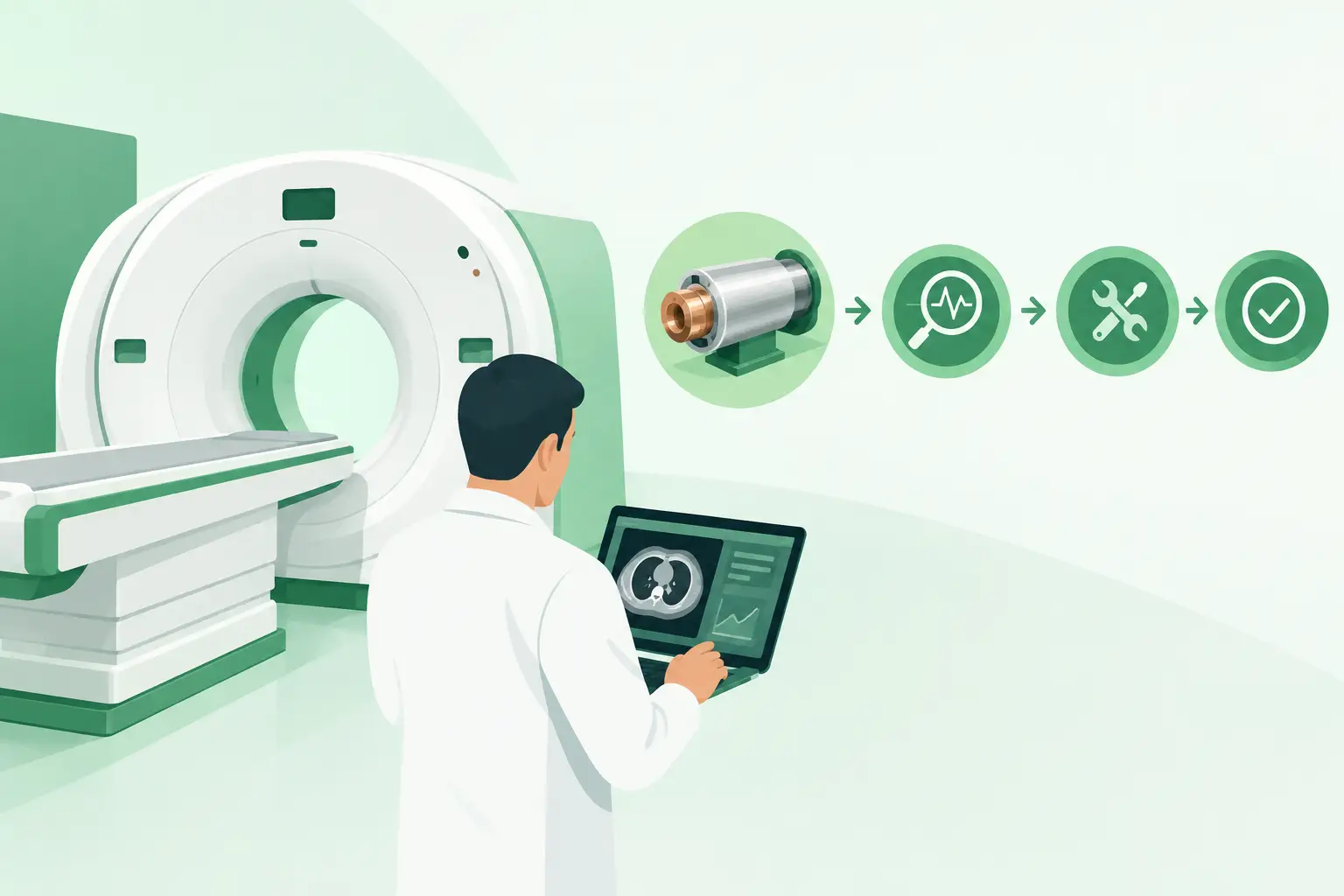
A useful imaging parts vendor review starts long before a purchase order is issued. When a CT gantry is down, an ultrasound probe has failed, or a legacy C-arm needs a control board that the OEM no longer supports, the question is not simply whether a vendor can quote a part. The question is whether that supplier can identify the exact required configuration, verify its condition, and move it through the process without creating a second service event.
For biomedical departments, independent service organizations, and imaging repair professionals, the cost of a wrong part is larger than the invoice value. It can mean repeat shipping, additional technician time, missed scans, delayed patient scheduling, and lost confidence in the service process. A vendor review should therefore measure sourcing accuracy and operational reliability, not just price and stated availability.
Start With Part-Number-Level Accuracy
Diagnostic imaging components are rarely interchangeable simply because they look alike or share a family name. A GE Healthcare detector, Siemens Healthineers power supply, Philips workstation board, or Canon/Toshiba tube housing may have revisions, software dependencies, connector differences, or system-specific configurations that matter in the field.
A qualified vendor should ask for the OEM part number whenever it is available. For assemblies, the vendor may also need the system model, serial range, revision level, photographs of labels, and a description of the fault. That level of questioning is not unnecessary friction. It is how a sourcing partner separates an exact-match request from a broad product search.
Be cautious when a supplier responds with a generic description only, such as “MRI coil,” “X-ray detector,” or “ultrasound probe,” without confirming the part number and compatibility basis. Generic naming can be useful for an initial inquiry, but it is not sufficient for approving a replacement part on a high-value imaging system.
Ask What the Match Is Based On
The strongest answer is specific: an exact OEM part-number match, a documented supersession, or a verified compatible alternative with clear technical rationale. These are not the same thing. An exact match usually presents the lowest integration risk. A superseded part can be acceptable when its intended use is established. A compatible alternative may solve an urgent problem, but it deserves a more detailed review of connectors, firmware, calibration requirements, and return options.
For hard-to-find components, the best vendor may not have the part physically on a shelf at the moment of inquiry. What matters is whether the vendor has a credible route to source it through established inventory channels and can explain the expected lead time honestly.
Evaluate Condition Labels Beyond “Used” or “Refurbished”
Condition terminology can be imprecise unless the supplier defines it. Used, tested, refurbished, repaired, and as-is each represent materially different risk profiles. A proper imaging parts vendor review should establish what happened to the component before it is offered for sale.
For example, a used board may have been removed from a working system and visually inspected, but not functionally tested under load. A refurbished power supply may have undergone fault isolation, component replacement, bench testing, and final inspection. A repaired ultrasound transducer may have had a cable or housing issue corrected, while its acoustic performance still requires verification. The label is less useful than the process behind it.
Ask the vendor to state the condition in practical terms: whether the part was tested, how it was tested, whether it was repaired, and whether any known limitations remain. The appropriate level of evidence depends on the part type. A cosmetic inspection may be reasonable for a non-critical cover or table trim component. It is not enough for a high-voltage tank, flat-panel detector, MRI RF coil, image intensifier, or critical control board.
Testing also has limits. A supplier may be able to test a component only in a compatible system environment, on a bench fixture, or through electrical verification. Each method provides different assurance. A credible vendor should explain the available test method rather than imply that every part has received identical validation.
Measure the Vendor’s Ability to Handle Legacy Equipment
The vendor that is excellent at current-production parts is not automatically equipped to support end-of-life imaging platforms. Legacy systems introduce additional complexity: documentation may be incomplete, part numbers may have changed, donor equipment may be scarce, and condition can vary substantially across available inventory.
Review the supplier’s modality and OEM depth. A capable imaging-parts source should be comfortable working across CT and PET/CT, MRI, nuclear medicine and SPECT, C-arm and fluoroscopy, X-ray, ultrasound, mammography, CR/DR, and DEXA. More importantly, it should understand the component categories within those systems, including detectors, X-ray tubes and tube housings, gradient components, RF coils, collimators, cooling assemblies, PCBs, consoles, and power supplies.
Breadth matters because many uptime events do not follow a predictable purchasing pattern. A service company may need a Philips imaging board one week and a Hologic mammography component the next. Working with a technically specialized source can reduce the time spent opening new vendor accounts and explaining the same compatibility requirements repeatedly.
Meditegic supports this type of requirement by sourcing used, refurbished, and select new imaging spares at the OEM part-number level across major modalities and legacy brands. For urgent requests, that specialization is more relevant than a broad catalog of unrelated medical products.
Review Response Quality, Not Just Response Speed
Fast quoting is valuable, especially when an imaging room is out of service. But a quote issued in minutes is only helpful if it identifies the correct item, condition, quantity, price, availability status, and expected dispatch timing.
A strong vendor response distinguishes between stock that is on hand, stock held by a qualified source, and stock that is being located. It should not present every lead as immediately available. Clear status information allows the buyer to decide whether to wait, repair the existing component, source an alternative, or escalate the service plan.
Pay attention to how the vendor handles incomplete information. Technical buyers do not always have a clean part number at the beginning of a breakdown. A useful supplier helps narrow the request through equipment model details, photographs, board identifiers, and cross-reference research. A supplier that simply declines any request lacking a perfect part number may be easy to transact with when information is complete, but less useful during a real field emergency.
Check Documentation, Packaging, and Return Terms
The purchasing process does not end when a part is located. For sensitive imaging components, shipping preparation and commercial clarity affect whether the replacement arrives usable.
Ask how electrostatic-sensitive boards, detectors, coils, and probes are packaged. Confirm whether fragile components receive appropriate protection and whether the shipment can be tracked through international transit when necessary. For global buyers, export paperwork and responsive communication can be as important as warehouse location, particularly in regions with limited OEM support.
Return and warranty terms deserve the same attention as price. The key question is not whether a policy exists, but what happens if the delivered item does not match the confirmed part number, arrives damaged, or fails within the stated coverage period. Terms should be understandable before the order is placed, especially for special-order or scarce parts that may carry different return conditions.
Use a Risk-Based Imaging Parts Vendor Review
Not every part requires the same approval process. A low-risk mechanical accessory and a high-value MRI component should not be evaluated with identical documentation requirements. The practical approach is to scale review depth to the consequence of failure.
For a lower-risk item, part-number confirmation, condition disclosure, price, and shipment timing may be enough. For critical electronics, high-voltage components, detectors, RF coils, or components that require difficult installation, add testing details, photographs where practical, serial or revision confirmation, packaging requirements, warranty coverage, and a clear escalation contact.
This approach prevents two common errors: overprocessing routine purchases and underreviewing mission-critical ones. It also gives technicians and procurement teams a repeatable standard when a request is urgent.
The Best Vendor Is the One That Reduces Repeat Work
A reliable imaging-parts supplier does more than locate inventory. It reduces uncertainty at the point where a system outage can become expensive: identifying the right component, setting accurate expectations about condition and availability, and supporting the transaction through delivery.
When reviewing a vendor, look for technical specificity, transparent condition reporting, realistic lead times, and evidence that the supplier understands the modality involved. The right sourcing partner will not make every difficult part easy to find. It will make the process of finding, verifying, and receiving that part far more controlled when uptime is on the line.