An X-ray room, MRI suite, or ultrasound service call can remain at a standstill over a component that looks ordinary on paper: a power supply, PCB, detector interface, cooling assembly, or probe. OEM part matching is the process that determines whether the replacement will actually work in that specific system configuration, revision, and modality - not merely whether it shares a similar description.
For clinical engineering teams, ISOs, and imaging refurbishers, an incorrect match creates more than a return shipment. It can extend downtime, consume technician hours, introduce calibration problems, and delay patient scheduling. Exact identification is therefore a technical sourcing task, not a catalog search.
What OEM Part Matching Actually Confirms
A valid match begins with the OEM part number, but it should not end there. Manufacturers often use closely related part numbers across product generations, software revisions, regional variants, or subsystem configurations. A component may fit physically while carrying different firmware, connector pinouts, voltage requirements, cooling specifications, or communication protocols.
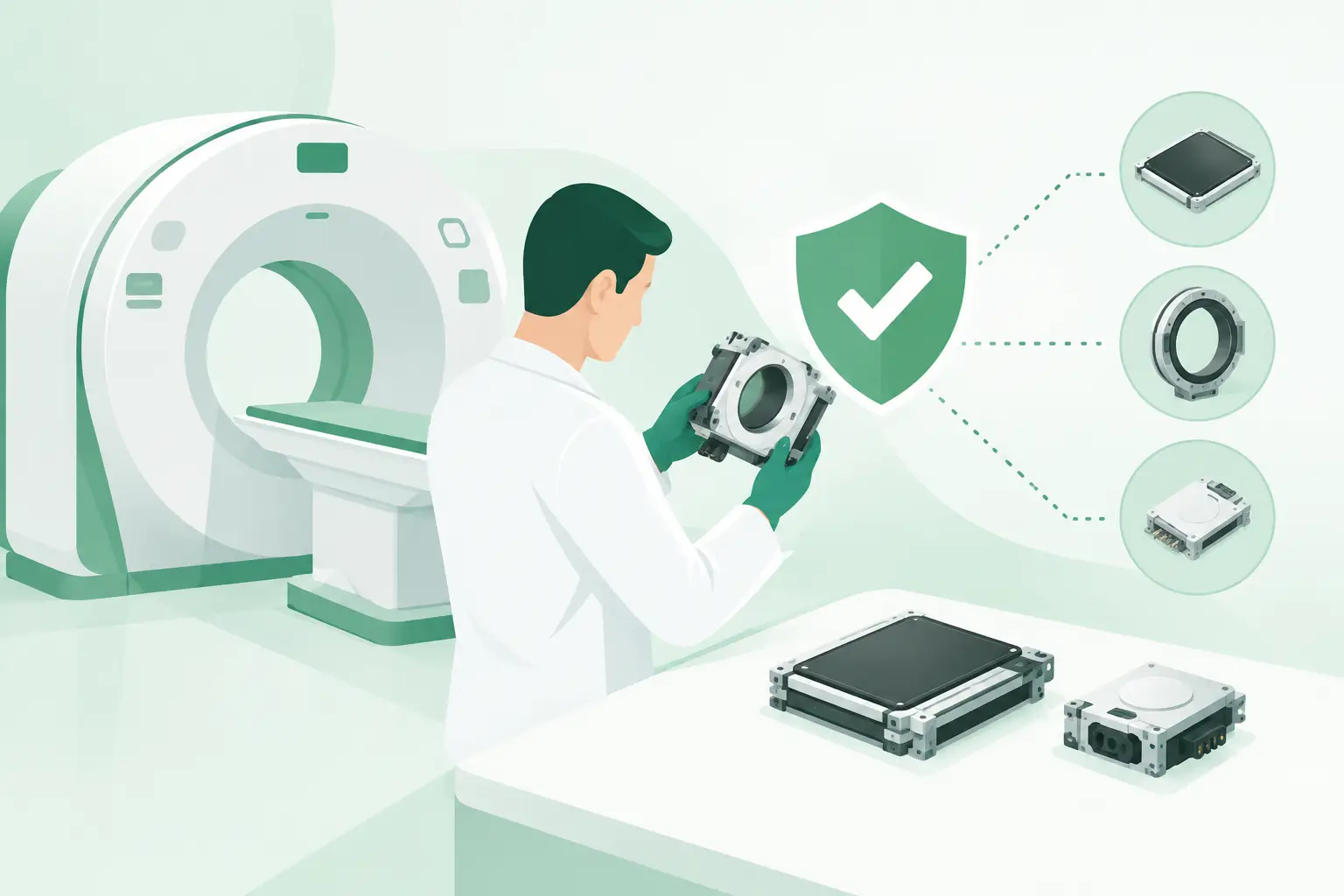
For example, two flat-panel detector assemblies may be associated with the same family of digital radiography systems but require different acquisition electronics. An MRI RF coil can have the same anatomical designation while being specific to a particular scanner platform or software generation. A CT gantry board may share its board layout with another revision yet have a changed component population or revision code that affects compatibility.
The goal is to confirm that the replacement part is appropriate for the installed system, not just that it resembles the failed item. That distinction matters most with high-value components such as X-ray tubes and housings, MRI gradient components, high-voltage tanks, image intensifiers, ultrasound transducers, detectors, and console electronics.
Why Descriptions Alone Cause Costly Errors
Descriptions are useful starting points, but imaging equipment terminology is inconsistent. A supplier may describe an item as a “power board,” “generator PCB,” or “control module” even when those terms refer to different assemblies. Legacy equipment makes this harder because original documentation may be incomplete, labels may be worn, and prior field repairs can leave a system with substituted components.
Part numbers also change. An OEM may supersede an original component with a revised assembly, issue a service kit under a new number, or discontinue the original number entirely. In some cases, a compatible substitute exists only when paired with another board, cable, or firmware update. In others, there is no safe substitution at all.
This is why a sourcing request based only on modality and model can produce false positives. “Siemens CT board” or “GE ultrasound probe” is not enough information for a dependable match. A technically credible supplier needs the exact part number whenever available, together with the equipment model, serial number, and relevant revision details.
Information That Produces a Faster, Better Match
The most effective requests arrive with clear identification data and a concise description of the failure. Photos of every label, connector, and revision sticker are often more useful than a single broad equipment photo. If the component has been removed, record its complete label before packaging it for return or repair evaluation.
A practical request should include the OEM name and full system model, the OEM part number, serial number, board or assembly revision, and whether the item is a direct replacement or part of an ongoing troubleshooting process. For electronic assemblies, error codes, observed symptoms, and service documentation references can help distinguish between similar parts.
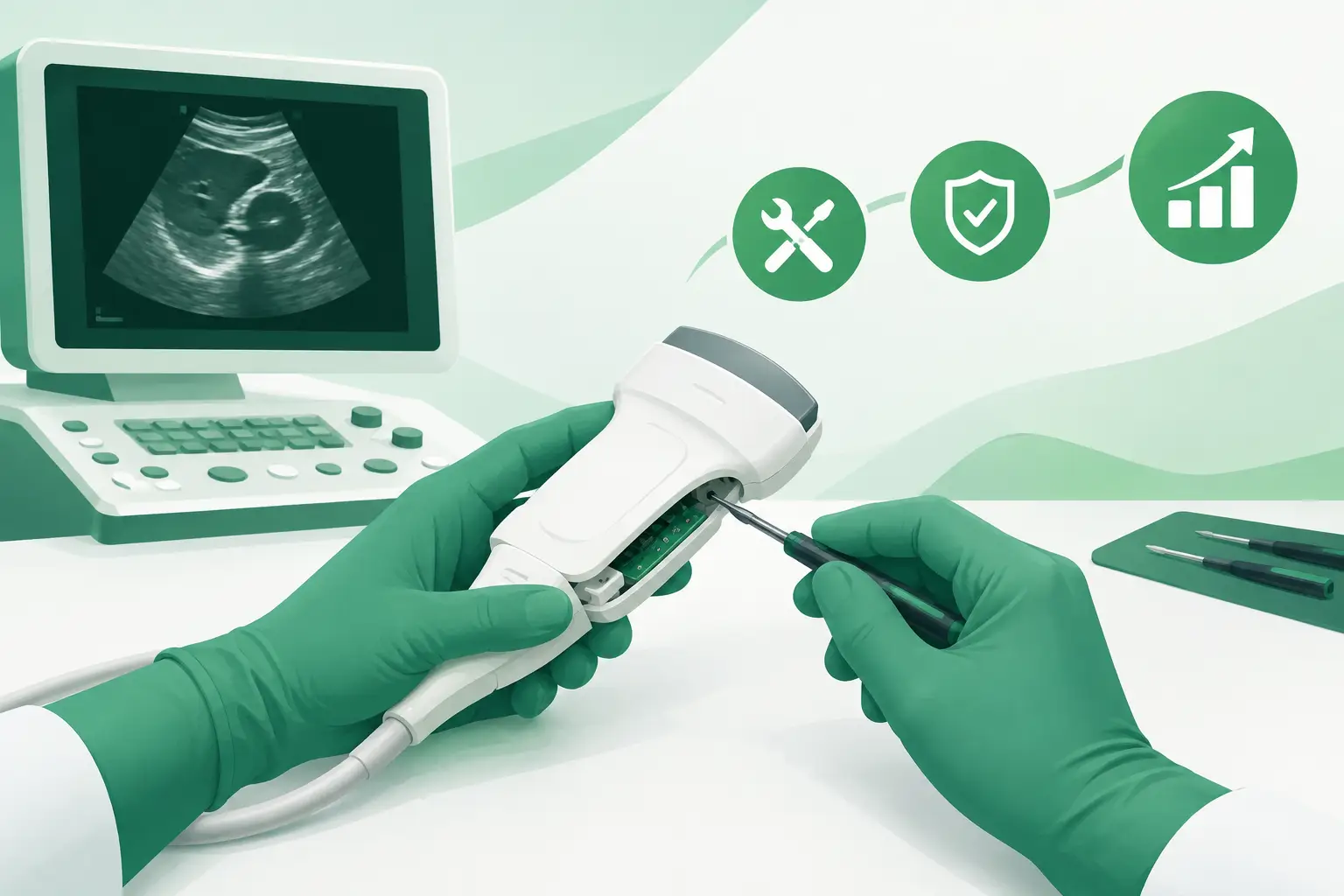
For probes and RF coils, include connector style, probe or coil label, and compatible platform information. For X-ray, fluoroscopy, and CT components, the tube housing, generator, gantry, or detector configuration may affect the result. A tube-related request, for instance, may require confirmation of housing type, focal spot specification, connector arrangement, and system application before a replacement can be evaluated.
This information does not slow procurement down. It removes avoidable back-and-forth and gives the sourcing team a defensible basis for locating a correct component quickly.
OEM Part Matching for Legacy Imaging Equipment
End-of-life systems are where part-number-level matching becomes especially valuable. OEM support may be limited, original stock may be exhausted, and the available aftermarket inventory may include used, refurbished, or removed components from multiple system revisions. The right source is rarely found by a generic web search alone.
Legacy systems also create a common trap: the original part number may be obsolete, while later revisions appear in the secondary market more often. That later revision might be a direct substitution, a conditional substitution, or incompatible. The answer depends on the system configuration and the OEM’s revision history.
Consider a discontinued mammography detector interface or a C-arm collimator assembly. Even when the mechanical mounting is identical, software support, cable routing, or control-board compatibility can vary. A supplier that understands the modality can identify when an available component is a true replacement and when further verification is necessary.
Meditegic supports this process through OEM part-number cross-referencing across CT, PET/CT, MRI, nuclear medicine, SPECT, C-arm, fluoroscopy, general X-ray, ultrasound, mammography, CR/DR, and DEXA systems. For hard-to-find parts, access to a broad global supplier network matters because a valid match may be located in a different market than the installed equipment.
Direct Replacement, Supersession, and Alternative Parts
Not every acceptable sourcing result has the same level of certainty. Procurement and service teams should distinguish among three outcomes.
A direct replacement has the same OEM part number and applicable revision, making it the clearest option when condition and testing requirements are met. An OEM supersession is a later manufacturer-designated number that replaces the original component. This can be appropriate, but the supersession should be confirmed for the specific equipment platform.
An alternative part is more complex. It may be compatible based on a known field substitution, shared assembly design, or a required accompanying change. Alternatives can be useful when original stock is unavailable, particularly for legacy systems, but they should not be treated as interchangeable without technical verification.
The trade-off is straightforward. A direct match may take longer to locate, while a verified supersession or alternative may restore service faster. The correct choice depends on system criticality, available documentation, installation requirements, and the buyer’s tolerance for configuration work. For an urgent repair, speed matters, but an unverified part can turn an urgent repair into a prolonged outage.
Condition and Testing Matter After the Match
Correct identification is only one part of a reliable purchase. The requested condition should match the component’s role and the service organization’s acceptance criteria. Used parts can be appropriate for many mechanical assemblies, covers, tables, gantry components, and certain electronic modules when condition is verified. Refurbished components may be preferable where a defined repair process and functional testing are needed.
Testing expectations should be discussed before shipment, particularly for electronics, transducers, detectors, image intensifiers, coils, and high-voltage assemblies. A supplier should be able to state what was tested, what is known about the item’s origin or condition, and whether the part is offered as an exact part-number match or a confirmed substitution.
For sensitive electronic components, packaging and handling also affect outcomes. Static protection, connector protection, and careful transport are operational details, but they matter when the part is difficult to replace and the repair window is narrow.
Build a Repeatable Identification Process
Organizations that maintain multiple imaging assets benefit from documenting part data before failures occur. Recording OEM part numbers during preventive maintenance, keeping photos of critical labels, and noting installed revisions creates a useful internal reference for future service events.
It is also worth documenting prior successful substitutions and configuration dependencies. If a particular workstation board requires a certain software image, or a detector replacement requires a calibration sequence, that knowledge should remain with the asset record rather than with one technician’s memory.
The best time to collect this information is not during an outage. A structured parts record gives service teams a faster starting point when a system becomes unavailable, especially when the part is discontinued or located through aftermarket channels.
When an imaging system is down, the fastest route is usually the most specific one: identify the component at the OEM part-number level, verify its revision and system application, and confirm condition before committing to shipment. That discipline turns a difficult sourcing request into a controlled repair decision - and helps put the equipment back into service with fewer surprises.