A mobile X-ray unit can be mechanically sound and still be out of service because of one unavailable board, damaged detector, failed high-voltage component, or worn mechanical assembly. For biomedical teams and independent service organizations, portable radiography spares are not a routine purchasing category. They are an uptime decision that affects patient throughput, service commitments, and the usable life of a high-value imaging asset.
Portable systems also create a distinct parts challenge. They travel between rooms, absorb frequent starts and stops, operate from battery power, and experience more physical handling than fixed radiography rooms. The correct replacement part must match not only the OEM and system family, but the specific configuration, revision, interface, and electrical requirements of the installed unit.
Why portable X-ray parts fail differently
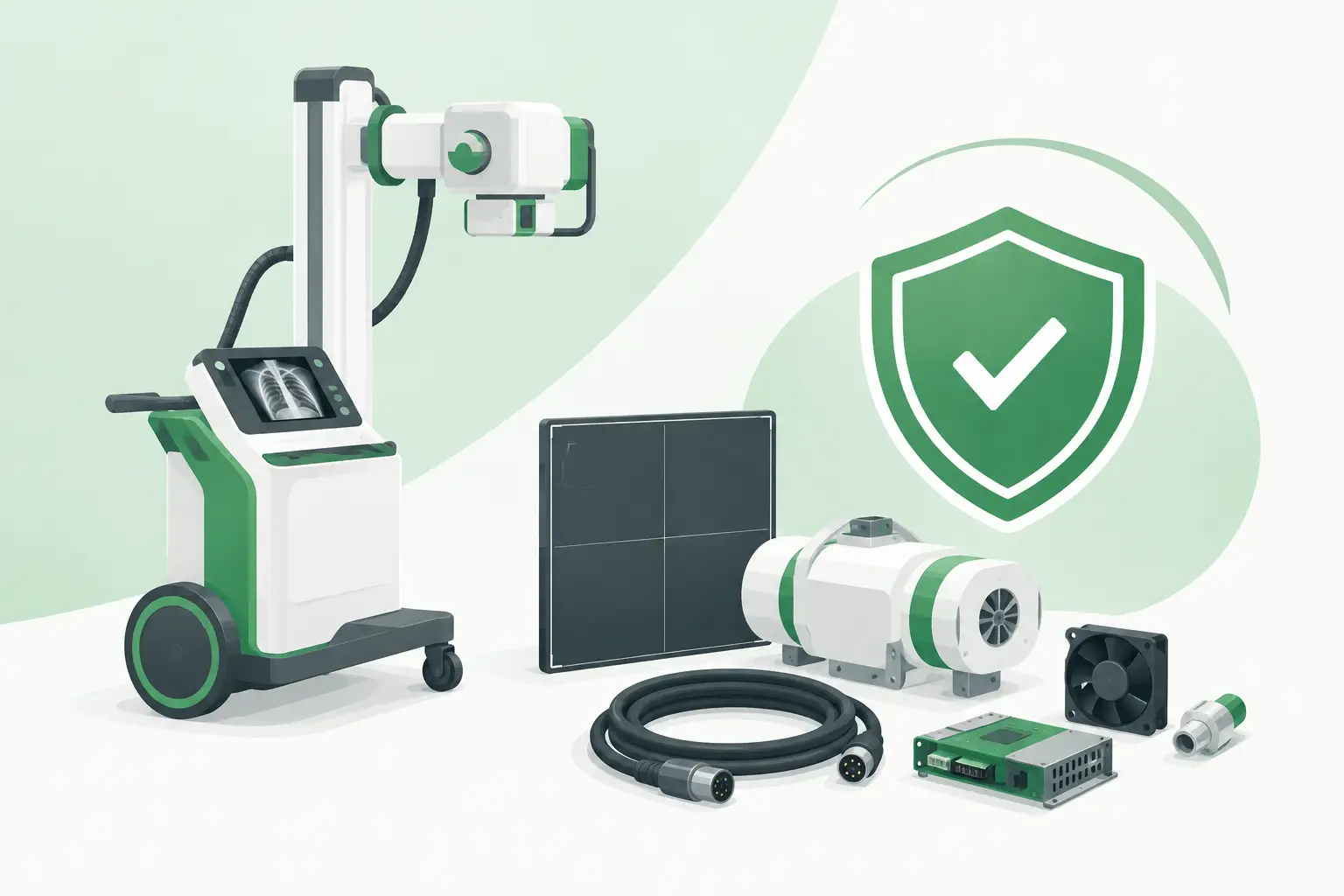
Portable radiography equipment combines an X-ray generator, tube and housing assembly, collimator, image acquisition components, workstation electronics, battery system, and mobile mechanical structure in one frequently moved platform. A fault can originate in any of these areas, and symptoms do not always identify the failed component on their own.
For example, an exposure failure may point to a generator board, high-voltage tank, cabling issue, tube-related fault, interlock, or power-distribution problem. A failed image acquisition sequence can be caused by a DR detector, detector interface, workstation PCB, communication cable, or software-compatible hardware revision. Replacing the most obvious component without confirming the failure path can increase downtime and leave a service team with an unnecessary spare on the shelf.
Movement adds another layer of wear. Casters, brakes, handles, counterbalance assemblies, tube-arm components, cable carriers, and locks are exposed to repeated mechanical stress. Battery packs, chargers, DC power modules, and battery-management components can become critical when a unit no longer completes a clinical route or loses power under exposure load. These are operational failures, not minor inconveniences.
High-priority portable radiography spares to identify
The right inventory strategy depends on installed base, service capability, and failure history. Still, several part categories consistently deserve attention because a single failure can take a mobile unit offline.
Image chain components
Digital image availability is central to portable workflow. Flat-panel detectors, detector handles, batteries, charging components, detector interface boards, acquisition PCBs, and workstation displays may all be system-critical. Detector sourcing requires particular care because compatibility can depend on model, detector size, interface generation, calibration status, and the system's configured software environment.
A detector with a similar appearance or a matching family name is not automatically interchangeable. The OEM part number, serial range when applicable, and detector revision should be checked before procurement. If a used or refurbished detector is being evaluated, condition and functional verification matter as much as physical compatibility.
Generator and exposure components
Portable units rely on tightly integrated power and exposure subsystems. Relevant spares can include high-voltage tanks, generator power supplies, inverter boards, control boards, exposure switches, high-voltage cables, tube housings, collimators, and associated sensors or interlocks.
Tube and housing assemblies must be treated as exact-match items. Electrical ratings, mounting geometry, connector types, heat characteristics, collimation interfaces, and generator compatibility all matter. A correct part-number cross-reference helps prevent a costly mismatch, particularly on older GE Healthcare, Siemens Healthineers, Philips, Canon/Toshiba, Fujifilm, Carestream, Shimadzu, and other legacy mobile X-ray platforms.
Power, charging, and mobility assemblies
When a mobile system cannot move or hold a charge, it may be clinically unavailable even if image quality is normal. Batteries, chargers, AC input assemblies, DC-DC converters, power-distribution boards, drive controls, motors, wheel assemblies, brakes, and mechanical locks can all become priority replacements.
These components should be sourced against the equipment's exact model and revision. Battery-related faults also require diagnosis beyond the battery itself. A charger failure, charging cable fault, connector damage, or battery-management control issue can present as reduced runtime or a no-charge condition.
Control and workstation electronics
Console computers, displays, keyboards, touch panels, PCBs, communication boards, and internal cabling are often overlooked until a system will not boot, store images, communicate with a detector, or complete a study. On end-of-life systems, these parts may be discontinued through standard channels despite being essential to an otherwise serviceable unit.
For these components, a clear fault description improves sourcing accuracy. Useful details include boot behavior, error codes, whether the issue is intermittent, relevant software version, and photographs of labels and connectors. That information helps distinguish between similar assemblies that are not functionally equivalent.
The part-number process that prevents mismatches
A portable X-ray system model number is a starting point, not a sufficient identification method. Manufacturers may use different assemblies across production runs, options, regional configurations, or hardware revisions. The part number printed on the removed component remains the most reliable procurement reference whenever it is available.
Before requesting a quote, collect the equipment manufacturer, model, system serial number, and exact part number from the failed item. Record revision codes, serial numbers, firmware labels, connector photos, and any alternate numbers printed on the assembly. For detector, tube, generator, and workstation components, include the observed fault and the result of basic troubleshooting.
This level of detail serves two purposes. First, it reduces time spent clarifying the request while an asset is down. Second, it lets a specialist compare OEM number changes, supersessions, and compatible alternatives at the component level. A cross-reference should never replace verification where a revision difference affects electrical, mechanical, or software operation.
Used, refurbished, or new-old-stock: choosing the right condition
Condition is a technical procurement decision, not simply a budget preference. Used parts can be appropriate for certain mechanical items, boards, displays, and assemblies when the source can confirm identity and condition. Refurbished components can be valuable for parts that benefit from inspection, repair, cleaning, or functional testing before shipment. New-old-stock may be preferable where the part is sensitive, scarce, or difficult to replace again.
The correct choice depends on the component's role and the consequences of another failure. A cosmetic cover and a generator power module do not carry the same operational risk. Likewise, a spare held for contingency use may justify a different condition profile than a component needed immediately to restore a unit serving a busy clinical route.
Ask for the facts needed to make that decision: exact OEM part number, condition classification, test status when applicable, photographs of labels and connectors, and available warranty terms. For equipment that is still under a service agreement or subject to a controlled maintenance program, confirm that the selected part and installation approach fit the applicable requirements.
Build a practical spare-parts plan for mobile units
Stocking every possible component is rarely efficient. A better approach is to identify the small number of failures that would create the longest outage and are hardest to source quickly. Review service records across the installed base, then separate frequently consumed mechanical items from low-frequency, high-impact electronic and image-chain parts.
For systems deployed across multiple locations, standardization can reduce exposure. Knowing which mobile X-ray models share detectors, batteries, collimator assemblies, or control boards makes it easier to prioritize contingency inventory. Conversely, keeping an undocumented spare from a retired unit can create false confidence if its revision is incompatible with the active fleet.
Maintain a record for each strategic spare with its full OEM number, revision, compatible system serial range if known, storage location, acquisition condition, test record, and date last verified. This is especially useful for hard-to-find boards and legacy assemblies, where a part may be available globally but require time for identity verification and logistics.
When fast sourcing matters most
A sourcing request is most effective when it is specific and technically complete. Provide the failed component's part number, system model and serial number, fault context, required quantity, preferred condition, and destination. If the unit must return to service under a narrow timeline, state that early so availability, testing, packaging, and shipping options can be assessed realistically.
Global sourcing is particularly relevant for discontinued portable radiography components. A part may no longer be available through a local channel but still exist in service inventory, refurbishment stock, or a decommissioned system elsewhere. The trade-off is that scarce parts require careful validation. Speed matters, but receiving an incorrect revision can extend the outage rather than resolve it.
Meditegic supports this type of part-number-level search across current and legacy diagnostic imaging equipment, helping technical buyers locate exact-match components when conventional supply channels cannot provide them.
The most useful next step is not to wait for the next mobile unit failure. Document the part numbers and revisions of the components most likely to interrupt your portable X-ray workflow now, while the equipment is operational and labels are accessible. That preparation turns an urgent search into a controlled repair decision.