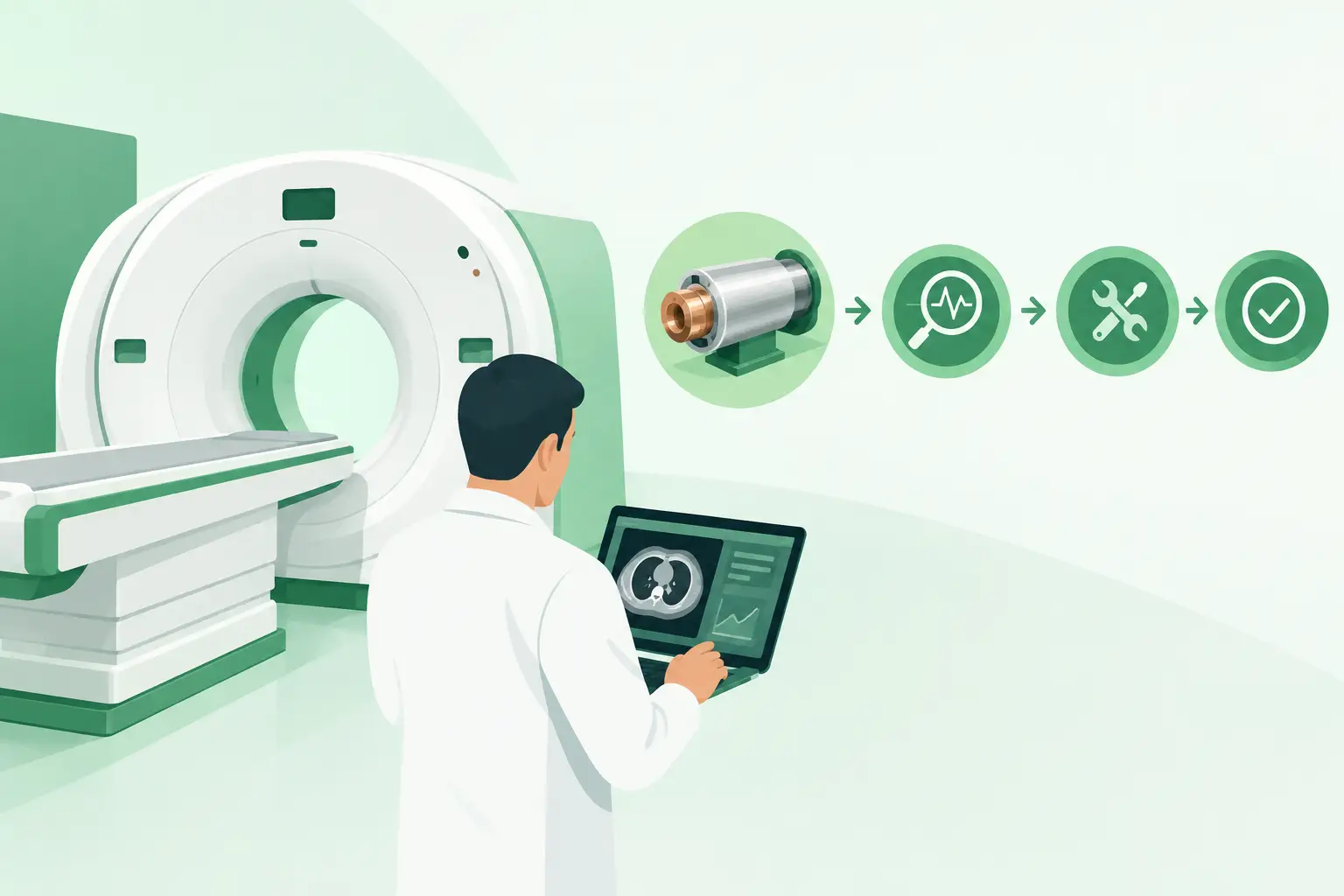
A failed imaging component rarely arrives at a convenient time. A CT workstation board, ultrasound power supply, C-arm monitor module, or MRI control assembly can stop a scheduled patient list and put a service team under immediate pressure. A disciplined refurbished imaging parts quality review gives biomedical engineers and independent service providers a practical way to assess whether an available part is suitable for installation, rather than simply available for purchase.
Refurbished parts can be a sound option for keeping mature imaging systems operational, particularly when OEM supply is limited or a component has been discontinued. But “refurbished” is not a universal technical standard. One supplier may use the term for a cleaned, function-tested part; another may mean a component that was diagnosed, repaired, calibrated where applicable, and retested under load. The difference affects installation risk, repeat failures, and the time required to return equipment to service.
What a Refurbished Imaging Parts Quality Review Should Confirm
The review should answer a straightforward question: can this exact part perform its required function reliably in this specific system configuration? Price matters, but it is only one variable. An inexpensive board that is incorrectly configured, poorly packed, or impossible to return can cost far more than its purchase price once labor, delayed appointments, and additional troubleshooting are considered.
Start with the exact manufacturer part number, revision level, and equipment model. Imaging systems often have assemblies that look identical while carrying different firmware, connector layouts, voltage requirements, or software compatibility. A part-number match is the strongest starting point, yet it may not be sufficient for high-integration components such as workstation electronics, detector interfaces, generator boards, and control modules.
Ask the supplier to confirm the source system or compatible equipment family when that information is available. For legacy platforms, an experienced supplier should recognize when a revision substitution is likely to require configuration work or when it presents an avoidable compatibility risk. This is especially relevant in CT/PET, MRI, nuclear medicine, CR, mammography, and C-arm equipment, where a single board may interface with several proprietary subsystems.
Condition language needs technical meaning
Terms such as used, tested, refurbished, repaired, and as-is should not be treated as interchangeable. The buyer needs to know what happened to the part after it was removed from service.
For a refurbished item, useful details include whether the component was inspected for physical damage, cleaned, repaired at board or subassembly level, tested in a compatible system or test fixture, and checked for stable operation over time. For mechanical assemblies, the review may also need to address wear points, bearings, cables, connectors, cooling paths, and moving elements. For ultrasound transducers, condition review should extend to the housing, lens, cable, strain relief, connector pins, and evidence of element or image-quality testing where available.
Not every part requires the same depth of refurbishment. A noncritical cosmetic panel and a high-voltage power supply should not be evaluated under the same criteria. The appropriate review depends on the part’s role, failure consequences, and the difficulty of access after installation.
Verify Testing Against the Part’s Actual Function
A quality claim is most useful when it is tied to a defined test. “Tested” should prompt the next question: tested for what, and how?
For electronic boards and power-related components, functional testing may include power-up behavior, voltage stability, communication response, error-code checks, and operation under representative load. A board that powers on is not necessarily a board that will remain stable during a scan sequence or under extended system use. Where full system testing is not practical, a supplier should be clear about the limits of the test rather than implying complete validation.
For imaging-related assemblies, testing should reflect the component’s impact on image acquisition or processing. Depending on the part, that may involve communication checks, detector response, image display behavior, calibration capability, or verification that the assembly is recognized by the host system. A replacement component can appear healthy in isolation yet fail once it encounters the software version, peripheral devices, or workload of the installed system.
Test records do not always need to be lengthy laboratory reports. However, a credible supplier should be able to state the method used, the observed result, and any known limitation. This level of clarity helps the service team decide whether the part is appropriate for an urgent repair, a planned replacement, or a lower-risk spare inventory position.
Consider repair history and component-level work
Component-level repair can extend the useful life of difficult-to-source imaging electronics, but it should be evaluated with precision. Ask whether the failure was identified, whether failed components were replaced, and whether related failure points were inspected. For example, replacing a visibly failed capacitor without addressing heat damage, corroded traces, or stressed connectors may not resolve the underlying issue.
This does not mean every repair requires a full engineering report. It means the repair scope should be proportional to the part’s criticality. A high-value control board that takes significant labor to access deserves more documentation and assurance than a straightforward external accessory.
Traceability Reduces Guesswork After Installation
Traceability is often what separates an efficient repair from an extended troubleshooting cycle. At minimum, a purchase record should retain the supplier name, supplied part number, serial number when applicable, date received, stated condition, and warranty terms. Photographs before installation can also be useful for documenting connector condition, labels, and revision markings.
For teams managing multiple sites or service contracts, this information supports recurring-failure analysis. If the same assembly fails repeatedly across a fleet, records can reveal whether the issue is related to a particular revision, environment, installation procedure, or upstream system fault. Without that history, each failure begins as a new investigation.
Traceability also protects against a common problem in the aftermarket: an equivalent-looking part arriving with an unverified or altered identification label. If a label, revision, or connector arrangement differs from the quoted item, stop before installation and resolve the discrepancy. The cost of a short verification call is small compared with the risk of damaging a board or creating a software mismatch.
Inspect Shipping Protection Before Powering Up
Even a properly refurbished component can be compromised in transit. Imaging electronics are vulnerable to electrostatic discharge, impact, moisture, and connector damage. Before accepting the part into service, inspect packaging and record any evidence of mishandling.
A practical receiving check should cover these points:
- The delivered part number, revision, and serial number match the order documentation.
- Sensitive electronics are protected with appropriate anti-static packaging, not loose plastic or unprotected foam.
- Connectors, pins, housings, cables, and mounting points show no shipping damage.
- Any included accessories, jumpers, brackets, or configuration items needed for installation are present.
If the carton is visibly damaged, document it before unpacking further. For urgent repairs, the instinct is to install immediately. That can be reasonable, but only after confirming that the component itself has not been compromised and that the supplier has been notified if there is a concern.
Evaluate the Supplier’s Support, Not Just the Part
A refurbished part is only one part of the transaction. The supplier’s ability to verify compatibility, respond quickly to technical questions, and handle a legitimate return directly affects downtime.
Before ordering, establish whether the quote identifies the exact condition offered and whether availability is confirmed rather than estimated. Ask about the return process, warranty duration, advance replacement options when available, and what information will be needed if the part does not resolve the fault. A supplier should not promise that every replacement will solve a system-level issue, because the original diagnosis may be incomplete. It should, however, provide a clear path for addressing a verified part failure or mismatch.
Responsive sourcing support becomes particularly valuable for discontinued assemblies and uncommon modalities. A broad supplier network can locate alternatives quickly, but the technical review still needs to happen before shipment. Meditegic supports this process by helping technical buyers source exact-match and hard-to-find imaging components while keeping part identification, condition, and urgency central to the quote discussion.
Match the Review Depth to the Operational Risk
There is no single inspection standard that fits every purchase. A low-cost, easily replaced peripheral may justify a simpler review. A scarce MRI control module, CT detector-related assembly, or ultrasound transducer with a tight installation window requires more verification before dispatch.
Consider four operational factors: the clinical impact of failure, the labor required to install the part, the availability of alternatives, and the ability to test the component before the system is needed. The higher these risks, the more valuable it becomes to request clear test details, traceability, packing confirmation, and defined warranty support.
A well-run refurbished imaging parts quality review does not slow down urgent procurement. It prevents the wrong kind of speed: ordering a questionable component quickly, then losing more time to incompatibility, damage, or an unclear return process. When the part number, condition, test scope, and support terms are understood before shipment, the service team can install with far greater confidence and focus on the work that matters - returning diagnostic capability to service.