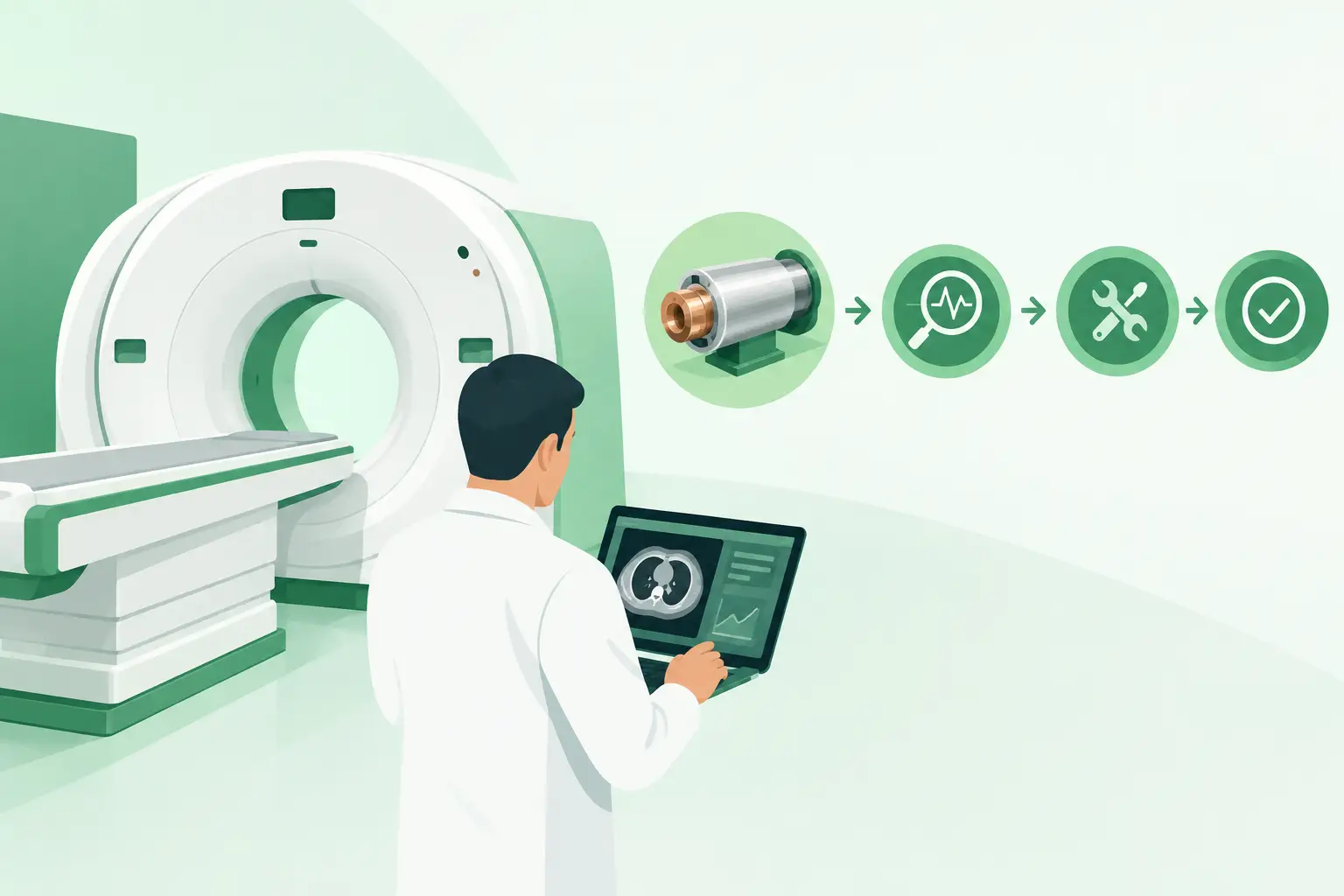
A CT scanner can continue to boot, rotate, and produce images while a collimator problem quietly compromises scan quality or limits available protocols. Knowing when to replace a CT collimator is therefore not just a question of visible damage. It requires separating a true mechanical or beam-shaping failure from tube, detector, calibration, software, or gantry-related faults before ordering a replacement.
For clinical engineering teams, ISOs, and imaging service providers, the right decision protects both patient throughput and the scanner’s remaining service life. A premature replacement adds avoidable cost and alignment work. Waiting too long can create repeated failed calibrations, unreliable slice-width selection, image artifacts, or an unplanned system outage.
What the CT Collimator Does - and Why Configuration Matters
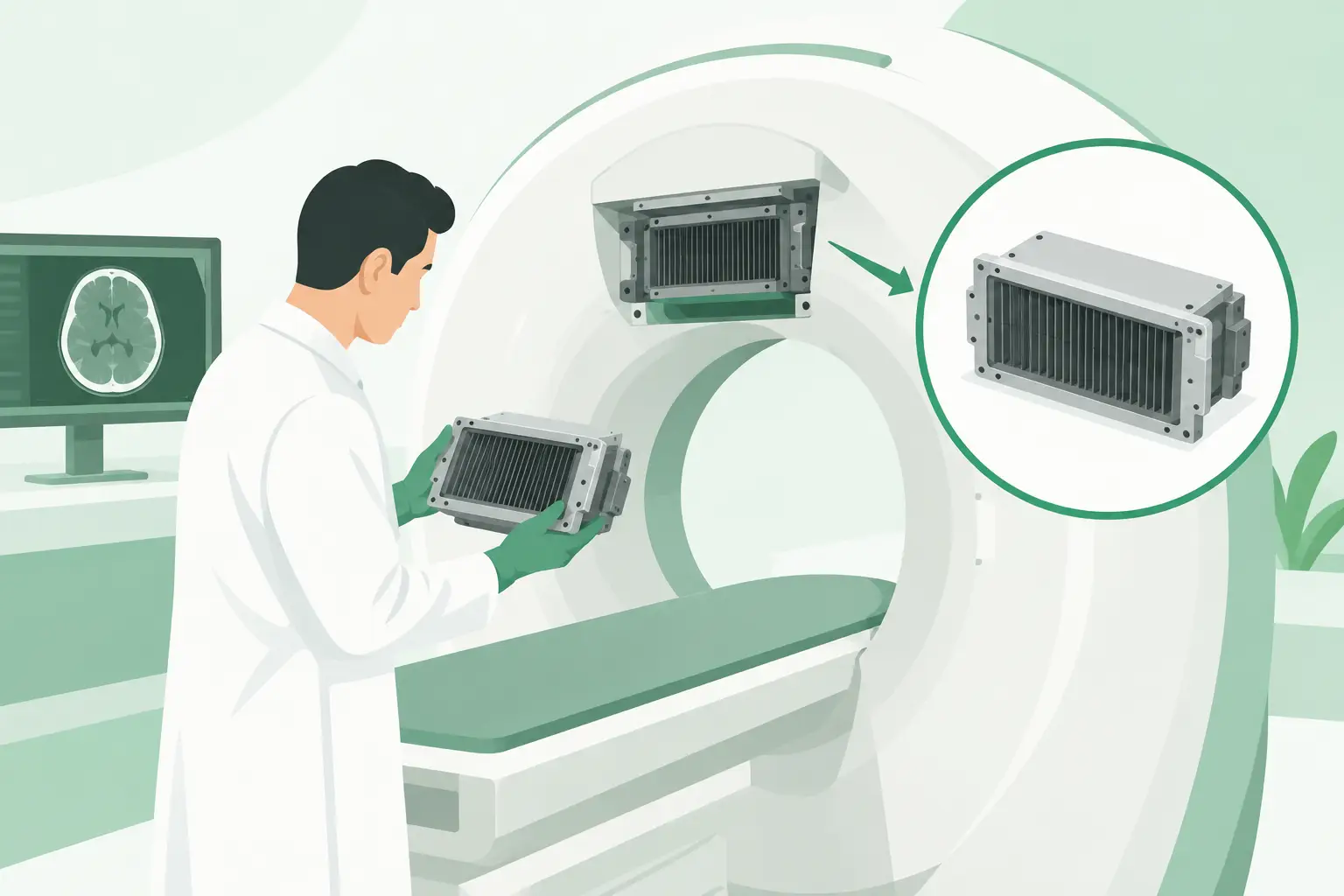
In CT, “collimator” may refer to different assemblies depending on the manufacturer and system generation. The pre-patient collimator near the X-ray source shapes the primary beam and controls the selected acquisition width. Some scanner designs also use detector-side collimation or anti-scatter structures that limit unwanted radiation reaching the detector.
These assemblies are not interchangeable simply because they appear similar or serve the same general purpose. Their mechanical travel, blade geometry, drive method, position sensing, mounting points, and firmware interface can vary substantially between GE, Siemens, Philips, Canon/Toshiba, and other platforms. Even within one OEM family, part revisions can differ by gantry version, detector configuration, or software level.
That distinction affects troubleshooting. A symptom associated with incorrect beam collimation may originate in the collimator assembly itself, but it can also result from a failed actuator, position encoder, cable harness, control board, tube-side component, calibration data issue, or detector fault. Replacement should follow a documented fault path rather than an assumption based on the error message alone.
Signs That a CT Collimator May Need Replacement
A replacement becomes increasingly likely when there is confirmed physical damage, repeatable position error, failed mechanical motion, or calibration evidence that cannot be resolved through approved adjustment or repair procedures. The strongest cases usually combine more than one of these indicators.
Visible damage or contamination
Inspect the assembly during authorized service access for bent blades, cracked housings, loose hardware, damaged mounting features, unusual wear, foreign material, or evidence of contact with adjacent components. A blade that has been physically deformed should not be treated as a cosmetic issue. Beam geometry depends on precise positioning, and even small changes can affect scan performance.
Contamination also matters. Dust, degraded material, corrosion, or residue can interfere with moving components and sensors. However, cleaning or removal of debris should be performed only in accordance with the applicable OEM service documentation. Do not assume that an apparently obstructed assembly requires replacement until its movement and positional feedback have been verified afterward.
Recurrent motion or position faults
A collimator that cannot consistently move to commanded positions is a practical replacement candidate, particularly after the drive path and electrical connections have been checked. Symptoms can include inability to select certain scan widths, repeated gantry initialization faults, inconsistent shutter movement, or error codes associated with collimator position feedback.
Intermittent faults deserve the same level of attention as a hard failure. A component that passes initialization once but fails after thermal cycling, repeated movement, or gantry rotation can create a difficult-to-schedule outage. Record the conditions under which the fault occurs, including scan mode, gantry temperature, commanded position, and whether the issue follows the assembly or remains with the system after connector and harness checks.
Image-quality changes that correlate with collimation
Image artifacts alone do not prove collimator failure, but they can provide an important trigger for investigation. Depending on the scanner architecture and fault location, a collimation issue may be associated with nonuniformity, unexpected edge effects, slice-thickness discrepancies, shading, elevated noise in particular protocols, or artifacts that recur at a specific beam-width selection.
The key word is correlate. If an artifact appears only when a certain collimation setting is selected and disappears at other settings, the collimator assembly, its drive mechanism, or its position feedback deserves focused testing. If the artifact appears across all protocols, the investigation should remain broader. Tube performance, detector channels, bowtie filter condition, calibration status, reconstruction settings, and patient positioning can all produce symptoms that may initially look similar.
Failed calibration or inability to maintain specification
A scanner may identify a developing issue through failed or unstable calibration before staff see a clear clinical image-quality complaint. If approved calibration procedures repeatedly fail and service diagnostics point to collimator position, beam geometry, or mechanical repeatability, replacement may be justified.
One failed calibration is not automatically a replacement decision. Review whether the system has experienced a recent software change, power interruption, tube replacement, gantry service event, or environmental condition outside operating limits. Repeatability is decisive: a consistent failure after the appropriate corrective steps is more meaningful than an isolated event.
When to Replace a CT Collimator Versus Repair It
The decision depends on the specific failure mode, OEM supportability, and the condition of the complete assembly. A damaged external cable, connector, sensor, actuator, or mounting component may be serviceable in some models. By contrast, damaged internal blades, worn pivot mechanisms, broken geometry-critical components, or assemblies with unavailable internal parts often make replacement the more controlled option.
Replacement is usually the better operational choice when the assembly has a known history of recurring faults, cannot hold positional accuracy, has sustained impact damage, or would require a repair with uncertain long-term reliability. This is particularly true for scanners with limited downtime windows, where a temporary repair could lead to a second outage soon after return to service.
There is also an end-of-life factor. On legacy CT platforms, an OEM exchange path may no longer be available, while the installed component may be discontinued. In those cases, a tested used or refurbished exact-match assembly can be the practical solution - provided its part number, revision, configuration, and condition are verified before shipment.
Verify the Fault Before You Source the Part
Before requesting a collimator, build a concise service record. It should include the scanner manufacturer, model, gantry serial number where relevant, exact OEM part number from the installed component, revision or dash number, error codes, service diagnostic findings, and clear photos of labels and connectors when available.
Part number verification is especially valuable because a system model name is rarely enough to guarantee compatibility. A supplier may locate several assemblies described as CT collimators for the same platform, yet only one may match the installed configuration. Confirm whether the quote is for the complete assembly or only a subcomponent, and clarify what accessories, cables, brackets, or sensors are included.
If the original part number is unreadable, do not rely solely on a visual match. Cross-reference the scanner configuration, service documentation, removed component dimensions, connector arrangement, and any available spare-parts records. Meditegic supports this type of part-number-level sourcing for difficult imaging components, helping service teams reduce the risk of receiving a near-match that cannot be installed.
Plan the Replacement as a Controlled Service Event
Collimator replacement is not complete when the new assembly is physically mounted. Follow the OEM-approved installation procedure, torque requirements, safety steps, alignment process, and calibration sequence for that scanner. Because the component influences beam geometry, improper installation can affect image quality and radiation output characteristics.
After installation, confirm normal initialization and commanded movement through all relevant positions. Complete the required calibrations and quality-control checks, then validate performance across the protocols and beam widths affected by the repair. Document the installed part number, serial number if present, configuration changes, test results, and the disposition of the removed component.
For an urgent outage, sourcing speed matters, but it should not override traceability. Request condition details, photos when needed, testing information, packaging requirements, and expected dispatch timing. A carefully verified replacement that arrives ready for the planned service window is more valuable than a faster shipment that introduces a compatibility question.
A CT collimator should be replaced when evidence shows it can no longer achieve or repeat its required mechanical and geometric function, not simply because an image artifact or generic error code appears. Treat the component as part of a complete diagnostic chain, verify the exact failure and exact part number, and make the replacement during a controlled service interval. That approach gives the scanner the best chance of returning to stable clinical operation without creating the next downtime event.