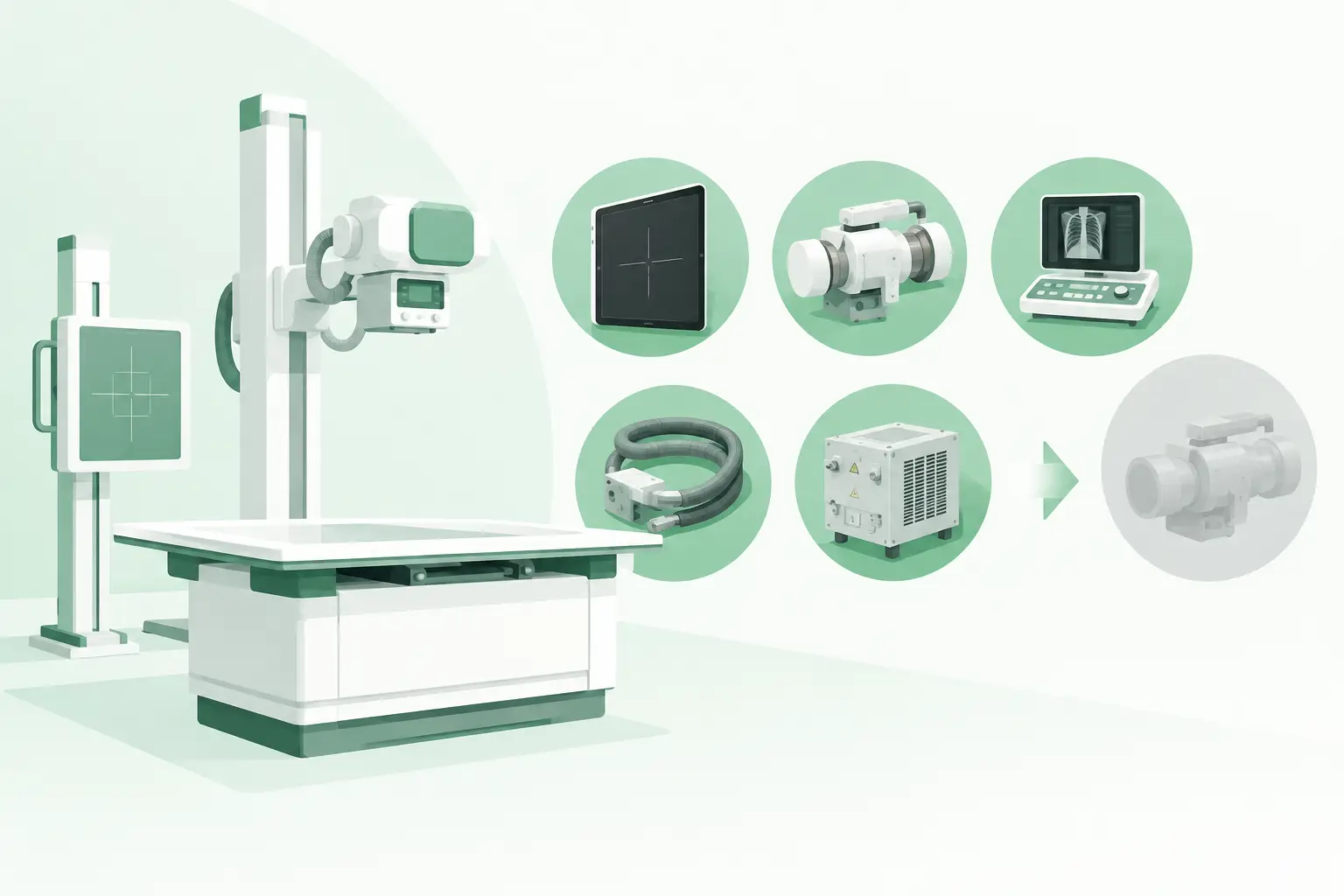
An X-ray room can remain clinically useful long after its original OEM sales cycle ends. The problem is that which X-ray parts become obsolete is rarely determined by the age of the system alone. A ten-year-old generator may still be serviceable, while a low-volume control board, display assembly, or detector interface has already disappeared from normal distribution.
For biomedical teams, ISOs, and imaging service providers, obsolescence is an uptime issue, not simply a product-lifecycle label. A component becomes operationally obsolete when an exact replacement, repair path, or qualified substitute can no longer be obtained quickly enough to keep the system in service. Understanding which parts are most exposed helps teams hold the right contingency stock, make better repair-versus-replace decisions, and begin sourcing before a failure becomes an outage.
What Makes an X-Ray Part Obsolete?
OEM end-of-support notices matter, but they do not tell the whole story. A part can be officially unsupported yet remain available through the aftermarket for years. Conversely, a part can be listed as supported while actual supply is constrained by low production volume, a discontinued subcomponent, or limited repair capability.
The highest-risk parts tend to share several characteristics: they are proprietary to one system family, use aging electronics or software, cannot be substituted without calibration or configuration, and were produced in relatively small quantities. Parts that are shared across several generations of equipment usually have a longer aftermarket life than model-specific assemblies.
Obsolescence also follows the equipment’s installed base. Once enough sites retire a particular platform, recovered-parts supply may initially improve. Later, as donor systems become scarce and remaining units stay in service longer, demand for specific assemblies can exceed available inventory. That is when a component moves from difficult to source to genuinely critical.
Which X-Ray Parts Become Obsolete Most Often?
Control boards, PCBs, and embedded electronics
Control boards are among the first X-ray components to become difficult to source. These include generator control PCBs, digital input/output boards, exposure control boards, collimator boards, table-motion boards, and workstation interface cards. Their risk is high because they are usually model-specific and may rely on discontinued processors, memory chips, connectors, or programmable logic.
A board can look intact but fail intermittently due to heat exposure, capacitor aging, damaged connectors, or corrupted firmware. Repair is sometimes possible, but only when the board can be tested under realistic operating conditions and firmware compatibility is known. A visually similar board with a different revision level may not be interchangeable.
For this reason, technicians should document the complete OEM part number, board revision, serial number when relevant, and the system configuration before requesting a replacement. The system model alone is rarely enough to identify an exact-match board.
Displays, console components, and legacy workstations
Older X-ray consoles often depend on proprietary display panels, touch interfaces, keyboards, power modules, and internal computer assemblies that were common when the system was built but are no longer manufactured. CRT monitors, older LCD panels, industrial PCs, specific video boards, and legacy storage devices are frequent trouble points.
The challenge is not always the physical component. A replacement workstation may require application software, licensing, configuration files, or hardware-specific drivers. Swapping in a generic computer or monitor can create image-display, communication, or calibration problems even if it powers on successfully.
When a console component begins showing intermittent faults, long boot times, unstable display output, or storage errors, it is worth sourcing a tested replacement before total failure. Waiting until the system cannot boot often turns a straightforward component exchange into an extended recovery effort.
Flat-panel detector assemblies and detector electronics
Digital radiography has shifted a significant portion of obsolescence risk from film-chain hardware to detector technology. Flat-panel detectors, detector control units, acquisition interface boards, battery modules for portable panels, and proprietary cables can become difficult to obtain as manufacturers transition to newer detector families.
The detector itself may remain functional, but its supporting electronics may not. A failed detector interface board or communication cable can remove the panel from service just as completely as damage to the scintillator or sensor array. These parts are frequently proprietary, and compatibility may depend on firmware generation, panel serial range, or acquisition software version.
Not every detector failure calls for a full detector replacement. A qualified diagnosis should distinguish between panel damage, power faults, cable faults, interface failures, and software communication errors. Replacing the wrong high-value assembly is an expensive way to discover that the actual fault was a smaller support component.
Image intensifiers and fluoroscopy chain components
For C-arm and fluoroscopy systems, image intensifiers remain a major obsolescence concern. As platforms migrate to flat-panel technology, support for older image intensifier sizes and related components can narrow. Camera assemblies, optical couplers, video distribution boards, and image-processing electronics may be equally difficult to locate.
Image intensifier availability depends heavily on exact diameter, input field size, mounting arrangement, electrical interface, and the system’s imaging chain. A part that appears close in size or connector layout is not automatically a safe replacement. Performance, calibration, and mechanical fit must all be considered.
These systems often stay in service because they remain useful for specific procedures and because replacement of the imaging platform is not always practical. That makes advance planning especially valuable for known high-risk components in the chain.
High-voltage tanks, generator modules, and power supplies
High-voltage tanks, generator power modules, inverter boards, filament transformers, and power supplies can be hard to source for aging general radiography and portable X-ray platforms. Their obsolescence pattern is different from that of electronics: some parts are repairable, but the required expertise, test equipment, and replacement subcomponents may no longer be readily available.
These assemblies operate under thermal and electrical stress, so failure history matters. Cooling problems, poor line power, repeated exposure faults, and damaged cables can shorten component life. Before condemning a tank or generator module, verify associated cables, interlocks, control signals, and cooling performance. A downstream fault can mimic a major generator failure.
Exact part-number matching is essential. Generator assemblies may differ by kV rating, software revision, regional electrical configuration, or interface protocol even within the same system family.
Collimators, motors, and mechanical motion components
Mechanical parts usually remain available longer than proprietary electronics, but they should not be treated as low risk. Collimators, shutters, lamp assemblies, table drives, locks, lift motors, bearings, cables, and bucky mechanisms can become obsolete when their original supplier exits the market or when an OEM discontinues a complete subassembly.
Collimators are a practical example. A failed lamp may be simple to address, while a damaged motor, worn gear train, or obsolete control module can require a complete collimator assembly. Mechanical interchangeability depends on mounting dimensions, field-size control, tube housing interface, and electrical connections. Similar-looking assemblies often have meaningful differences.
Parts That Usually Have a Longer Aftermarket Life
Standardized items such as common fuses, relays, selected connectors, cooling fans, and some power-management components may be easier to obtain than proprietary assemblies. That does not mean generic substitutions are always appropriate. In diagnostic imaging equipment, electrical ratings, shielding, connector pinout, thermal requirements, and safety specifications must be verified.
X-ray tube availability also varies considerably by system family, housing design, generator compatibility, and the remaining installed base. A tube or tube housing is not obsolete simply because the system is older. In many cases, qualified used or refurbished options remain available. The key question is whether the exact configuration can be sourced, tested, and supported within the required downtime window.
How to Reduce Obsolescence-Driven Downtime
The most effective approach is to identify vulnerable assemblies before they fail. Review service history for recurring faults, intermittent errors, parts with long lead times, and components that have already been superseded multiple times. A parts-risk register for each installed system can be more useful than a general inventory list because it ties risk to actual equipment, configurations, and clinical dependency.
For critical systems, maintain complete identification records: OEM system model, serial number, software version, exact component part number, revision, photographs of labels and connectors, and known alternates. This information shortens the quotation process and prevents delays caused by incomplete identification.
When a rare part is located, ask practical questions before approving a purchase: Is it tested? Is it the exact part number and revision? Does it include necessary accessories, cables, or mounting hardware? Is a return process available if compatibility is confirmed to be incorrect? The answer depends on the part type, but these details matter most for boards, detectors, generator modules, and console assemblies.
Meditegic supports this process by sourcing hard-to-find imaging parts at the OEM part-number level across general and portable X-ray, C-arm and fluoroscopy, CR/DR, mammography, CT, MRI, ultrasound, and other diagnostic modalities. For a legacy X-ray system, a fast and accurate request begins with the label on the failed component, not just the equipment name.
The practical goal is not to predict every failure. It is to recognize the parts with shrinking support early enough that an unexpected fault does not become an open-ended search. In imaging service, the most valuable replacement part is often the one identified before the room goes down.