A scanner that completes its daily checks but fails during demanding sequences can point directly to the gradient subsystem. Understanding why MRI gradients fail helps service teams separate a true gradient fault from problems in the amplifier, cooling circuit, cabling, power distribution, or system controls. That distinction matters because an incorrect diagnosis can turn a targeted repair into days of avoidable downtime.
MRI gradients create the rapidly changing magnetic fields that encode spatial position during an exam. They operate under high electrical load, switch at high rates, and generate substantial heat and mechanical force. The gradient coil assembly, gradient amplifier, chiller or water circuit, filters, interconnects, and control electronics must all perform within specification. A fault anywhere along that chain may produce similar symptoms.
Why MRI Gradients Fail Under Real Operating Conditions
Gradient failures are rarely random. Most develop through cumulative thermal stress, degraded cooling, electrical insulation breakdown, mechanical fatigue, or faults outside the gradient coil itself. Scanner age, workload, room conditions, service history, and sequence demands all affect the failure pattern.
Thermal stress and inadequate cooling
Heat is one of the primary reasons gradient components fail. During high-duty-cycle protocols, the gradient amplifier and coil assembly dissipate significant energy. If water flow is restricted, coolant quality is poor, a pump is weakening, a heat exchanger is fouled, or a temperature sensor is inaccurate, the system may exceed its operating limits.
The first indication may be intermittent. A scanner can run routine sequences without issue, then fault during diffusion, echo-planar imaging, fast spin echo, or other gradient-intensive protocols. Operators may report that the system works after a cool-down period, only to repeat the failure later in the day. That behavior should prompt a review of actual coolant flow, inlet and outlet temperature, pressure, alarm history, and chiller performance before condemning the gradient coil.
A cooling problem left unresolved can damage more than the chiller. Repeated overheating accelerates insulation aging, stresses amplifier power modules, and can contribute to permanent coil or interconnect failure.
Electrical insulation and winding faults
A gradient coil contains conductors and insulation designed to tolerate rapid current switching and strong electromagnetic forces. Over time, thermal cycling and vibration can degrade insulation or create a partial short between windings. A winding may also develop an open circuit at a connection point.
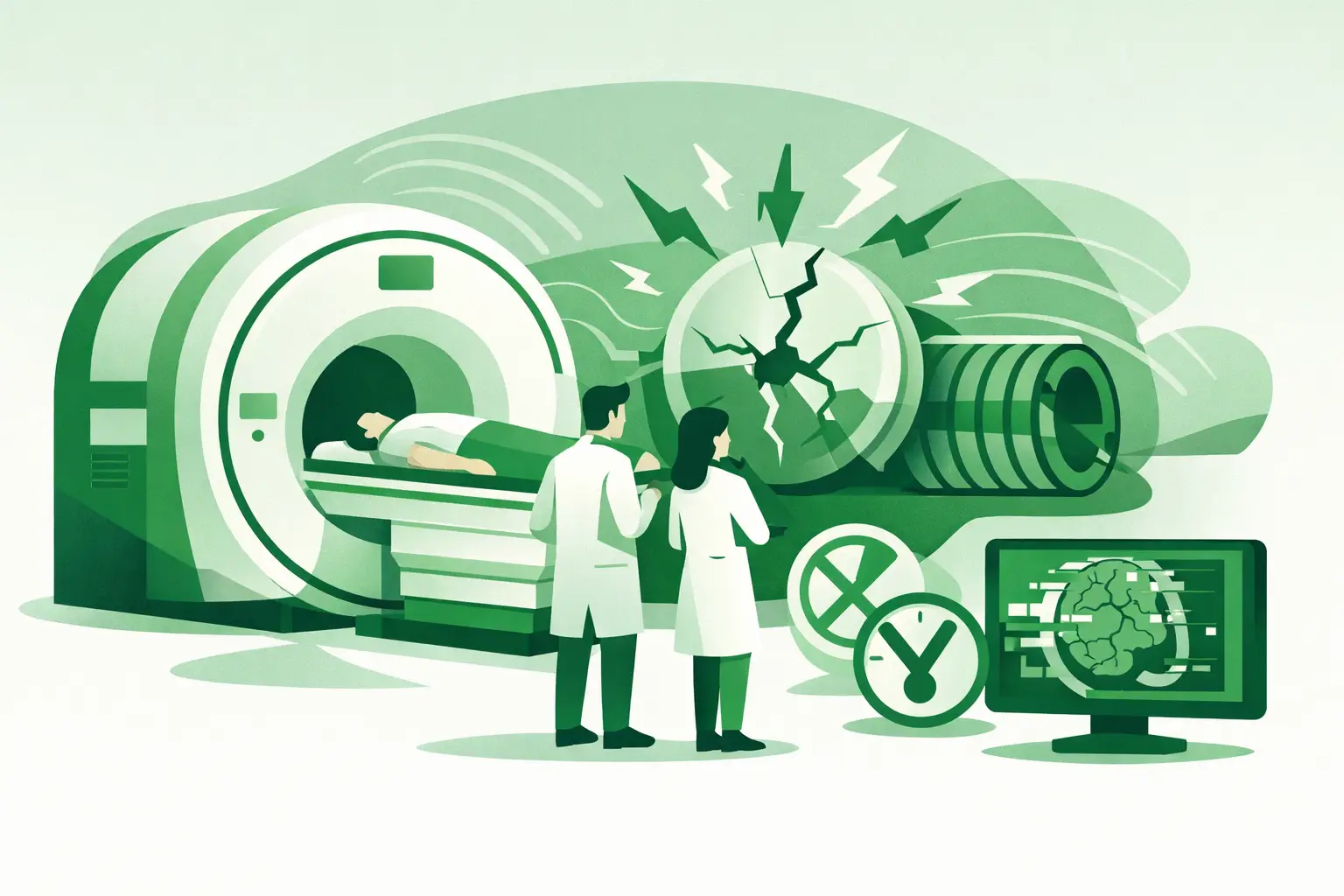
These failures can appear as axis-specific errors, abnormal current readings, amplifier trips, sequence aborts, or persistent calibration failures. Image symptoms may include geometric distortion, localized warping, ghosting, signal loss, or artifacts that change according to the active gradient axis and selected sequence.
However, an error associated with the X, Y, or Z axis does not automatically prove that the corresponding coil winding has failed. The same message can originate from an amplifier channel, output cable, filter assembly, connector, current sensor, or control board. Service teams should interpret error logs alongside resistance, inductance, insulation, and channel-comparison measurements specified by the system manufacturer.
Amplifier faults that mimic gradient failure
The gradient amplifier is often suspected first because it contains high-power electronics subject to heat and electrical stress. Failed IGBT modules, gate-driver circuits, capacitors, power supplies, current sensors, contactors, or internal cooling components can disable one channel or cause repeated overcurrent faults.
An amplifier issue may closely resemble a defective gradient coil. For example, a fault that follows a specific amplifier channel after controlled diagnostic testing points toward the cabinet rather than the magnet assembly. By contrast, a fault that remains associated with the same physical axis despite verified amplifier-channel substitution may narrow the investigation toward the coil, cabling, or passive interface components.
This is a decision point with real procurement consequences. Gradient amplifiers, amplifier modules, control boards, and complete gradient coil assemblies are materially different parts, with different lead times, compatibility requirements, and installation scope. Ordering based on an alarm description alone is risky.
Mechanical fatigue, vibration, and acoustic loading
MRI gradients are designed to move rapidly against powerful magnetic forces. That motion creates the familiar acoustic noise of MRI scanning, but it also imposes mechanical stress on windings, supports, fasteners, and internal interfaces. Over a long service life, repeated vibration can loosen connections, fatigue conductors, or alter the mechanical integrity of the assembly.
Mechanical faults may present as a change in scanner sound before image quality degrades. New rattling, knocking, unusually sharp acoustic behavior, or vibration during specific sequences deserves investigation, particularly when paired with intermittent gradient errors. These signs do not always mean the coil has failed, but they should not be dismissed as normal system noise.
Connectors, cables, and passive components
High-current cables, bulkhead connectors, terminal blocks, filters, and interface assemblies are easy to overlook because they are not always named in the primary fault message. Yet a corroded contact, heat-damaged terminal, partially seated connector, or compromised cable can introduce resistance, unstable current delivery, and intermittent faults.
This is especially relevant after previous service work, transport, room modifications, chiller maintenance, or component replacement. A careful inspection for discoloration, heat marks, coolant exposure, damaged shielding, loose hardware, and connector wear can prevent an unnecessary high-value assembly replacement.
Symptoms That Help Narrow the Fault
Gradient-related symptoms should be evaluated as a pattern, not as isolated events. A hard system stop with a repeatable axis error is different from an artifact that appears only after extended scanning. Likewise, a fault present immediately at power-up suggests a different path than one triggered only under load.
Useful evidence includes the exact error code and time stamp, sequence being run, affected axis or channel, coolant temperature and flow data, recent service changes, audible changes, and whether the fault clears after the system cools. Comparing behavior across protocols can be particularly revealing. If low-demand sequences pass while high slew-rate sequences fail, thermal capacity or dynamic electrical loading deserves close attention.
Image artifacts should also be documented rather than described only as "poor image quality." Record the anatomy, plane, sequence, phase-encoding direction, repetition pattern, and whether the artifact is reproducible. This information helps distinguish gradient-related distortion from RF coil issues, field homogeneity problems, patient motion, or reconstruction faults.
A Service Approach Before Ordering Parts
MRI gradient troubleshooting must follow the OEM service documentation, site safety procedures, and the capabilities of qualified personnel. The subsystem involves high voltage, stored energy, chilled-water connections, and components located around the magnet. Improvised testing or bypassing protective circuits can create safety risks and obscure the original fault.
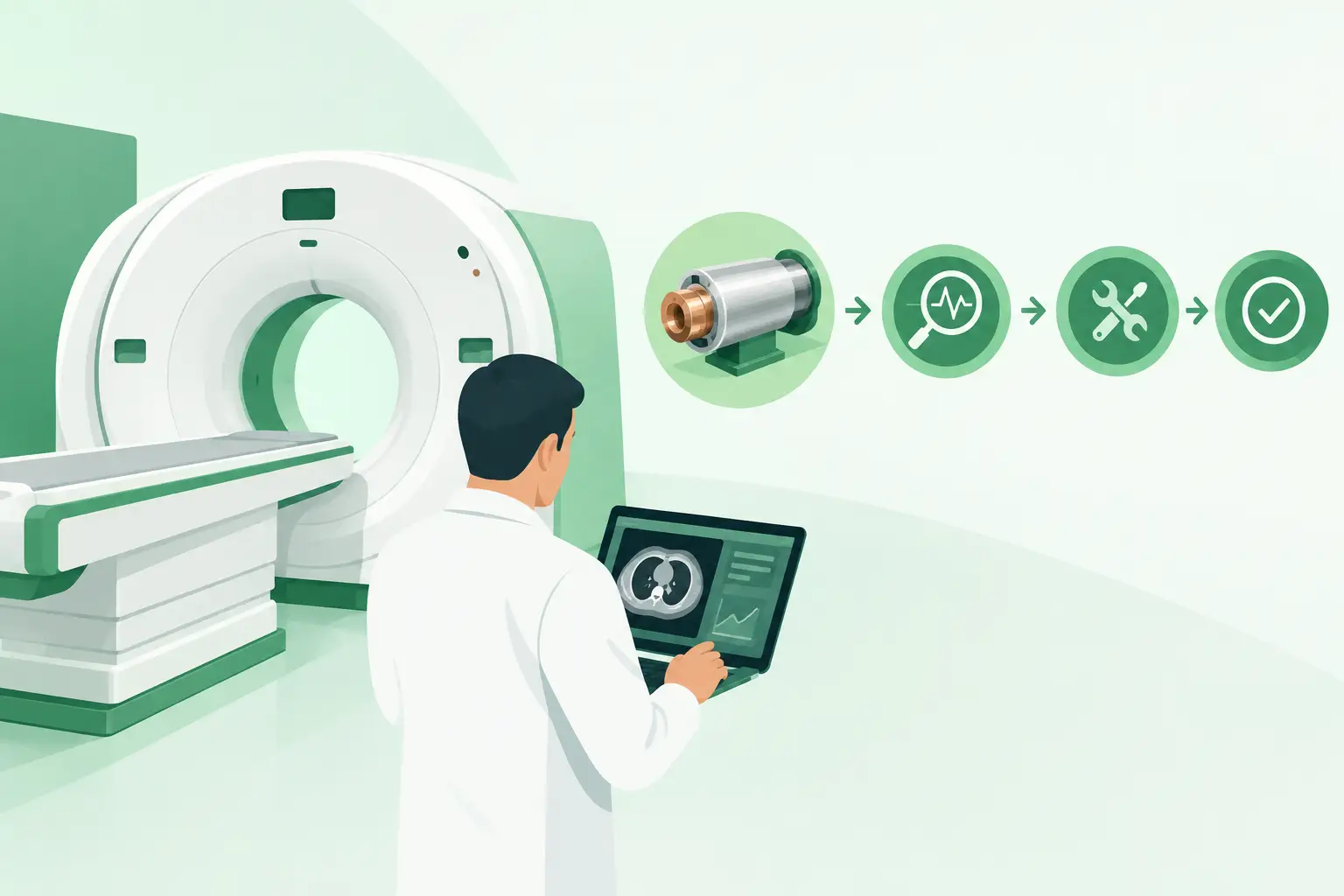
Begin by preserving the evidence. Export fault logs, capture the system configuration, and document installed part numbers and revisions before swapping components. Confirm room power quality, cooling status, cabinet ventilation, and alarm history. Then use the manufacturer-approved diagnostic process to isolate the fault to a coil, amplifier channel, cooling component, cable assembly, or control interface.
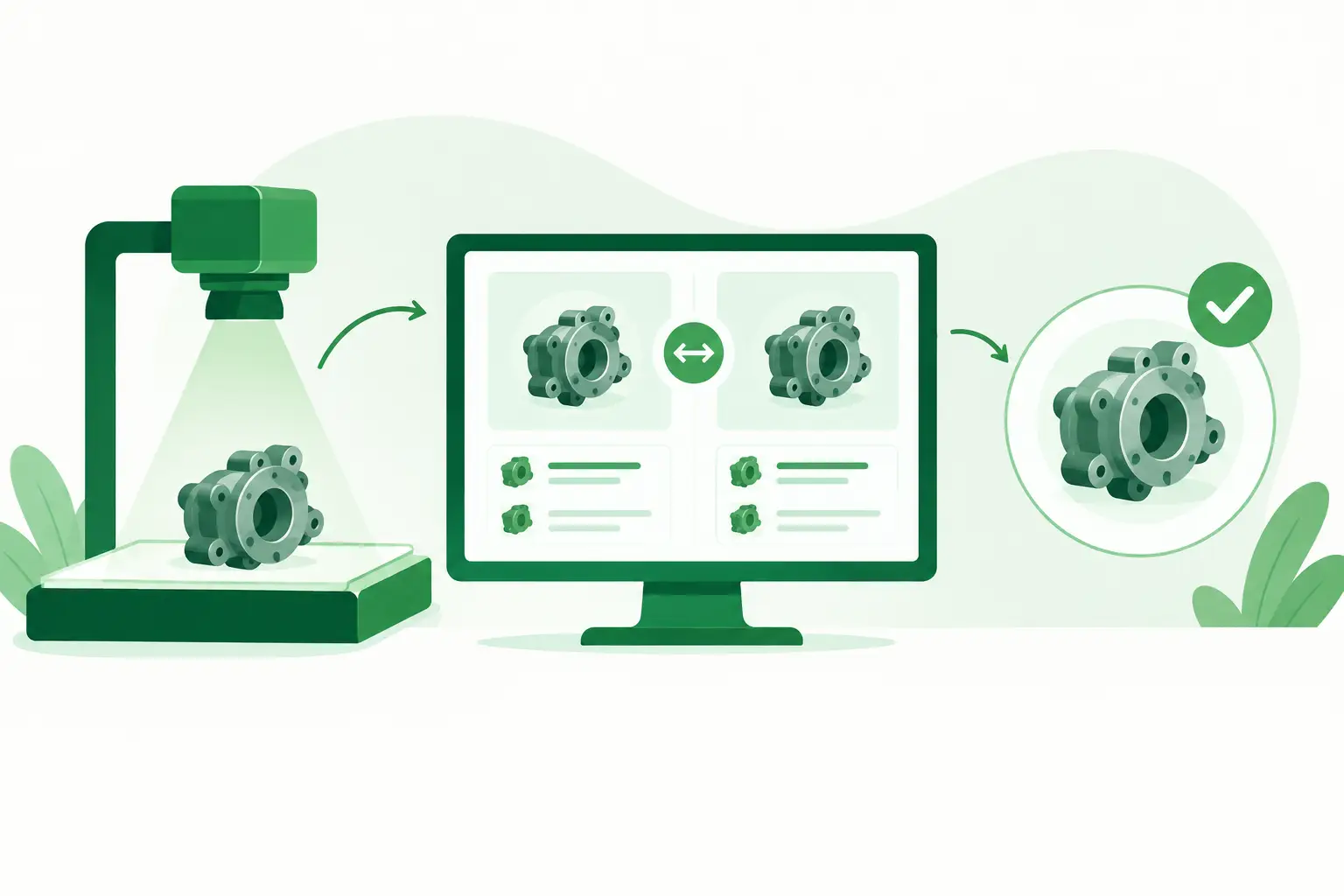
Part-number-level verification is essential once the defective assembly is identified. MRI components that appear similar may differ by scanner model, field strength, software generation, gradient configuration, revision, connector arrangement, or amplifier compatibility. A correct replacement request should include the OEM part number from the failed component when available, system model, serial or configuration details, fault description, and any relevant photographs of labels and connectors.
For legacy systems, the repair-versus-replacement decision depends on the failed item. A serviceable amplifier board or cooling component may justify repair. A coil assembly with confirmed internal winding damage may require replacement or a specialized rebuild path. Lead time, system age, installation requirements, and availability of matching components all influence the practical choice.
Protecting Uptime When a Gradient Fault Is Confirmed
Once the fault is isolated, speed depends on accurate information, not just a fast search. A supplier should be able to work from an exact OEM part number and confirm compatibility against the system configuration. For difficult MRI spares, request condition details, testing information where applicable, revision confirmation, and clear identification of what is included with the assembly.
Meditegic supports this type of sourcing need by locating exact-match MRI gradient components, amplifier assemblies, cooling parts, cables, and control electronics across major OEM platforms, including older systems where standard channels may be limited. The objective is not to replace more than necessary. It is to obtain the correct component with enough technical certainty to return the scanner to service efficiently.
When an MRI gradient fault appears, treat the scanner's symptoms as evidence rather than a parts list. The right diagnosis can preserve a repairable subsystem, avoid a mismatched replacement, and put clinical capacity back where it belongs: available for the next scheduled patient.