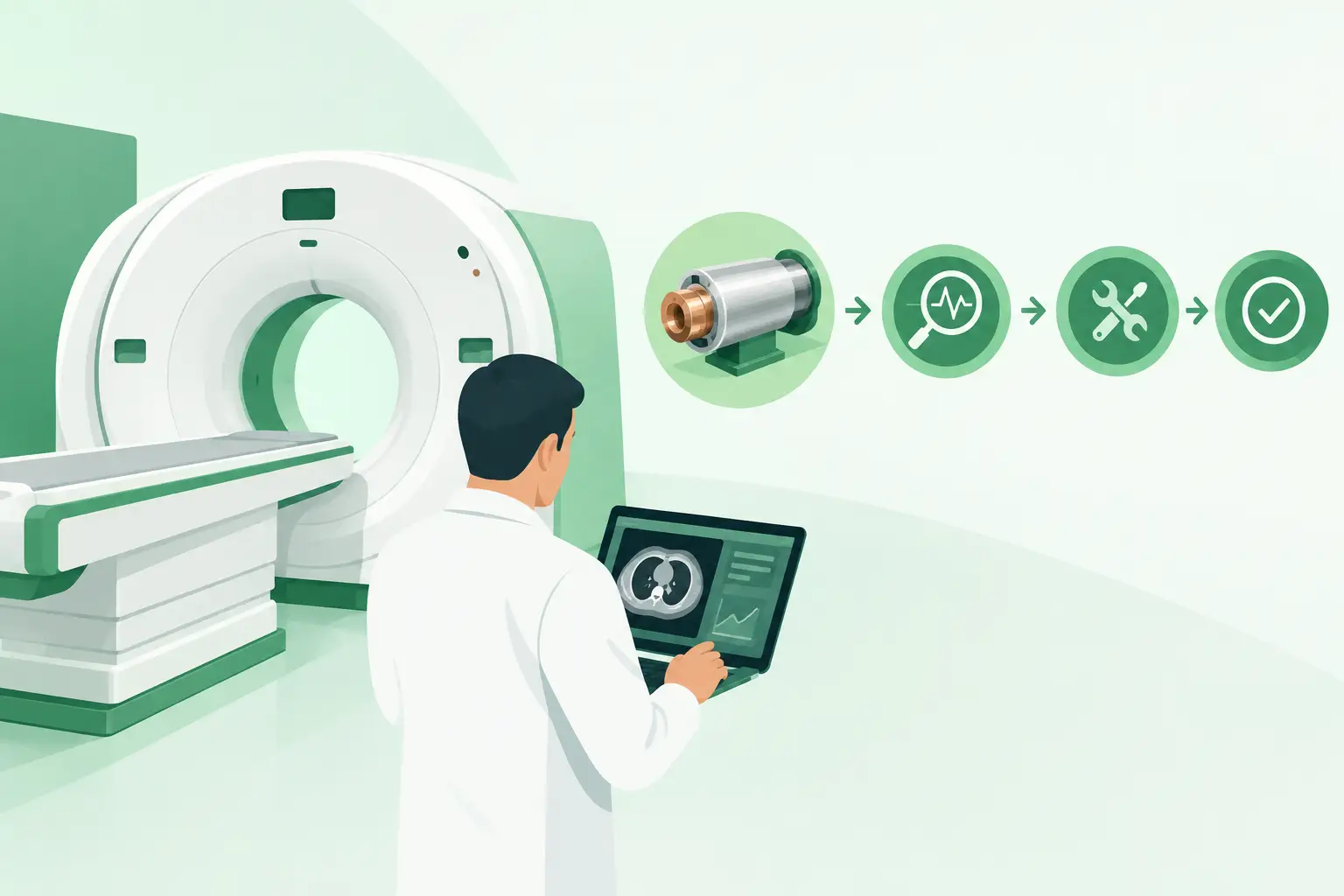
A CT scanner can be sidelined by a component that is difficult to inspect, hard to cross-reference, and rarely stocked as a simple off-the-shelf spare. Finding the best sources for CT slip rings is therefore not just a purchasing task. It is a technical sourcing decision that affects gantry repair time, system reliability, service-call exposure, and the clinic's ability to keep scheduled examinations moving.
CT slip rings operate within one of the scanner's most demanding assemblies: the rotating gantry. Depending on the system design, the slip-ring assembly transfers power, control signals, and data between stationary and rotating sections. A replacement must align with the specific CT platform, gantry configuration, interfaces, mechanical fitment, and service requirements. A part that looks similar, or even comes from the same OEM family, may not be a usable substitute.
For biomedical teams, independent service organizations, and imaging equipment refurbishers, the strongest source is usually the supplier that can verify the exact assembly before shipping, not simply the supplier that lists a generic CT slip ring first.
Why CT Slip Ring Sourcing Requires More Than a Part Search
A slip ring is not a universal wear item. CT manufacturers have used different gantry architectures across product generations, and a part number can be tied to a particular rotational assembly, software generation, cable arrangement, detector configuration, or production revision. Legacy systems make the problem more acute because OEM availability may be limited and the installed base may depend on recovered or refurbished inventory.
The practical risk is a mismatch that is discovered only after the gantry is opened. That can extend downtime, create additional labor cost, and leave a service team searching for a second part while the system remains unavailable. For a busy imaging site, the cost is not limited to the component itself. It includes rescheduled scans, technician time, and the uncertainty of an open repair.
A capable source should be prepared to work from the OEM part number, scanner model, serial number where relevant, and photos of labels or connector locations. The more exact the identification process, the less likely a buyer is to receive a related but incompatible assembly.
The Best Sources for CT Slip Rings by Sourcing Situation
There is no single best channel for every CT slip-ring requirement. The correct source depends on whether the part is current production, discontinued, urgently needed, or part of a complex gantry repair. The following channels serve different purposes.
OEM service channels for current supported systems
The OEM is often the first reference point for a currently supported scanner, particularly when the required part is available under an active service agreement or the repair procedure requires manufacturer-specific support. OEM channels may also provide the clearest documentation for supersessions, revisions, and installation requirements.
The trade-off is availability and lead time. For older CT platforms, an OEM may no longer carry the assembly, may offer only a higher-level replacement, or may not be able to support an individual component within the gantry. Where time is critical, it is wise to begin parallel sourcing rather than waiting for a single channel to confirm stock.
Specialized diagnostic imaging parts suppliers
For discontinued, hard-to-find, or urgently needed CT components, a specialist imaging-parts supplier is often the most effective source. Unlike general industrial component distributors, these suppliers understand that a CT slip ring must be identified in relation to the scanner and gantry assembly, not by a broad product description.
A specialized supplier should have access to used, refurbished, and select new imaging spares, plus the ability to search by OEM part number across multiple inventory sources. This matters for systems from GE Healthcare, Siemens Healthineers, Philips, Canon/Toshiba, and other OEMs with large installed bases and numerous legacy configurations.
Ask whether the supplier can confirm the part-number label, revision status, condition, included hardware, and origin of the component. A supplier that handles CT gantry parts regularly will also recognize when the requested number may refer to a related board, cable set, cooling element, or assembly rather than the slip ring itself.
Meditegic supports this type of exact-match sourcing through a global network focused on diagnostic imaging spare parts, including difficult-to-source CT gantry components for current and legacy equipment.
Reputable CT equipment dismantlers and refurbishers
Dismantled systems can be a valuable source when a slip ring is no longer available through regular distribution. A qualified refurbisher may have parts removed from compatible donor gantries and may retain records showing the donor system model, part number, and operating history.
This route can produce a fast solution, but condition verification is essential. A buyer should establish whether the assembly was tested before removal, whether it was removed from a functioning system, and whether it has been stored in a controlled environment. Photos of the actual unit, including identification labels and connector areas, are more useful than catalog images.
The best dismantlers do not treat recovered inventory as anonymous surplus. They preserve traceability and can explain the donor platform, the part's condition, and any limitations on testing.
Independent service networks with validated surplus inventory
Experienced CT service organizations sometimes hold surplus parts from their own field inventory, system upgrades, or deinstalled equipment. This can be useful when a technician needs a specific legacy assembly quickly and has a trusted relationship with another service provider.
The limitation is consistency. These inventories are typically narrow, documentation can vary, and the seller may not have the resources to perform detailed cross-reference work. This channel is strongest when the buyer already has a confirmed OEM part number and can independently validate compatibility.
Unverified online marketplace listings are a different category. They may help reveal that a part exists in the secondary market, but they should not be treated as a primary sourcing strategy for a critical gantry component. Generic descriptions, stock photographs, missing labels, and no stated test history are warning signs.
What to Verify Before Ordering a CT Slip Ring
The purchase order should follow technical verification, not replace it. Before committing to a source, confirm the OEM part number and any revision or suffix. If the manufacturer has issued a supersession, confirm that the offered assembly is the approved replacement for the installed configuration.
Also verify the exact CT model and gantry version. A system family name alone may not be sufficient. Production changes within the same model line can affect connectors, mounting points, communication interfaces, and associated components.
Condition must be stated clearly. Used, tested, refurbished, and as-removed are not interchangeable descriptions. “Tested” should mean the seller can explain the level of testing performed. “Refurbished” should identify what work was completed, such as inspection, cleaning, electrical evaluation, bearing-related assessment where applicable, or replacement of specified subcomponents. If no functional test is possible outside a complete gantry, the seller should say so directly.
Documentation should include clear photos of the actual part, labels, serial information when available, and a list of included accessories. Determine whether mounting hardware, cable assemblies, shielding, or related interface parts are included. A low component price can become expensive if the needed companion hardware is missing.
Finally, confirm shipping protection and return terms before dispatch. Slip-ring assemblies and related gantry electronics require packaging that protects sensitive surfaces, connectors, and mechanical elements during transit. For international shipments, the supplier should be able to provide accurate commercial documentation and coordinate delivery without creating avoidable delays.
Build a Faster Procurement Process for Critical Gantry Parts
The most effective CT parts teams do not begin their search after a failure occurs. They maintain an equipment record for each scanner that includes model, serial number, gantry identification, known part numbers, service history, and photographs of major labels. That record gives technicians and sourcing staff a much better starting point when a fault leads to a slip-ring investigation.
For systems approaching end-of-life, identify high-risk assemblies before they become urgent. This does not always mean purchasing inventory in advance. It can mean validating capable suppliers, preserving accurate part-number records, and knowing which components have limited secondary-market availability.
When a failure is active, send a complete request from the start: scanner model, OEM part number, revision, photos, fault context, required delivery date, and destination. A precise request reduces clarification cycles and lets a specialist supplier search more effectively across supplier inventory.
The right CT slip-ring source is the one that reduces uncertainty before the part arrives. Exact identification, honest condition disclosure, evidence of compatibility, and responsive logistics matter more than a broad claim of availability. When the gantry is open and the schedule is at risk, that discipline is what turns a difficult spare-parts search into a controlled repair.