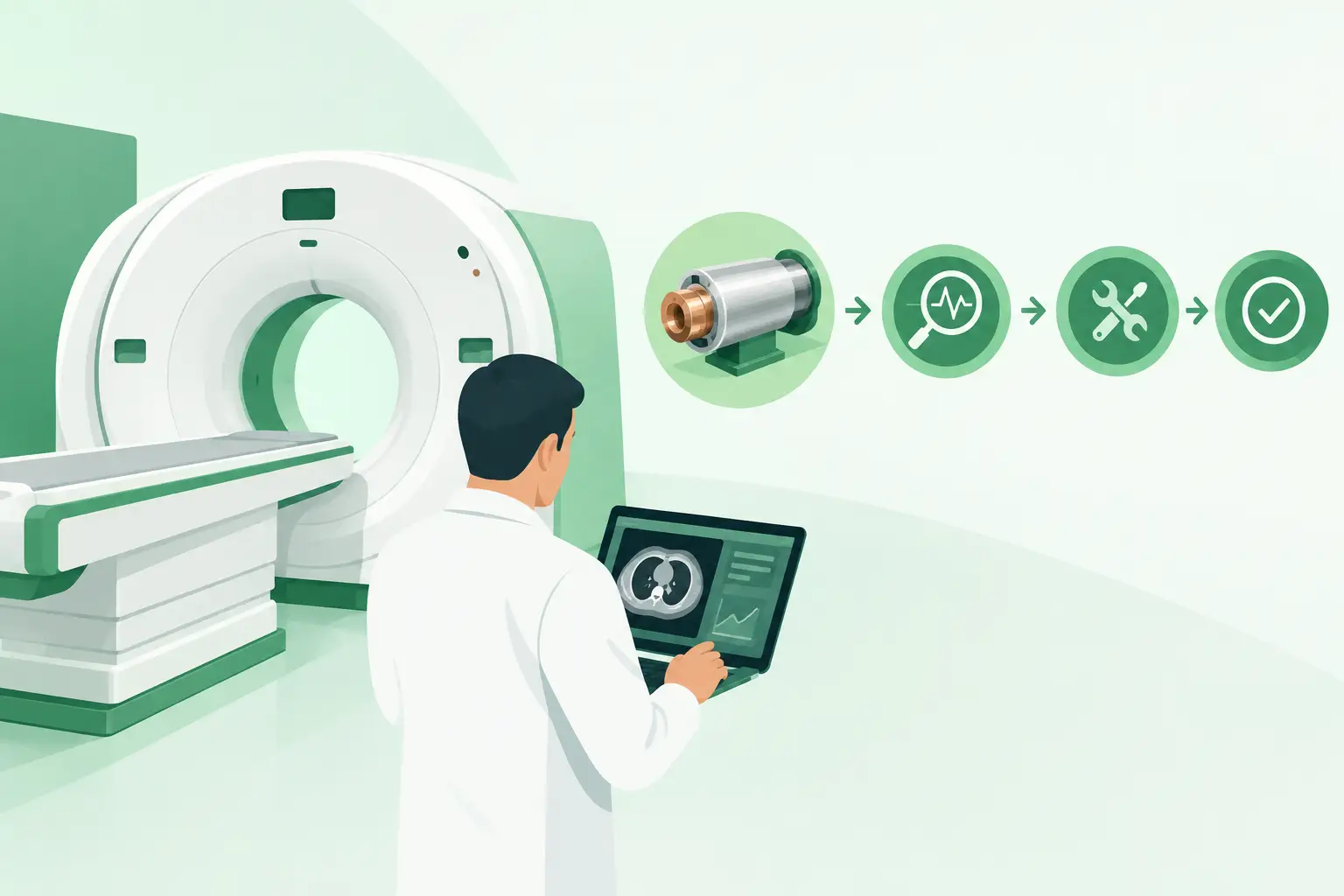
A CT scanner can stay down for days because of one failed gantry part, and the real cost usually starts well before the replacement arrives. Lost scan capacity, delayed patient scheduling, service backlog, and repeated troubleshooting all add pressure. That is why ct gantry component replacement is rarely just a parts transaction. It is a technical procurement decision with direct operational impact.
The gantry is one of the most complex areas of the CT system. It combines high-speed mechanical movement, critical power and signal pathways, cooling, control electronics, and safety interlocks in a tightly integrated assembly. When a component fails, the question is not only what part is bad. The real question is whether the replacement will restore stable performance without creating another fault chain a week later.
Why CT gantry component replacement gets complicated fast
On paper, the request may look simple: identify the failed part, order a replacement, install it, and return the system to service. In practice, gantry failures often sit at the intersection of wear, heat, vibration, calibration sensitivity, and legacy platform constraints.
A failed slip ring-related component, drive element, cooling assembly, sensor board, interlock piece, or gantry control board can present symptoms that overlap with software faults, cable issues, or tube-side problems. Error codes help, but they do not always isolate root cause. A technician may confirm one failed component while still needing to assess whether surrounding assemblies have also degraded.
This is where many delays begin. If the sourcing process starts without precise identification, the wrong part revision or an incompatible substitute can extend downtime instead of reducing it. For older CT platforms, that risk increases because OEM support may be limited, part numbers may have changed, and field documentation may be incomplete.
What matters before you source the replacement
The most useful replacement request is built around exact equipment data and failure context, not just a broad component description. Model, serial number, part number, revision, and clear fault symptoms all matter. If the old label is damaged or the assembly has multiple interchangeable-looking variants, photos and board markings can be the difference between a same-day quote and a long back-and-forth.
For gantry parts, compatibility should always be treated carefully. Two components may look identical and even come from the same product family, but firmware dependency, connector differences, mounting revisions, or calibration expectations can still make one unusable. This is especially true in mixed-service environments where systems have had prior upgrades, undocumented field modifications, or prior aftermarket repairs.
Condition is another practical decision point. Used, refurbished, and new surplus parts each have a place, depending on urgency, budget, and risk tolerance. A refurbished board or assembly may be the right choice when verified function matters more than cosmetic condition. A used part may be appropriate when the need is immediate and stock options are limited. What matters is not the label alone, but traceability, inspection standard, and the supplier’s ability to confirm fitment.
The sourcing risk behind CT gantry component replacement
The hardest part of ct gantry component replacement is often not the installation. It is avoiding procurement mistakes under time pressure.
Technical buyers usually face three recurring risks. The first is misidentification. A symptom-based order placed too quickly can lead to replacing a secondary component while the primary failure remains unresolved. The second is compatibility drift, where a part number appears correct but the revision does not match the system configuration. The third is supply uncertainty, especially on discontinued or low-circulation gantry components where online availability does not reflect actual stock.
A dependable sourcing process reduces those risks by validating part data before shipment, checking alternatives when the original number is unavailable, and setting expectations clearly around condition and lead time. In the CT aftermarket, speed matters, but speed without verification usually costs more.
For imaging service providers and biomedical teams, that is why specialized sourcing support matters. General industrial distributors may handle standard electronics well enough, but gantry-related CT parts often require modality-specific cross-checking and access to fragmented inventory channels. Meditegic operates in that lane, where difficult-to-source imaging components need fast, accurate procurement support rather than generic catalog fulfillment.
Which gantry parts usually drive urgent replacements
Not every gantry issue creates the same urgency. Some faults can be scheduled into a planned maintenance window. Others stop scanning immediately or create unstable operation that cannot be left unresolved.
Drive and rotation-related components tend to be high priority because they directly affect gantry motion and system safety. Cooling-related assemblies are also time-sensitive, especially when overheating risks secondary damage. Control boards and interface modules can be equally urgent because they may trigger startup failure, communication loss, or repeated interlock errors. Sensors, switches, and internal cable sets may look smaller on paper, but when they interrupt gantry readiness, they become mission-critical just as quickly.
The replacement path depends on what failed and how the system is used. A high-volume site may favor the fastest verified available unit. A smaller imaging center may accept a slightly longer lead time for a tested refurbished option that protects budget. Neither approach is universally correct. The right answer depends on downtime tolerance, scanner age, and whether the system is near a broader lifecycle decision.
When replacement is better than repair
Some gantry components can be repaired at board or assembly level. Others should be replaced outright because repair turnaround is too long, failure modes are recurring, or the installed environment does not justify another cycle of troubleshooting.
Replacement is often the better choice when a known-failure assembly is available from stock, when the existing part has visible wear or heat damage, or when labor costs from repeated testing will exceed the value of a direct swap. It is also usually preferred when a service team is supporting multiple sites and needs a predictable return-to-service window.
Repair can still make sense for rare or very expensive parts with little market availability, especially if the failed unit remains the best core for restoration. But in urgent uptime scenarios, waiting on a complex repair process may not be practical. That trade-off should be evaluated early, not after two days of unsuccessful sourcing.
What good suppliers do differently
A supplier that understands CT gantry component replacement should do more than send pricing. The useful value is in reducing ambiguity.
That means asking for the right identifiers, recognizing when a part number may have alternates, confirming stock status realistically, and being transparent about condition. It also means understanding that your team may be balancing service calls, patient scheduling pressure, and internal approval constraints all at once.
For international buyers and independent service organizations, logistics also matter. A hard-to-find gantry component has little value if export handling, packing quality, or documentation slows delivery. Responsive quotation and accurate part validation are part of the product in this market, not separate extras.
Building a better process for future gantry failures
Most organizations only think about gantry replacement strategy when the scanner is already down. A better approach is to tighten documentation before the next failure. Keep part numbers tied to equipment serial numbers, record prior replacements by revision, and save photos of critical assemblies while the system is open during service. Those small steps shorten diagnosis and improve quote accuracy later.
It also helps to know which parts on your installed base are becoming difficult to source. Legacy CT systems can remain productive for years, but only if procurement teams and service teams treat parts availability as part of lifecycle planning. Waiting until a discontinued gantry board fails is rarely the cheapest point to start the conversation.
The practical goal is simple: reduce uncertainty between fault identification and system recovery. When your sourcing partner can validate part fit, offer realistic condition options, and move quickly on hard-to-find inventory, ct gantry component replacement becomes far more manageable.
A down CT system always creates urgency, but urgency does not have to create chaos. The teams that recover fastest are usually the ones that combine sound technical diagnosis with precise, specialized sourcing support.