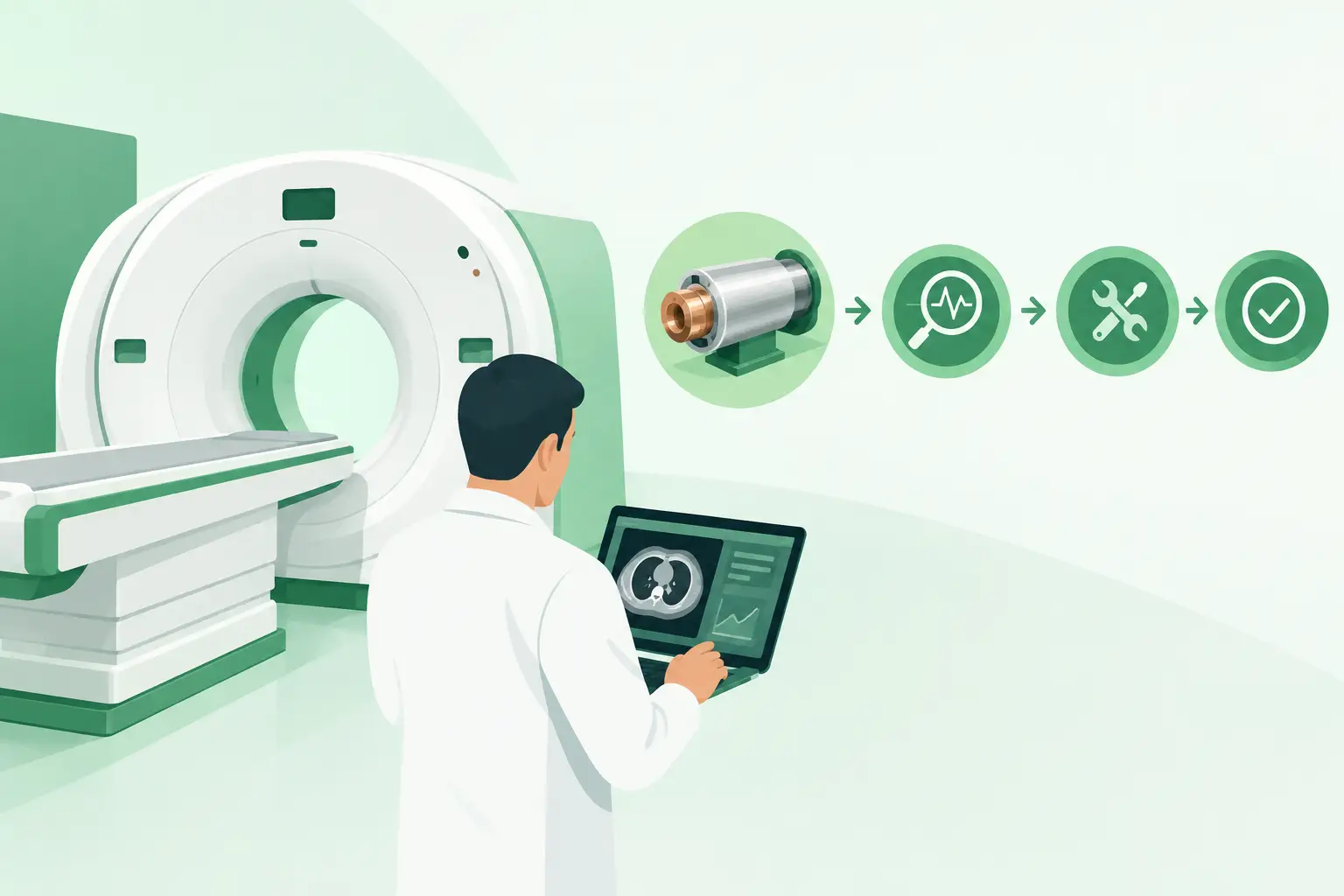
An MRI scanner can be unavailable because of a component that is physically small but operationally critical: an RF coil with an intermittent channel, a failed coil interface board, a table-positioning assembly, or a cooling-system component. Sourcing MRI parts and coils is therefore not a general purchasing task. It is a technical identification and verification process where the wrong revision, connector configuration, or software compatibility can extend downtime rather than resolve it.
For clinical engineering teams, ISOs, refurbishers, and imaging service providers, the objective is clear: obtain an exact-match replacement that restores the system safely and predictably. That requires more than matching the scanner manufacturer and model family.
What Falls Under MRI Parts and Coils?
MRI replacement parts span several interdependent subsystems. RF coils receive the weak signals emitted by hydrogen nuclei after excitation, making them central to image quality, protocol coverage, and patient throughput. The term “coil” may refer to a head, knee, spine, body, extremity, cardiac, breast, or flexible surface coil, but each has distinct channel counts, cabling, positioning hardware, and system compatibility requirements.
The broader MRI parts category includes RF amplifiers, transmit-receive modules, preamplifiers, coil interface electronics, gradient components, power supplies, computer boards, patient table assemblies, bore and room cooling components, cabinet fans, monitors, console hardware, and system-specific cables. A fault in any one area may present as a coil issue, an image artifact, a communication failure, or an intermittent system error.
This is why a part request should begin with evidence, not assumptions. An error code, service log entry, photographs of labels and connectors, and the full OEM part number help distinguish a failed coil from a failed interface, cable, RF-chain component, or configuration issue.
MRI Coils Are Not Interchangeable by Appearance
Two coils can look nearly identical and still be unsuitable substitutes. The same anatomical coil design may exist in different revisions for different magnet generations, field strengths, software releases, patient tables, or coil connection architectures. A coil intended for one platform may not register correctly on another, even where the connector appears compatible.
The Details That Determine Compatibility
The OEM part number is the primary identifier, including suffixes, revision levels, and assembly numbers. A serial number can also be useful when tracking manufacturing versions or confirming service history. Buyers should provide the MRI manufacturer, scanner model, field strength, and available system software information when requesting a replacement.
Connector style and pin configuration matter as much as the label. Coil ports can differ by generation, and adapter use is not automatically appropriate. The physical fit must also be verified: table mounts, patient supports, cable routing, coil housing dimensions, and positioning accessories vary between platforms.
Channel architecture is another common source of mistakes. A multi-channel receive coil may be tied to a particular receiver configuration and imaging workflow. Replacing it with a similar but lower-channel coil can affect available protocols, acceleration techniques, image quality, or workflow expectations. In other cases, the system may reject an incompatible coil outright.
For this reason, “head coil for a Siemens MRI” or “GE knee coil” is not enough information for a dependable quote. A precise request is usually built around the part number first, then confirmed against the system configuration.
How to Assess a Coil Before Replacement
Not every image-quality problem calls for immediate coil replacement. Before sourcing a coil, service personnel should isolate the failure as far as practical using approved diagnostic procedures. A recurring channel error, localized signal drop-out, visible cable damage, fluid ingress, broken latches, or repeated failure on the same coil can point toward the coil assembly. However, a port issue, interface board fault, or receiver-chain problem can produce similar symptoms.
A controlled swap test, where permitted by service procedures and available equipment, can help determine whether the fault follows the coil or remains with the scanner port. Comparing behavior across compatible coils and ports can reduce the risk of ordering a part that will not correct the underlying failure.
Physical inspection still has value. Check housings for cracks, stress around cable strain relief, damaged locking mechanisms, bent pins, corrosion, and damaged patient-contact surfaces. For flexible coils, inspect for folds, tears, and internal conductor damage caused by repeated handling. These observations should be documented before the unit is sent for evaluation or replaced.
Replacement decisions also depend on operational context. A dedicated coil that supports high-volume exams may warrant an immediately available replacement, while a lower-use specialty coil may be suitable for repair evaluation if a backup is available. The correct path depends on clinical demand, failure mode, lead time, and the system’s remaining service life.
Used, Refurbished, and Select New MRI Spares
For legacy and current MRI platforms, used and refurbished parts are often the most practical route when an OEM part is discontinued, unavailable, or subject to a long lead time. That does not mean all pre-owned components are equal. Condition, traceability, functional testing, repair history, completeness, and packaging requirements should be addressed before shipment.
A used coil may be appropriate when it has been verified as functional and the required part number, revision, and connector details are confirmed. A refurbished coil may be preferable when known wear items, housings, cables, or electronics have been evaluated or repaired. The right choice depends on the component, the failure risk, and the urgency of returning the scanner to service.
For electronics such as RF boards, power supplies, and gradient-related assemblies, buyers should ask whether the unit is supplied as an exact exchange, an outright purchase, or a repairable core transaction. Those terms affect turnaround planning, return obligations, and total cost. They also matter when a failed unit must remain available for troubleshooting until the replacement is installed and validated.
A Better Procurement Workflow for MRI Parts
Fast sourcing begins with a complete technical request. Sending only a general description typically creates additional rounds of questions and delays the quote. At minimum, provide the OEM part number, scanner manufacturer and model, system serial number where relevant, the failed component description, error codes or symptoms, and clear photos of labels and connectors.
For coils, include the anatomy, channel count if known, coil type, cable condition, and whether the request is for a complete assembly or a specific accessory. For cabinet components and boards, photographs of the front and rear labels, revision stickers, and connectors are particularly helpful. Many parts have alternate numbers that are not visible in standard equipment documentation.
A reliable sourcing partner should cross-reference the request at the OEM part-number level rather than relying only on broad modality categories. This is especially important for older GE Healthcare, Siemens Healthineers, Philips, Canon/Toshiba, Hitachi, and other installed MRI platforms where multiple generations remain in active service.
Meditegic supports this process by sourcing difficult imaging spares through a global supplier network, with a focus on exact-match identification for MRI and other diagnostic imaging modalities. For an urgent request, technical accuracy is what protects turnaround time. A quick quote for the wrong component is not a solution.
Common Mistakes That Extend MRI Downtime
The most costly sourcing errors tend to be preventable. Ordering from a partial label, assuming identical-looking coils are interchangeable, or omitting a revision suffix can result in a part that cannot be installed or recognized by the system. Another frequent problem is treating a coil as the confirmed failure without checking the port, interface, and RF path.
Buyers should also account for shipment handling. MRI coils contain sensitive electronics and mechanical elements that can be damaged by poor packing. A coil should be protected against impact, cable strain, and movement inside the shipping container. For returnable cores, document the condition before shipment and follow packaging instructions closely.
Finally, plan for installation and acceptance testing. Receipt of the part is not the end of the procurement process. The service team needs the appropriate window to install the component, run applicable diagnostics, confirm coil recognition, check image quality, and verify that the original symptom has been resolved.
Keep Part Data Before the Failure Occurs
The most effective time to collect MRI coil and component information is before a failure takes a scanner out of service. Maintaining a record of installed coil part numbers, available backups, common service parts, system configurations, and prior failure history gives a biomedical department or ISO a faster starting point when an urgent event occurs.
For high-use MRI assets, identify the coils and components whose loss would immediately affect scheduled exams. A current part-number record, a clear fault description, and photographs captured during planned maintenance can turn a difficult emergency search into a focused sourcing request. When uptime is on the line, precise identification is often the shortest path back to imaging.