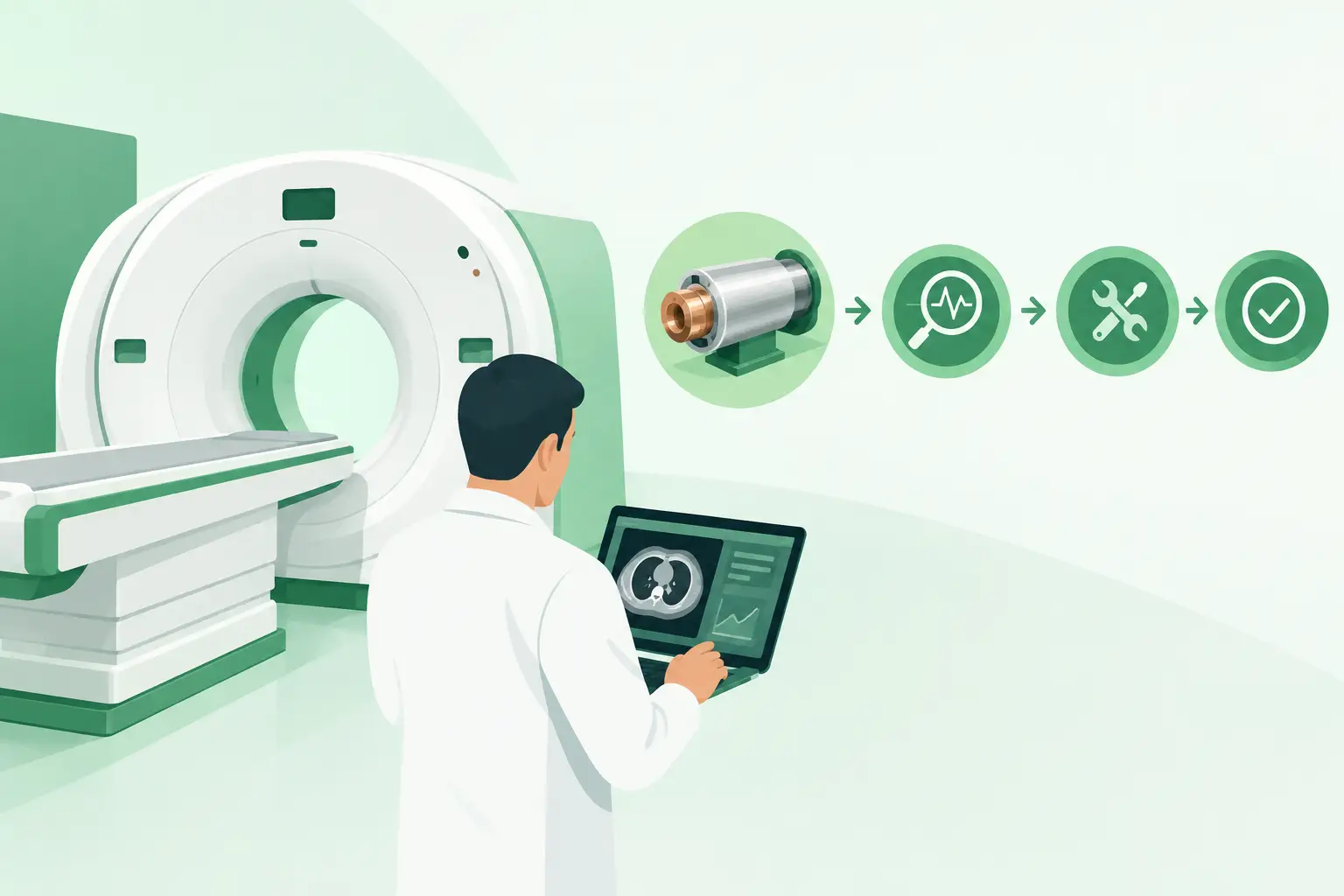
A GE CT scanner can be down because of one failed board, a cooling component, or a table-motion assembly that is no longer readily available through standard channels. In that situation, buying GE imaging spare parts is not a generic procurement task. The replacement must match the system configuration, the failed component, and the service plan closely enough to restore operation without creating a second fault.
For biomedical teams, independent service organizations, and imaging refurbishers, the fastest route is usually not a broad search for a part description. It is a disciplined verification process built around the OEM part number, revision level, modality, and system-specific interfaces. That process matters even more on legacy platforms, where visually similar assemblies may not be interchangeable.
Why GE Imaging Spare Parts Need Exact Verification
GE Healthcare imaging platforms span CT, PET/CT, MRI, nuclear medicine, C-arm and fluoroscopy, general X-ray, mammography, ultrasound, CR/DR, and bone densitometry. Within each modality, generations of systems can use similar names while relying on different electronics, mechanical fittings, firmware requirements, or cable configurations.
A detector board, power supply, ultrasound probe, RF coil, high-voltage component, or workstation assembly can look correct in a photograph and still be wrong for the installed system. Part-number-level sourcing reduces that risk. It also gives the supplier a defined basis for checking available stock, cross-references, alternates, and condition before a quote is issued.
The goal is not simply to find a lower-cost component. It is to return a high-value imaging asset to service with a part that can be installed, tested, and supported with confidence.
7 Checks Before Ordering GE Imaging Spare Parts
1. Start with the OEM part number, not the equipment family name
The GE part number from the removed item, service documentation, or system parts list should be the primary identifier. Include all prefixes, suffixes, dashes, and revision markings. A single suffix can distinguish a board revision, connector format, software-related variant, or factory update.
If the label is damaged or missing, provide clear photographs of every available marking, including serial labels and connector faces. The equipment model and subsystem location are useful supporting details, but they should not replace the part number. “GE CT power supply” is a category. A complete OEM number is a sourcing instruction.
2. Identify the system configuration and modality details
A supplier needs more than the scanner brand and model. For CT and PET/CT, provide the system family, gantry or console configuration, and relevant option details when known. For MRI, identify the magnet platform, coil type, and the specific cabinet or subsystem involved. For ultrasound, the console model and transducer connector configuration are often essential.
This context helps distinguish between parts that are technically related but not compatible. It can also expose dependencies. A replacement console board may require a matched software version; a table component may differ by patient-table configuration; an image intensifier or flat-panel detector may require a particular mounting or calibration arrangement.
3. Confirm what failed before sourcing the replacement
The failed part is not always the root cause. Before ordering, record the fault code, symptoms, recent service history, and diagnostic findings. A no-power condition may be caused by an upstream high-voltage tank, cable, interlock, fuse path, or control board rather than the power supply initially suspected.
This is especially relevant for components that are expensive, scarce, or labor-intensive to replace. If a board has been removed for evaluation, document the reason for removal and whether visible damage, overheating, liquid exposure, or connector damage is present. That information helps determine whether an exact replacement, an exchange option, or a broader subsystem review is the more sensible path.
4. Specify the condition required for the repair
Used, refurbished, and select new spare parts each have a place in imaging maintenance. The appropriate choice depends on the component type, equipment age, failure urgency, available testing information, and the buyer's internal quality requirements.
A used assembly may be appropriate when the part is obsolete, the source unit is known, and the repair requires fast access to a discontinued component. A refurbished part may be preferable for assemblies that can be evaluated, repaired, and tested through a defined process. Some parts, particularly complex imaging components, require more detailed discussion of functional status, repair history, and return terms.
Condition labels should not be treated as interchangeable. Ask what was tested, whether the part was removed from a working system, whether repairs were performed, and what documentation is available. The right answer depends on the part. A workstation PCB, MRI coil, X-ray generator component, and ultrasound transducer do not have the same testing criteria.
5. Check revision, firmware, and paired-component requirements
Many imaging parts operate as part of an integrated chain. A control board may communicate with a specific software release. A detector subsystem may rely on matching cables, power modules, or acquisition electronics. MRI components can have system-specific interface requirements that are not apparent from a general description.
Before release, verify whether the replacement must match a revision exactly, whether firmware loading is needed, and whether the original component contains calibration or configuration data. Ask whether companion components, specialized tools, or post-installation procedures are required. These questions are not delays. They prevent a replacement from arriving only to become the next item on a troubleshooting list.
6. Give the supplier installation and delivery constraints
A part that is correct but arrives too late does not solve an uptime problem. State whether the system is fully down, operating with limited capability, or scheduled for service. Include the desired delivery date, shipping destination, receiving hours, and any packaging concerns for sensitive electronics, detectors, probes, coils, or high-voltage assemblies.
For international buyers, confirm the delivery contact, destination details, and any documentation needed for import handling before shipment. This is particularly useful in regions where OEM support or conventional imaging-parts distribution is limited. Clear logistics information allows the sourcing process to focus on parts that can actually meet the repair window.
7. Keep the removed component and preserve traceability
Do not discard the failed item until the replacement is installed and the system has passed appropriate checks. The original label, revision code, and connector layout may be needed during final compatibility verification. In some cases, the removed component may also be relevant to an exchange arrangement or repair assessment.
Maintain a simple record containing the equipment serial number, failed part number, replacement part number, supplier information, installation date, fault description, and test results. This record improves future troubleshooting and helps service teams spot repeat failures. It is also valuable when a legacy system has multiple field modifications that are not reflected in basic equipment documentation.
What a Useful Parts Request Looks Like
A complete request shortens the quotation cycle and reduces back-and-forth. At minimum, it should state the OEM part number, equipment modality and model, quantity, required condition, fault context, and delivery destination. Photos of the label and component are highly useful when part numbers are incomplete or when multiple revisions are in circulation.
For example, a request for a GE ultrasound transducer should identify the probe model, connector type, console model, and the observed issue, such as cable damage, image dropout, or failed element performance. A request for a CT assembly should include the exact part number, scanner family, subsystem position, relevant fault codes, and whether related cables or boards have already been tested.
The quality of the request directly affects sourcing accuracy. It lets a specialized supplier search beyond a simple keyword match and evaluate actual compatibility across available inventory and global supplier channels.
When an Alternate Part May Be Acceptable
An alternate, superseded, or cross-referenced part can be a practical solution, particularly for end-of-life GE platforms. But it should never be accepted solely because it is described as compatible. The supplier should establish the basis for the substitution: an OEM cross-reference, a matching revision, known field interchangeability, or a documented configuration requirement.
There are situations where an exact match remains the better choice. That is common when the component carries configuration data, interfaces with proprietary software, affects image acquisition, or is paired with another assembly. For urgent repairs, an available alternate can reduce downtime, but only after the technical fit has been verified.
Meditegic supports this process by sourcing exact-match and hard-to-find diagnostic imaging components at the part-number level across GE and other major OEM environments. For buyers managing legacy systems or an active service call, detailed identification data is what turns a difficult search into an actionable quote.
A carefully documented request will usually save more time than a rushed order. When the system, part number, revision, condition, and fault context are aligned before shipment, the replacement has a far better chance of being the component that gets the imaging room back into service.