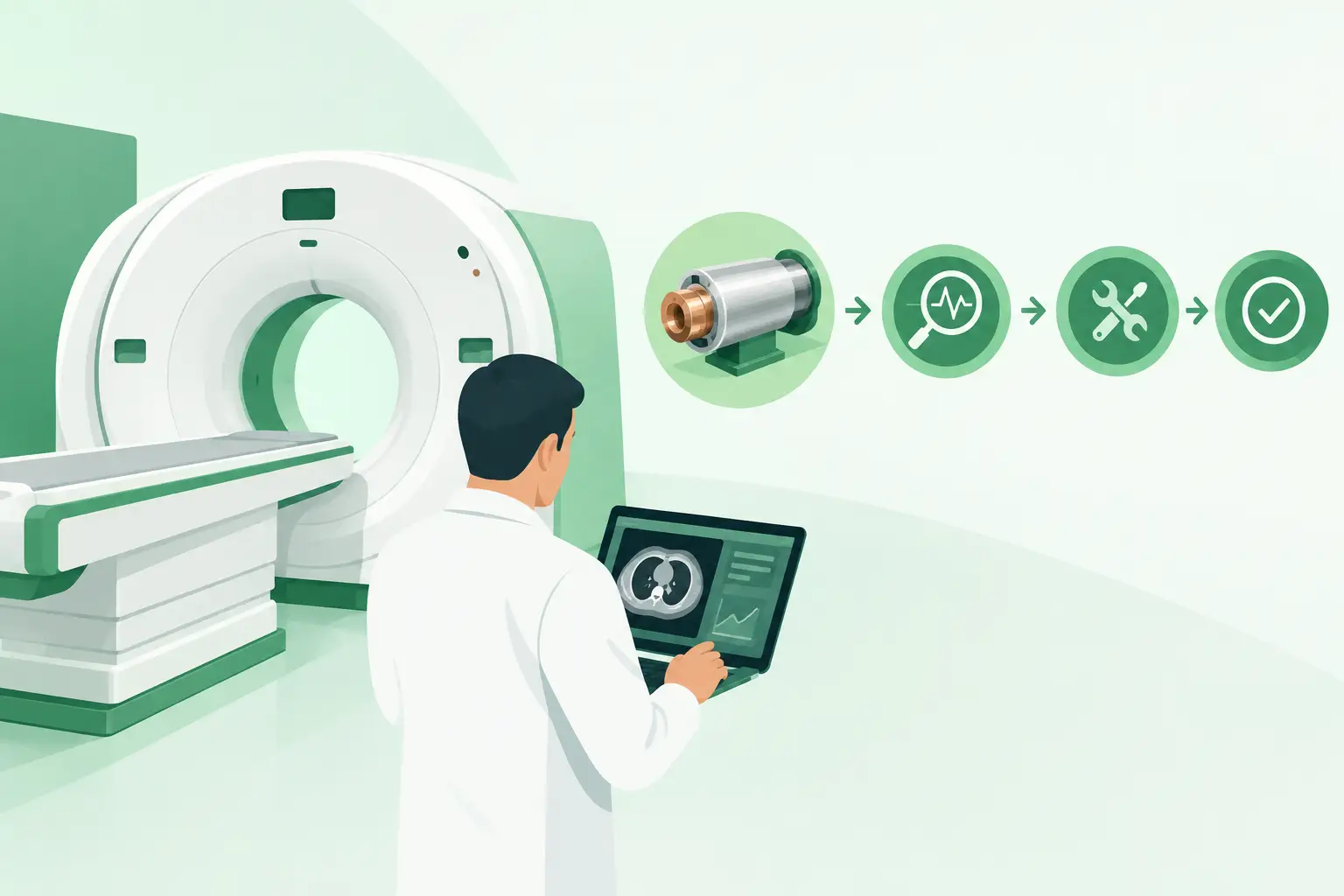
A CT scanner can be fully serviceable except for one failed high-voltage component. An ultrasound system may be down because a specific transducer is damaged. A legacy C-arm can be waiting on a control board no longer supplied through the original channel. These are the situations where hard to find replacement parts become an uptime problem, not simply a purchasing task.
For clinical engineering teams, independent service organizations, and imaging equipment refurbishers, the objective is not to find a similar-looking component. It is to secure an exact, traceable replacement that restores the system correctly and avoids extending downtime through a second failed procurement attempt.
Why Imaging Parts Become Hard to Find
Diagnostic imaging systems have long service lives. A facility may operate an MRI, general X-ray room, mammography unit, or ultrasound platform for years after the OEM has shifted its support focus to newer generations. During that period, a part can become difficult to source for several reasons: the manufacturer may discontinue it, inventories may be absorbed by service organizations, or available stock may be listed under incomplete or incorrect descriptions.
The challenge is especially acute with parts that are specific to a particular system configuration. Examples include CT detector modules, MRI RF coils, X-ray tube housings, image intensifiers, flat-panel detectors, ultrasound probes, gantry boards, high-voltage tanks, cooling assemblies, and console components. Two items can share a general category and still be electrically, mechanically, or software-incompatible.
Part scarcity also changes over time. A component that was routinely available six months ago may disappear after a common failure trend, a system retirement cycle, or a reduction in recoverable donor equipment. Conversely, a part marked obsolete in one supplier catalog may still be available through properly identified surplus, tested used stock, refurbished inventory, or global recovery channels.
The Part Number Is the Starting Point, Not a Detail
When sourcing a difficult imaging spare, the OEM part number is the most useful piece of information a buyer can provide. It turns a broad request such as “Siemens X-ray board” or “GE ultrasound probe” into a sourcing task that can be verified across supplier inventories.
A complete request should include the part number from the component label, the equipment manufacturer, system model, and the failure context when it affects compatibility. For a board or workstation component, revision number, serial range, software version, and connector configuration may matter. For a transducer, probe model and connector type are essential. For a detector, buyers may need to confirm calibration, interface, or system-specific compatibility before committing to a replacement.
Photographs of labels, connectors, and the installed component are often valuable when the label is worn, the number has multiple formats, or the equipment documentation conflicts with the physical part. This is not administrative overhead. It reduces the risk of receiving a component that fits the category but not the system.
Avoid substituting based on appearance alone
Imaging parts are often visually similar across model families. A power supply may use the same enclosure but a different voltage specification. An MRI coil may use a similar connector while requiring a different system interface. A collimator may mount in the same position but have different field coverage or control requirements.
A supplier should be able to explain whether the offered part is an exact match, an approved cross-reference, or a potential alternative requiring technical confirmation. If that distinction is unclear, the lowest quoted price can quickly become the highest-cost option once return freight, additional downtime, and repeated troubleshooting are considered.
A Practical Process for Sourcing Rare Imaging Spares
The fastest path is usually a disciplined request process, not sending a vague inquiry to dozens of general suppliers. Begin by identifying the failed assembly and confirming whether the failure has been diagnosed at the component level. Replacing a board, power supply, or tube assembly before confirming the root cause can create an expensive false repair.
Next, collect the information needed to match the part precisely: OEM part number, manufacturer and system model, revision level where applicable, photographs, quantity required, and the time window for delivery. State whether a used, refurbished, or select new spare is acceptable. Condition flexibility can materially expand the available supply pool, but it should never replace compatibility verification.
Then assess the offer on more than availability. Ask about the part’s condition, whether it has been inspected or tested, what is included, and whether any core return is expected. For items such as ultrasound transducers, flat panels, X-ray tubes, and complex electronics, the meaning of “tested” should be relevant to the component. A basic power-on check is different from functional testing under operational conditions.
Finally, plan the installation side. Some replacements require configuration, calibration, alignment, software setup, or post-install quality checks. The sourcing decision should account for the technician, tools, documentation, and service window required to return the imaging asset to clinical operation.
Used, Refurbished, or New: Choosing the Right Condition
There is no single correct condition category for every imaging spare. The right choice depends on urgency, component type, system age, budget, and the level of inspection required by the service team.
Used parts can be appropriate when the component has been removed from a working system, is correctly identified, and can be evaluated before installation. They may be the most realistic route for legacy gantry assemblies, obsolete PCBs, table components, legacy consoles, and other discontinued items where alternatives are limited.
Refurbished parts are often preferable where a component can be meaningfully restored or tested, such as certain power supplies, electronics, RF coils, cooling components, and selected mechanical assemblies. Refurbishment quality varies by part type and process, so buyers should confirm what work was performed rather than treating the term as a universal standard.
Select new spares can be the appropriate choice for parts still available through authorized channels or specialized inventory. Availability, however, is not guaranteed simply because a system remains installed. For end-of-life platforms, an experienced aftermarket sourcing partner may have access to inventory that is no longer visible through conventional distribution.
Where General Suppliers Fall Short
General industrial or medical supply channels can handle common items, but they are often not organized around modality-specific compatibility. A buyer looking for a Philips detector, Canon/Toshiba tube assembly, Hologic mammography component, Fujifilm CR part, or Hitachi ultrasound probe needs more than a category match. They need a supplier that can work from the OEM number and understand the system context.
This becomes more important when a request crosses modalities and brands. A service provider supporting GE Healthcare CT, Siemens Healthineers MRI, Philips fluoroscopy, and Samsung/Medison ultrasound equipment may need a single sourcing resource that can locate parts across multiple manufacturer ecosystems without forcing the team to rebuild its search process each time.
Meditegic specializes in this exact-match work, sourcing used, refurbished, and select new diagnostic imaging spares through a global supplier network. The focus is operational continuity for systems where a missing detector, coil, board, probe, or high-voltage component can keep a high-value asset offline.
Questions That Protect the Repair
Before placing an order for a scarce component, technical buyers should resolve several practical questions. Is the offered item the exact OEM part number, including the relevant revision? Has it been tested in a way that is meaningful for its function? Are accessories, cables, brackets, or connectors included if they are required for installation? What is the actual dispatch timing, rather than the estimated availability date?
It is also reasonable to ask whether the supplier has identified any known compatibility limitations. For example, a replacement console board may need a specific software image, while a detector may require calibration procedures after installation. These issues do not necessarily make the part unsuitable. They simply need to be known before the equipment is opened and the service team is on site.
For urgent cases, clear communication can save more time than an aggressive quote request. Provide the exact part number first, identify the system, state the required delivery window, and indicate whether an alternate condition is acceptable. That allows the sourcing team to pursue viable inventory immediately rather than spending hours clarifying the basic requirement.
Build a Better Record After Each Repair
Every hard-to-source repair produces useful information. Record the confirmed part number, system configuration, failure mode, replacement condition, installation requirements, and supplier performance. Over time, this creates a practical internal reference for recurring failures and vulnerable legacy assets.
For equipment with known supply risk, it may be worthwhile to identify critical spares before failure occurs. This does not mean stocking every component. It means recognizing which single items - such as a specific probe, control board, detector component, or power module - could create prolonged downtime if they fail without a sourcing plan.
When a difficult part is needed, speed matters. Accuracy matters first. A precisely matched component, verified against the system and sourced through the right channels, gives the repair team the best chance of turning an urgent outage into a completed service event rather than a prolonged search.