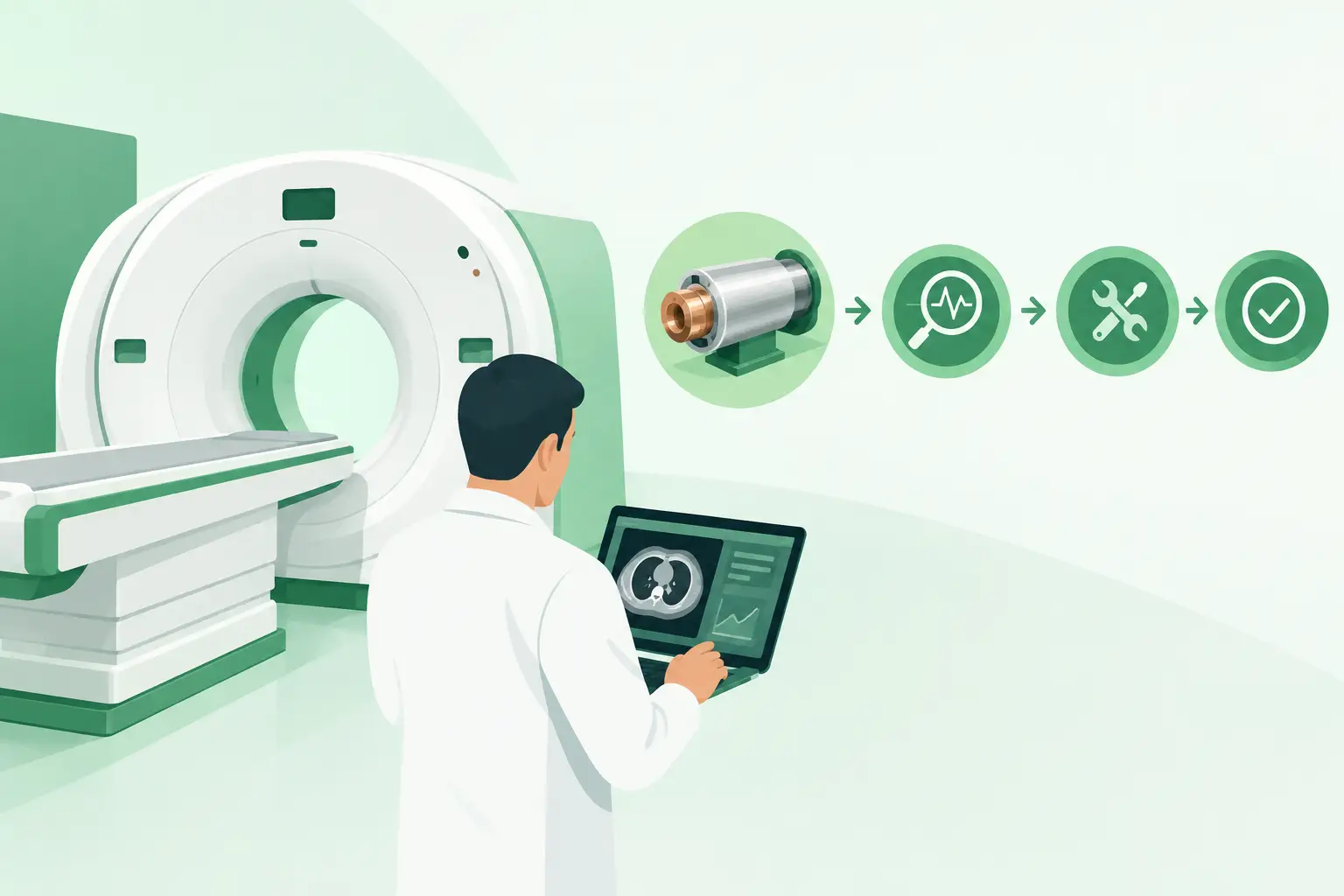
A CT room can be ready for a full day of scheduled scans, yet remain idle because of one failed high-voltage tank, detector board, or console component. That is the operating reality behind a guide to healthcare aftermarket procurement: the job is not simply to find a part at an acceptable price. It is to identify the exact replacement, establish its condition and compatibility, and get it into the service workflow without introducing a second failure point.
For biomedical departments, ISOs, refurbishers, and private imaging providers, aftermarket procurement is most valuable when OEM support is limited, a component is discontinued, or a repair cannot wait through a standard supply cycle. The process demands more technical discipline than general purchasing because imaging systems are configuration-sensitive, revision-dependent, and costly to keep offline.
What Healthcare Aftermarket Procurement Covers
Healthcare aftermarket procurement is the sourcing of replacement components for installed diagnostic imaging equipment outside a conventional OEM supply path. It can include used, refurbished, and select new spare parts, depending on the component, system age, required lead time, and service strategy.
In diagnostic imaging, the relevant inventory is highly specific. A buyer may need an ultrasound transducer for a particular platform, a flat-panel detector for a DR room, an MRI RF coil, a C-arm image intensifier, a PET/CT power supply, or a PCB identified by an OEM part number. The same requirement can apply to X-ray tube housings, collimators, cooling assemblies, gantry components, tables, workstations, and control boards.
The word "aftermarket" should not be treated as a synonym for generic. A part can be physically similar to another component and still be unsuitable because of firmware, connector configuration, revision level, calibration requirements, or system-specific options. Procurement starts with identification, not with a broad product description.
Start With an Exact Technical Requirement
The fastest way to delay a quote is to submit a request such as "Siemens CT board" or "GE ultrasound probe." Those descriptions may be enough to begin a conversation, but they are rarely enough to source safely. A precise request gives suppliers the information needed to cross-reference inventory and avoid costly back-and-forth.
For a high-confidence sourcing request, provide the following details:
- OEM part number, including every suffix, revision, and dash code shown on the label
- Imaging modality, manufacturer, system model, and software or configuration information when relevant
- Clear photos of the part label, connectors, boards, and any visible damage
- Serial number of the installed system or failed component when it helps confirm compatibility
- Required condition, such as tested used, refurbished, or new spare part where applicable
- The fault context, urgency, ship-to location, and whether an exchange core is available
Part number accuracy matters more than a familiar system name. One product family may use different detector interfaces, power ratings, board revisions, or coil variants across production years. A supplier that works at the OEM part-number level can search for the correct item rather than offering an approximate match that creates another service call.
Use the Failed Part as the Primary Reference
When possible, source from the label on the removed component, not from an old service record or a broad equipment manual. Documentation can be incomplete, and parts may have been changed during prior repairs. Photographs are particularly useful for legacy systems where a part number may cross-reference to multiple revisions.
If the component is still installed, have a qualified technician capture label details before removal. This is often the difference between an express quote for an available part and a day spent clarifying whether two similar components are actually interchangeable.
Evaluate Condition as Carefully as Compatibility
Used, refurbished, and new spare parts are different procurement choices, not interchangeable descriptions. The correct option depends on the role of the component, the age and value of the system, the urgency of the outage, and what verification can be supplied before shipment.
A tested used component can be a practical choice for a legacy workstation, power supply, table assembly, or hard-to-find board when time is critical. Refurbished parts may be appropriate when the component has a known wear profile or requires repair and functional evaluation before resale. Select new spares can make sense where availability exists and the application calls for that condition.
The buyer should ask what the stated condition means in operational terms. Was the part removed from a working system? Was it functionally tested? Are label photos available? Has the supplier identified cosmetic damage, repair history, or missing accessories? What warranty or return terms apply if the part is verified incompatible despite an accurate request?
There is no single condition category that is best for every repair. A lower purchase price may be attractive, but it has to be weighed against repeat labor, system access time, shipping urgency, and the consequence of another downtime event. For a heavily scheduled CT, MRI, or mammography asset, the lowest-priced component is not always the lowest-cost decision.
Guide to Healthcare Aftermarket Procurement: Verify the Supplier
The strongest aftermarket suppliers do more than list broad categories of inventory. They can work from an exact OEM number, understand modality-specific failure points, and search across multiple channels when the part is not sitting on a shelf.
Assess a supplier on practical evidence. Can they distinguish a tube housing from the tube itself? Do they recognize that an MRI coil may require confirmation of connector type and system compatibility? Can they explain whether a listed detector is the correct panel revision? Are they comfortable sourcing discontinued parts for GE Healthcare, Siemens Healthineers, Philips, Canon/Toshiba, Hologic, Fujifilm, Hitachi, and other current or legacy platforms?
Availability claims also need clarification. "Available" can mean physically in stock, held by a partner, pending testing, or potentially obtainable. Ask whether the item is on hand, whether it has been inspected, and what the realistic dispatch window is. For urgent repairs, that distinction is as important as price.
A specialized supplier should also be able to support the documentation needed for an informed purchase decision: part label images, condition confirmation, packing details, shipping options, and a clear statement of what is included. This reduces the risk of receiving a bare component when the repair requires a specific cable, bracket, interface module, or accessory.
Build Procurement Around Downtime, Not Unit Price
A complete purchasing decision includes more than the component quote. Calculate the probable cost of continued downtime, rescheduled exams, technician labor, expedited freight, and the risk that the system remains unavailable if the first replacement is incorrect.
This does not mean every repair warrants premium shipping or the most expensive condition category. For lower-utilization equipment or a noncritical backup system, it may be reasonable to prioritize cost and accept a longer lead time. For a primary diagnostic asset, a reliable exact-match part with a confirmed dispatch date is usually the more defensible decision.
Procurement teams should establish an escalation threshold before equipment fails. For example, define which modalities require same-day sourcing activity, who approves expedited freight, and what technical data must accompany every emergency request. A simple internal protocol prevents delays caused by waiting for part photos, approvals, or system details while the equipment is offline.
Keep Records That Improve the Next Repair
Every completed purchase should strengthen the next one. Record the installed system model, failed part number, replacement part number, revision, source, condition, arrival date, and repair outcome. Over time, this creates a useful internal history of repeat failures, compatible substitutions, preferred suppliers, and components worth keeping as contingency stock.
Targeted stock is especially useful for parts with predictable failure patterns or difficult lead times. The goal is not to carry excessive inventory. It is to identify a small number of high-impact spares for systems where even a short outage disrupts patient scheduling or service commitments.
Plan for Shipping, Packaging, and Arrival Inspection
Diagnostic imaging components are not ordinary parcels. Flat panels, probes, boards, coils, and high-voltage components may require specialized packaging, static protection, shock protection, or temperature considerations. International shipments can add transit variability and customs documentation requirements, particularly when parts are moving to regions with limited local OEM support.
Before shipment, confirm the destination address, consignee contact, packaging expectations, freight priority, and any import documentation needed by the receiving organization. On arrival, inspect the package before installation. Compare the received part number and revision with the purchase confirmation, photograph any shipping damage, and preserve the original packaging until the component is installed and accepted.
This inspection step is simple, but it protects both the buyer and supplier. It also prevents a technician from losing time installing a component that was misidentified at receiving.
Make the Sourcing Request Easy to Act On
The best aftermarket procurement requests are concise but complete: exact part number, system information, photos, required condition, location, and required delivery date. That gives a technical supplier a clear path to search, verify, quote, and ship.
Meditegic focuses on this part-number-driven process for difficult diagnostic imaging spares across CT, PET/CT, MRI, Nuclear Medicine, C-arm, X-ray, ultrasound, mammography, CR/DR, and DEXA environments. When an imaging asset is down, clear technical information and a supplier that understands the component are the two inputs most likely to shorten the path back to service.