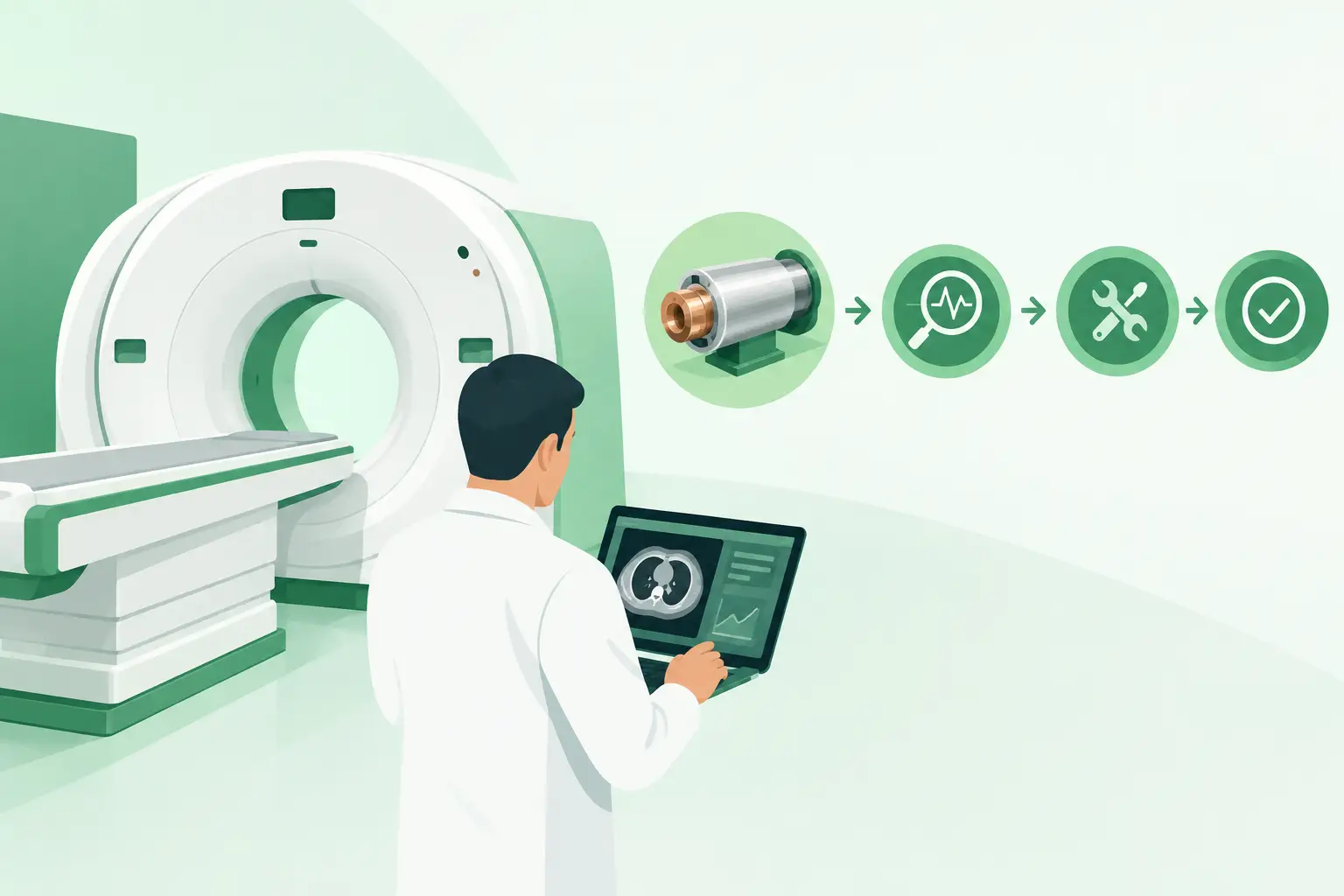
An imaging system can be down for a small component that is inexpensive relative to the asset it supports. A failed power supply, worn table cable, unavailable detector board, or damaged ultrasound probe can halt exams just as completely as a major assembly failure. The right top imaging components to stock are therefore not the most common parts in a catalog. They are the exact-match, failure-prone, long-lead components that protect the systems your team is responsible for keeping operational.
For biomedical departments, ISOs, and imaging service organizations, the goal is not to build a warehouse of speculative spares. It is to establish a controlled inventory strategy based on installed base, service history, part-number accuracy, lead time, and the clinical impact of downtime.
How to Prioritize Top Imaging Components to Stock
Start with the equipment that creates the greatest operational exposure. A high-volume CT scanner, a legacy fluoroscopy room with limited OEM support, or an ultrasound platform used across multiple care locations deserves more attention than a device with low utilization and readily available support.
For each system, identify the specific OEM model, configuration, software generation where relevant, and installed part numbers. A modality name alone is not enough. Two systems from the same manufacturer may use different detector electronics, workstation assemblies, high-voltage components, or transducer interfaces. Stocking a near match is not a downtime solution.
A practical priority model considers four factors: how often the part fails, how long it takes to source, whether it can be diagnosed and replaced in the field, and what happens when the system is unavailable. Components that score high in two or more categories are strong candidates for local stock or a prequalified sourcing plan.
The choice also depends on your service model. A single clinic may keep a focused set of probes, power components, and X-ray room spares. An ISO supporting GE, Siemens, Philips, Canon/Toshiba, Hologic, Fujifilm, and other platforms across a region will typically need a wider but more controlled cross-reference inventory.
High-Value Imaging Spares by Modality
CT and PET/CT: Power, Motion, and Control Components
CT downtime often becomes expensive quickly because of scan volume and the complexity of the system. Complete gantry assemblies are rarely practical inventory items, but their service-critical subcomponents often are.
High-voltage tanks, generator-related power supplies, control boards, gantry communication boards, cooling components, table control assemblies, and table drive parts should be evaluated against the installed base. Detector-related electronics and data acquisition components also warrant close attention when supporting older systems, particularly where repair options are limited and replacement boards have long sourcing cycles.
For PET/CT, system-specific detector electronics, power assemblies, cooling hardware, and workstation components require particular discipline. Verify part numbers, revisions, and compatibility before holding stock. A board from a similar platform may not be usable in the affected configuration.
MRI: RF Coils, Cooling, and Gradient-Related Spares
MRI inventory decisions should focus on components that can interrupt scanning yet may be available only through specialized channels. RF coils are an obvious category, especially high-use coils that are vulnerable to cable, connector, housing, or element failures. Stocking every coil is usually unnecessary, but maintaining coverage for the coils most essential to local exam demand can materially reduce downtime.
Cooling-related components, selected power supplies, patient table assemblies, interface modules, and qualified gradient-related components may also be appropriate for organizations with the technical capability to diagnose and install them. MRI parts are highly configuration-dependent. Coil connector type, software compatibility, magnet platform, and part-number revision should be confirmed before purchase.
X-Ray, C-Arm, and Fluoroscopy: Exposure Chain and Mechanical Wear Items
In general X-ray, mobile X-ray, C-arm, and fluoroscopy environments, the exposure chain and mechanical movement systems are common inventory priorities. Collimators, high-voltage cables, control boards, power supplies, image intensifier components, flat-panel detector assemblies, and tube housing-related components can all create immediate service events.
Detector inventory requires a careful trade-off. Flat panels represent a significant investment and can be sensitive to handling and storage conditions. For a fleet with repeated detector exposure risk or limited access to replacement units, holding a qualified compatible panel may be justified. For lower-volume operations, a rapid sourcing arrangement may be more efficient than local ownership.
Table locks, hand switches, foot switches, cables, brakes, bearings, and position-control boards are smaller components that should not be overlooked. They are often easier to replace than a detector or high-voltage assembly, but can still make the room unusable when unavailable.
Ultrasound: Probes, Power Supplies, and System Boards
Ultrasound transducers are among the most useful spares to keep available because they are high-use, application-specific, and often subject to cable strain, connector damage, acoustic lens wear, or element failure. The right approach is to stock the probes that support your most time-sensitive studies, not necessarily every probe used with the platform.
Confirm the probe model, connector, system compatibility, and clinical application before sourcing. A transducer that physically connects may still lack the required compatibility for a given ultrasound system or software generation.
Beyond probes, consider main power supplies, CPU or acquisition boards, operator-panel components, trackballs, monitors, and console assemblies for platforms that remain heavily used. These parts can be especially valuable for legacy systems where OEM replacement paths have narrowed.
Mammography, CR/DR, Nuclear Medicine, and DEXA
Mammography and DR systems often depend on detector panels, detector control electronics, power supplies, collimators, compression assemblies, workstation components, and motion-related parts. Because image quality and safety functions are involved, replacement components should be evaluated not only for part-number fit but also for condition, testing status, and installation requirements.
For CR, practical stock may include reader power supplies, control boards, transport components, laser-related assemblies, and workstation hardware. In nuclear medicine and SPECT, detector electronics, photomultiplier-related assemblies, power supplies, motion-control boards, and cooling components can be difficult to locate once a platform reaches later lifecycle stages. DEXA systems may require specific detector, table, arm, control, or workstation parts that are no longer routinely available through standard channels.
Stock by Part Number, Not by Description
Descriptions such as "Siemens CT power supply" or "GE ultrasound probe" are useful starting points, but they are not sufficient for procurement. The stock record should include the OEM part number, revision where applicable, manufacturer and system model, modality, condition, test information, date received, storage location, and known compatible configurations.
This discipline prevents a common inventory failure: owning a part that appears relevant but cannot be installed. It also makes it faster to respond when a field engineer calls with an urgent requirement. A searchable part-number record turns internal inventory into a genuine uptime resource instead of a collection of uncertain surplus.
Condition should be defined clearly. Used, refurbished, and select new spare parts can each have a place in an imaging inventory strategy, depending on the component, system age, urgency, and validation requirements. A lower acquisition cost is not meaningful if the part has uncertain provenance or cannot be verified before installation.
Avoid Over-Stocking Through Planned Sourcing
Not every hard-to-find component belongs on a shelf. Large, costly, low-failure assemblies can tie up capital and become obsolete before they are needed. For these parts, the better control is a documented sourcing pathway: accurate system details, confirmed OEM part numbers, known interchange limitations, and a specialist supplier that can search beyond standard distribution channels.
This is particularly useful for legacy platforms and multi-OEM service portfolios. Meditegic supports these requirements through part-number-level sourcing across CT, MRI, PET/CT, X-ray, fluoroscopy, ultrasound, mammography, nuclear medicine, CR/DR, and DEXA components, helping technical buyers locate exact-match spares when internal inventory does not cover the failure.
Review stock at least quarterly, and after any significant failure event. Parts used during an urgent repair should be replenished based on the actual reason they were needed. Parts that have become obsolete, damaged in storage, or unsupported by the remaining fleet should be reassessed rather than automatically reordered.
The best imaging spare-parts inventory is not the largest one. It is the one that lets a technician identify the failed component, confirm the correct part number, and move immediately toward a qualified replacement when uptime is on the line.