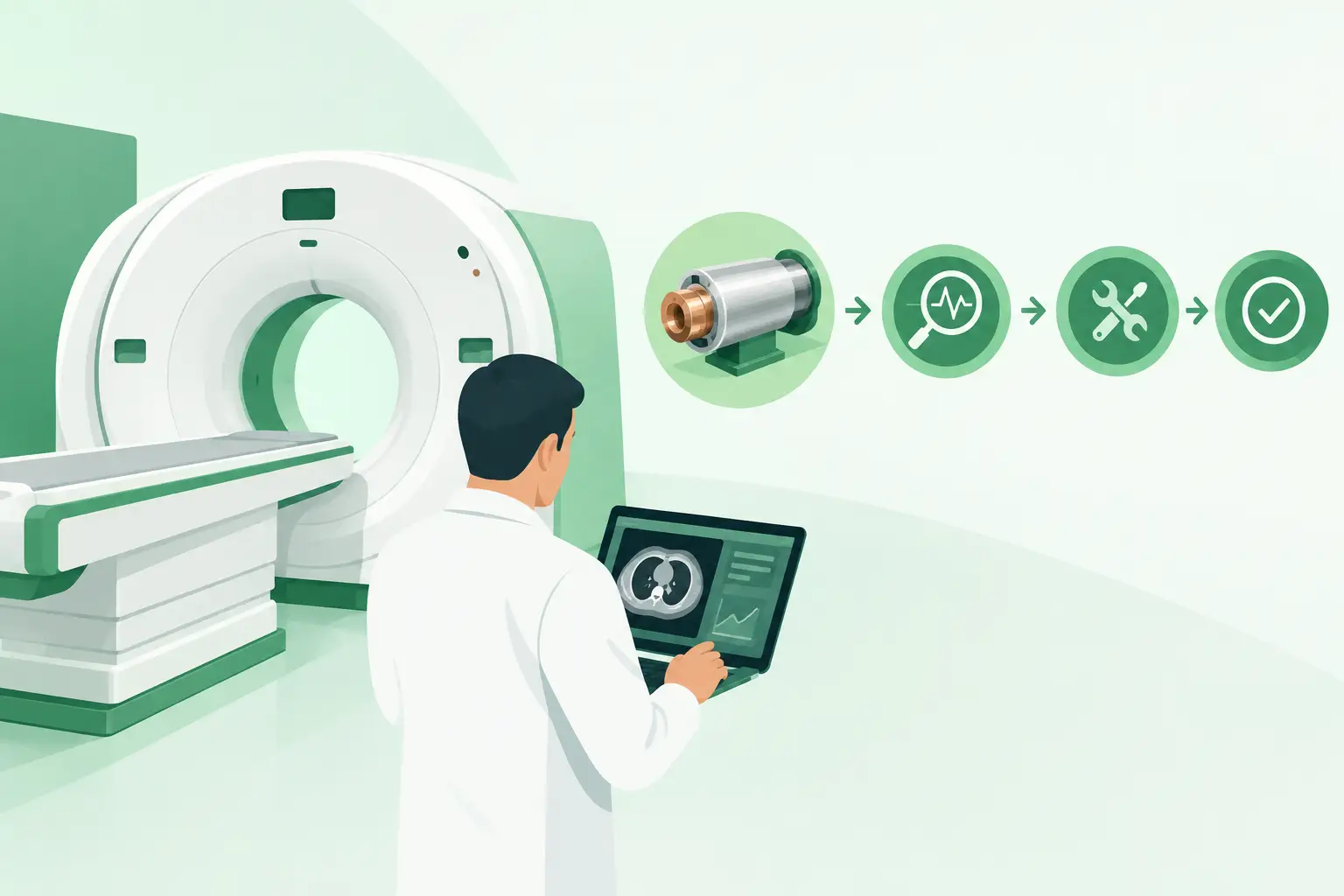
A CT gantry cannot remain down because a power supply is difficult to identify. An ultrasound room cannot wait weeks while a probe model is guessed from a photo. Rare healthcare component sourcing is the discipline of finding the correct replacement part for a specific imaging system, confirming that it will work in that system, and moving it quickly enough to protect clinical capacity and service commitments.
For biomedical teams, independent service organizations, and imaging equipment refurbishers, the challenge is rarely just locating a part with a similar description. It is matching the OEM part number, revision, configuration, connector set, and operating compatibility for equipment that may be several generations old. The wrong component can extend downtime, create an avoidable return, or introduce a new fault into a system that was otherwise serviceable.
Why Rare Healthcare Component Sourcing Is Different
Diagnostic imaging parts are not interchangeable simply because they look alike or carry a similar family name. A detector, MRI RF coil, high-voltage tank, image intensifier, or control board may have several revisions with different firmware requirements, mounting points, cables, or calibration dependencies. A replacement must be assessed at the part-number level, not by modality alone.
This becomes more difficult as systems move beyond active OEM support. Legacy CT, MRI, nuclear medicine, fluoroscopy, mammography, and ultrasound platforms often remain clinically valuable, particularly where replacement of a complete system is not economically justified. Yet the parts supply chain becomes fragmented. Inventory may sit with service companies, deinstallers, repair specialists, refurbishers, or suppliers in other regions, often under alternate descriptions or outdated OEM references.
A conventional distributor may stock common items but cannot always trace a discontinued Siemens board, a GE tube housing, a Philips workstation component, or a Canon/Toshiba collimator to the exact configuration required. Effective sourcing depends on a deep cross-reference database, technical interpretation, and access to a broad supplier network that spans multiple modalities and OEM environments.
Start With Identification, Not a Generic Request
The fastest sourcing process begins with complete technical information. A request for “an MRI coil” or “an X-ray detector” creates uncertainty that can consume valuable time. The preferred starting point is the OEM part number from the failed component, supported by the system model, serial information when available, and a clear description of the failure.
For an imaging part request, provide the modality, manufacturer, system model, OEM part number, revision or version, and quantity required. Photos of labels, connectors, board markings, and damaged areas can resolve ambiguity when documentation is incomplete. For transducers and probes, include the exact probe model and connector type. For PCBs and control boards, the board number is often more useful than the equipment family name.
The difference matters. A GE, Siemens, Philips, Hologic, Fujifilm, Hitachi, Shimadzu, Carestream, Samsung/Medison, Mindray, or Esaote platform may use components with close but non-interchangeable references. Even within one OEM family, a later revision can be incompatible with an earlier console or software configuration.
Validate the Part’s Role in the Fault
Sourcing speed has little value if the identified component is not the actual cause of failure. Before ordering a scarce replacement, service teams should confirm the diagnosis through error logs, electrical testing, known-good substitution where available, and review of service documentation.
This is especially relevant for expensive parts such as X-ray tubes, tube housings, MRI gradient components, flat-panel detectors, high-voltage assemblies, and ultrasound probes. A fault attributed to a tube may originate in a generator or cooling circuit. A suspected detector issue may involve a cable, power distribution board, acquisition interface, or calibration problem. A disciplined diagnosis protects both the repair budget and the available inventory of hard-to-find parts.
Assess Condition Based on the Component Type
Used, refurbished, and select brand-new spare parts each have a place in imaging service. The right choice depends on the component, the system’s remaining service life, the urgency of the repair, and the level of testing that can be documented.
A used part may be appropriate when it has been removed from a functioning system, inspected, and is the only practical option for a legacy platform. Refurbished parts can be preferable when the component has a known repair path and meaningful functional testing is available. Examples may include certain power supplies, boards, consoles, cooling assemblies, and mechanical parts. For mission-critical assemblies, buyers should ask what testing was performed, whether accessories are included, and what return or warranty terms apply.
Condition descriptions should be specific. “Tested” should lead to practical questions: tested for what function, on which platform or fixture, and with what result? A cosmetic inspection is not equivalent to operational verification. Conversely, not every part can be fully tested outside the original system. When bench testing is limited, the sourcing partner should state that clearly rather than overstate certainty.
Plan Around Lead Time, Not Just Price
When an imaging room is unavailable, the purchase decision should account for the full cost of delay. That includes canceled exams, redirected patients, technician time, service penalties, rental exposure, and the pressure placed on other equipment. The lowest quoted price is not necessarily the lowest operational cost if the supplier cannot verify availability, prepare the part promptly, or ship reliably to the destination.
A practical quote should establish whether the item is physically available, the stated condition, estimated dispatch timing, warranty terms, and shipping options. If the part is being located through a network rather than held in stock, that distinction matters. It affects confidence, lead time, and the ability to reserve the component while approvals are obtained.
International sourcing adds another layer. Packaging requirements, customs documentation, transit time, and the sensitivity of the component can all affect delivery. A delicate ultrasound transducer, detector panel, image intensifier, or precision board requires appropriate handling and packing. For urgent cases, a supplier experienced in serving buyers across multiple countries can help prevent logistical detail from becoming the next source of downtime.
Build a Repeatable Sourcing Record
Rare parts become easier to source when each repair produces better records for the next one. Biomedical departments and service organizations benefit from tracking installed systems, common failure components, OEM part numbers, compatible revisions, prior suppliers, testing outcomes, and lead times. This does not replace technical judgment, but it eliminates repeated research during an outage.
Keep a record of parts that have long replenishment cycles or are approaching obsolescence. For an older CT, C-arm, mammography unit, SPECT system, or portable X-ray platform, a small number of failure-prone assemblies may deserve proactive attention. Holding every possible spare is rarely sensible, particularly for high-value components. However, identifying critical parts and establishing a sourcing route before failure occurs can materially reduce recovery time.
The decision to stock a spare depends on failure frequency, replacement lead time, cost of downtime, shelf-life considerations, and whether the component can be stored safely. A frequently failing board with limited availability may justify a backup. A costly component with uncertain storage needs may be better managed through a qualified sourcing relationship and an accurate reference file.
What a Qualified Imaging Parts Source Should Provide
A capable rare-parts supplier does more than search a catalog. It asks for the identifiers needed to prevent a mismatch, cross-references OEM numbers, confirms the modality and system context, and communicates condition and availability without vague assurances. It should be comfortable discussing components across CT and PET/CT, MRI, nuclear medicine and SPECT, C-arm and fluoroscopy, general X-ray, ultrasound, mammography, CR/DR, and DEXA.
Technical range is particularly valuable for organizations supporting mixed fleets. A single service provider may need an MRI RF coil this week, a fluoroscopy table assembly next week, and an ultrasound probe after that. Meditegic supports this type of exact-match sourcing across major OEM brands and legacy imaging platforms, helping technical buyers focus on the repair rather than spend hours navigating disconnected channels.
The best request is specific, but it does not need to be perfect. If the label is worn, the part number is incomplete, or the equipment history is unclear, share what is available: photos, model information, error codes, board markings, and the failed part’s physical details. Those facts give an imaging-parts specialist the evidence needed to narrow the search and avoid a costly near-match.
When a rare component determines whether an imaging system returns to service, procurement is not an administrative task. It is a technical recovery process. Treat the part number, condition evidence, compatibility check, and delivery plan as one decision, and the path from fault to restored operation becomes far more controllable.