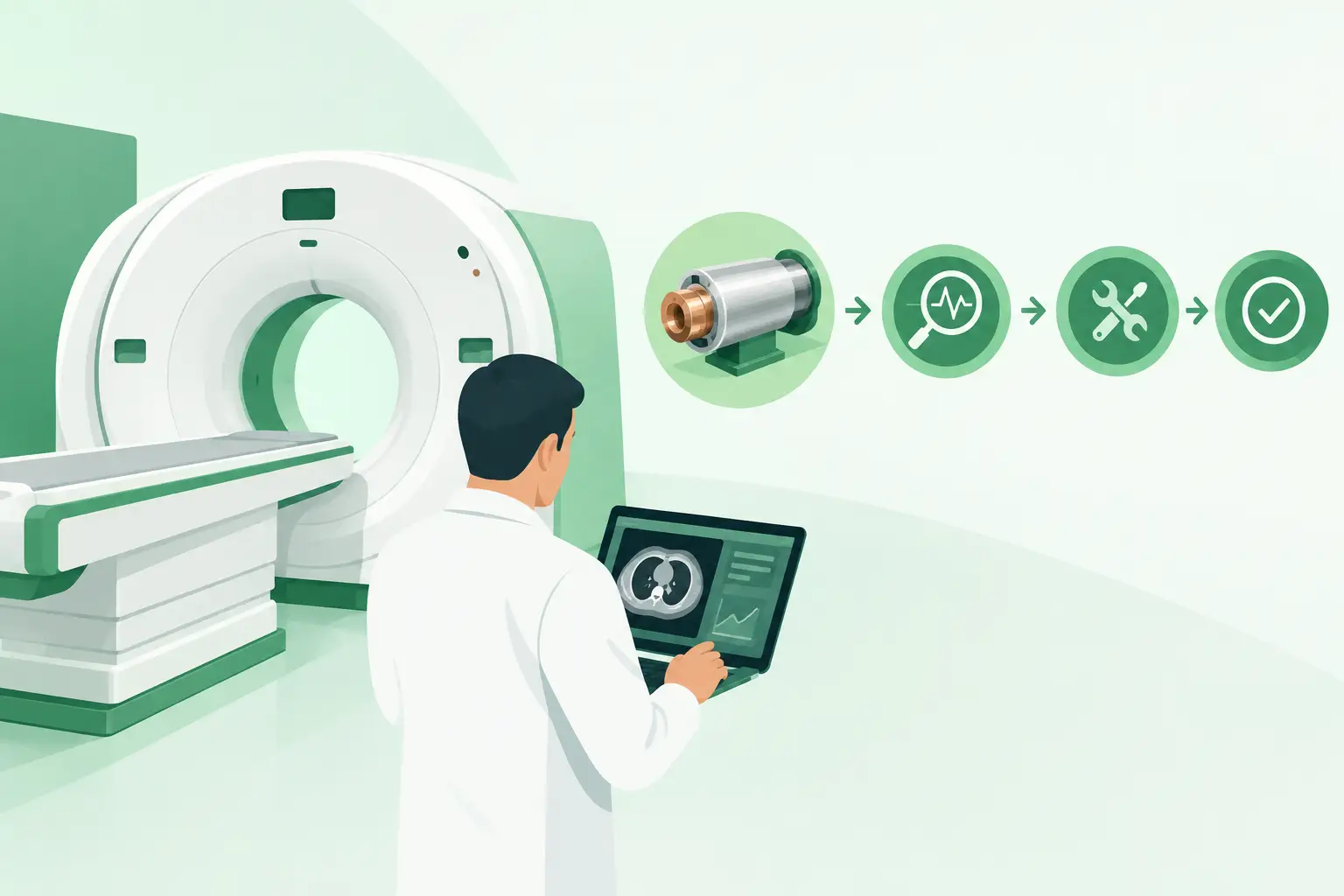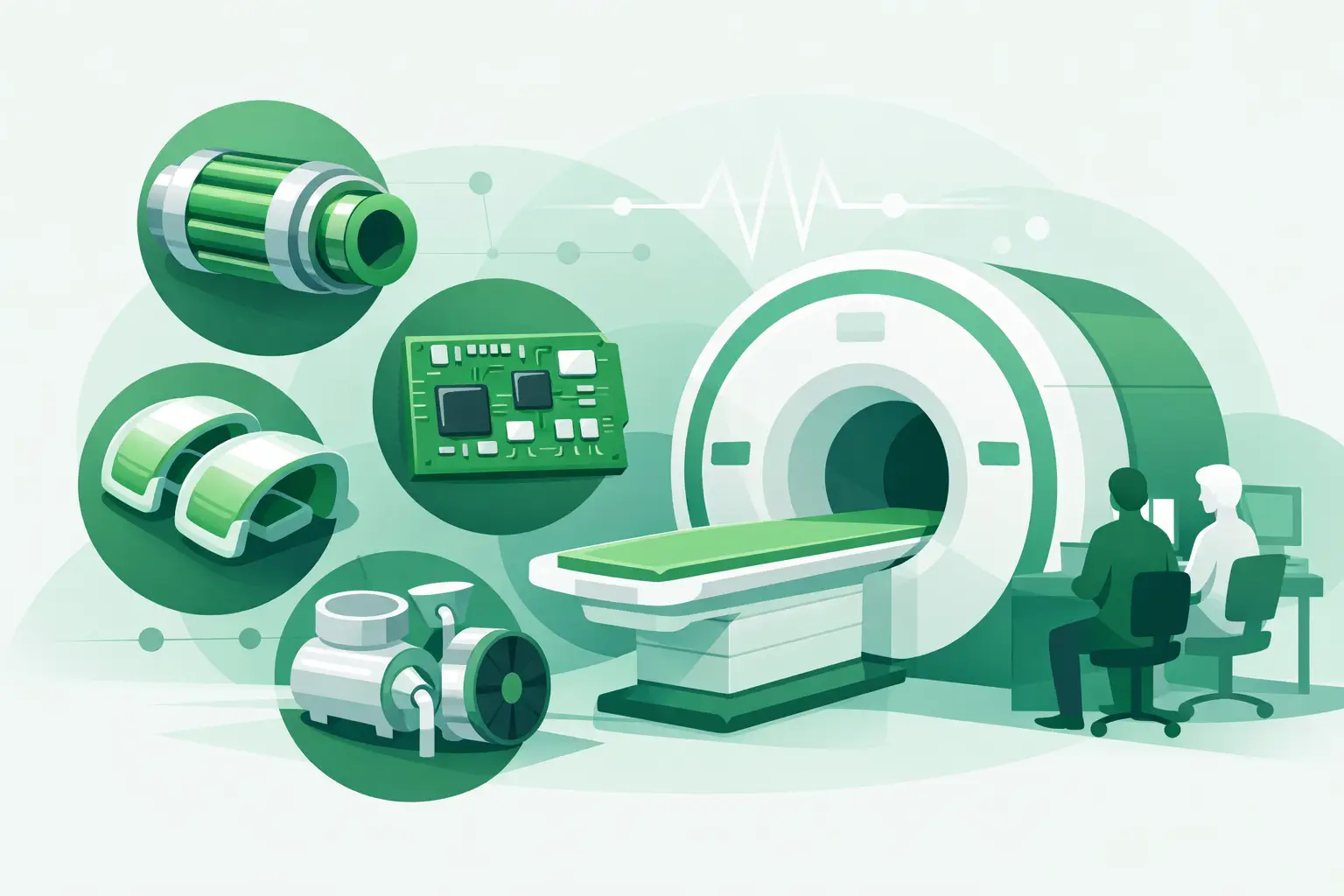
An MRI scanner can appear to have a single failure while the root cause sits several assemblies away. A table that will not index may involve a drive, encoder, controller, harness, or power-distribution issue. An image-quality complaint may trace to an RF coil, preamplifier, cable, gradient subsystem, cooling condition, or console configuration. For service teams, sourcing MRI parts is therefore not simply a matter of finding a component with a familiar description. It is an exact-match exercise that affects uptime, image quality, and the safe return of a high-value imaging asset to clinical service.
MRI Parts Are a System, Not a Shelf List
MRI systems combine high-field magnet technology, precision electromechanical assemblies, RF electronics, gradient hardware, cooling infrastructure, and specialized computing. Each subsystem has different failure modes, handling requirements, compatibility rules, and replacement lead times. A part that looks physically similar may not be interchangeable across scanner models, software generations, field strengths, or system configurations.
For that reason, the OEM part number remains the most useful starting point when procuring a replacement. It identifies the required assembly more accurately than a generic term such as "coil board," "table motor," or "power supply." In legacy systems especially, there may be multiple revisions of an assembly, each with a different connector, firmware expectation, calibration requirement, or approved use location.
The practical objective is operational continuity. Clinical engineering departments, ISOs, and imaging service providers need the correct part in hand quickly enough to reduce scanner downtime without introducing a new compatibility problem.
Magnet and cryogenic support components
The magnet is the defining MRI subsystem, but it is not a single serviceable item. Depending on the system design, related components can include cryocooler assemblies, cold-head support hardware, compressor-related components, helium monitoring equipment, cryogenic valves, sensors, cables, and control boards. These components require careful identification because magnet platform, cooling architecture, and installation configuration matter.
Cryogenic and magnet-related work also carries specialized safety and service requirements. Sourcing the correct component is essential, but replacement and recommissioning should remain within the scope of qualified personnel following the applicable OEM procedures. A fast part shipment cannot compensate for an incorrect installation process around a superconducting magnet.
Gradient system components
Gradient coils create the spatial encoding that makes MRI imaging possible. Their operation depends on high-current gradient amplifiers, power stages, interconnects, monitoring hardware, cooling components, and control electronics. A gradient-related fault can produce system errors, abnormal noise, failed calibrations, image artifacts, or an inability to proceed with scanning.
Common replacement needs include gradient amplifier boards, power modules, controller boards, cooling pumps, heat exchangers, fans, cables, and associated power-distribution components. A diagnosis should distinguish between a failed gradient coil assembly and a fault in the amplifier, control, or cooling path. The difference is significant in both repair scope and sourcing strategy.
RF coils and receive-chain assemblies
RF coils are among the MRI parts most directly connected to day-to-day clinical workflow. Head, spine, body, knee, shoulder, breast, and other specialty coils can develop issues from cable strain, connector damage, failed electronics, element faults, latch wear, or physical handling damage. A coil may still be recognized by the scanner yet produce low signal, channel errors, nonuniformity, or intermittent failures.
The receive chain extends beyond the patient coil. It can include preamplifiers, coil interface boards, RF cables, connectors, filters, transmit/receive components, and cabinet electronics. Compatibility is particularly important here. A coil or interface assembly must align with the scanner family, channel architecture, connector type, and software-supported configuration. The clinical name of a coil alone is rarely enough to ensure a correct replacement.
Patient table and positioning hardware
The patient table is a high-use mechanical system, and its availability has an immediate effect on scheduling. Typical MRI table components include tabletop assemblies, table drives, motors, belts, gearboxes, encoders, brakes, rollers, lift components, position sensors, control boards, hand switches, and cable assemblies.
A table fault may prevent patient positioning, trigger an interlock, or stop a scan sequence before it starts. Because tables vary by bore design, patient-weight rating, system generation, and accessory configuration, model-level identification is not sufficient in many cases. A part number, photographs of labels and connectors, and the scanner serial number can materially reduce the risk of receiving an incompatible assembly.
Power, Cooling, and Control: The Parts Behind Many Faults
Not every MRI failure is a magnet, coil, or table failure. Power and environmental subsystems are frequent sources of instability, particularly in older equipment where capacitors, fans, relays, pumps, and power modules have accumulated significant operating hours.
Power-related MRI components can include low-voltage power supplies, high-voltage assemblies, power distribution units, contactors, breakers, transformers, rectifier modules, and cabinet control boards. Cooling-related components may include pumps, chillers, heat exchangers, hoses, flow sensors, fans, temperature sensors, and valves. A failed cooling component can lead to protective shutdowns that appear at first to be an amplifier or gradient fault.
Consoles and workstations are another critical category. The scanner may require replacement PCBs, interface cards, monitor components, storage devices, keyboard assemblies, network hardware, or complete console subassemblies. Yet console sourcing requires caution: hardware replacement may involve software versions, system licenses, configuration files, or calibration steps. The part should be evaluated as part of the scanner environment, not as a standalone computer component.
What to Verify Before Ordering MRI Parts
The fastest procurement process starts before the request is sent. A precise request allows a sourcing specialist to check inventory, supplier options, condition, and compatibility without repeated clarification. For urgent cases, providing the following information can prevent costly delays:
- OEM name, scanner model, field strength, and system serial number
- Exact OEM part number, including suffixes, revision identifiers, and label photographs
- Part description and the subsystem where the component is installed
- Fault code, symptom, or service diagnosis, if available
- Connector photos, board revision details, and any relevant configuration information
Part condition should be discussed openly. Used, refurbished, and select new-old-stock parts can each have a role in a repair plan. The right choice depends on component type, system age, lead time, available testing information, and the service provider's validation process. A refurbished electronic assembly may be appropriate for one application, while a highly specific coil or legacy controller may be available only as a tested used unit.
The goal is not to treat all replacements as equivalent. It is to select a component whose identity, condition, and compatibility support a reliable repair.
Sourcing for Legacy and Discontinued MRI Systems
Legacy MRI equipment often remains clinically valuable long after OEM support options narrow. That creates a different purchasing challenge: the part may no longer be readily stocked, its original part number may have been superseded, or available inventory may be scattered across independent service organizations, refurbishers, and regional suppliers.
Cross-referencing becomes essential in these cases. A sourcing partner should be able to evaluate whether a listed part number is an exact match, an approved revision, a component from a compatible configuration, or merely a similar-looking item that should be avoided. This is especially important for RF coils, gradient electronics, table assemblies, and console boards, where one incorrect revision can turn an urgent repair into another outage.
Meditegic supports this type of part-number-level search across MRI and other diagnostic imaging modalities, drawing on a global supplier network to locate difficult, discontinued, and urgently needed components. For technical buyers, the value is not a generic catalog result. It is a focused sourcing process built around the specific system and failed assembly.
A Better Way to Think About MRI Spare Parts
The best MRI parts strategy begins with diagnosis and ends with documented compatibility. Keep accurate records of installed part numbers, prior replacements, fault history, and system configuration while the scanner is operational. When a failure occurs, that information shortens the path from fault isolation to a viable replacement.
For an urgent repair, speed matters. But the part that restores service is not simply the first available component. It is the verified component that fits the scanner, supports the repair procedure, and gives the service team confidence to put the system back into clinical use.